

Understanding the correct medical codes to use in behavioral health billing can be a daunting task, especially when it comes to the commonly used CPT code 99213. This code is typically used for an established patient office or other outpatient visit that lasts under half an hour. But what if you need to upcode or downcode? Let’s delve into the details.
Understanding CPT Code 99213
CPT code 99213 is reserved for established patients who have previously completed an intake session (code 90792). This code is distinguished from other evaluation and management codes by its specific use case. Physicians typically spend 15 minutes face-to-face with a patient presenting an issue of low to moderate severity.
However, if the patient is new, this particular code cannot be used. Instead, we need to consider alternative codes based on the complexity of the treatment and the duration of the visit.
Alternative Codes: 99214 and 99215
When the complexity of treatment increases, we can bill with an E/M CPT code of higher complexity. For instance, use code 99214 for patients with moderate complexity of treatment. Use code 99215 for high complexity of treatment. Choose these codes based on an extensive review of the patient’s files, considering factors such as the increase in complexity and the timeline for treatment.
Ensuring Accurate Billing
At Integrity, we take a deep dive into the evaluation and management of each established patient. Our team thoroughly reviews the important components in your medical records, as outlined by the American Medical Association (AMA). These components include an expanded problem-focused history, an expanded problem-focused examination, and medical decision making of low complexity.
A Real-World Example of Incorrect Use of CPT Code 99213
“In one of our recent forensic assessments, we encountered a situation that perfectly illustrates the importance of accurate coding,” recalls Denise Corbisiero, Co-Owner and COO of Integrity Billing Company. “We found that a healthcare provider had been consistently using CPT code 99213 for all established patient visits, regardless of the complexity of the treatment. This was a clear misuse of the code.” As Denise explains, “The provider was treating patients with moderate to high complexity issues, which should have been billed under codes 99214 or 99215. By using 99213 across the board, they were not only under-representing the level of care provided but also missing out on higher reimbursement rates. Our forensic assessment helped identify this discrepancy and correct their billing practices, ensuring accurate representation of their services and maximizing their revenue.”
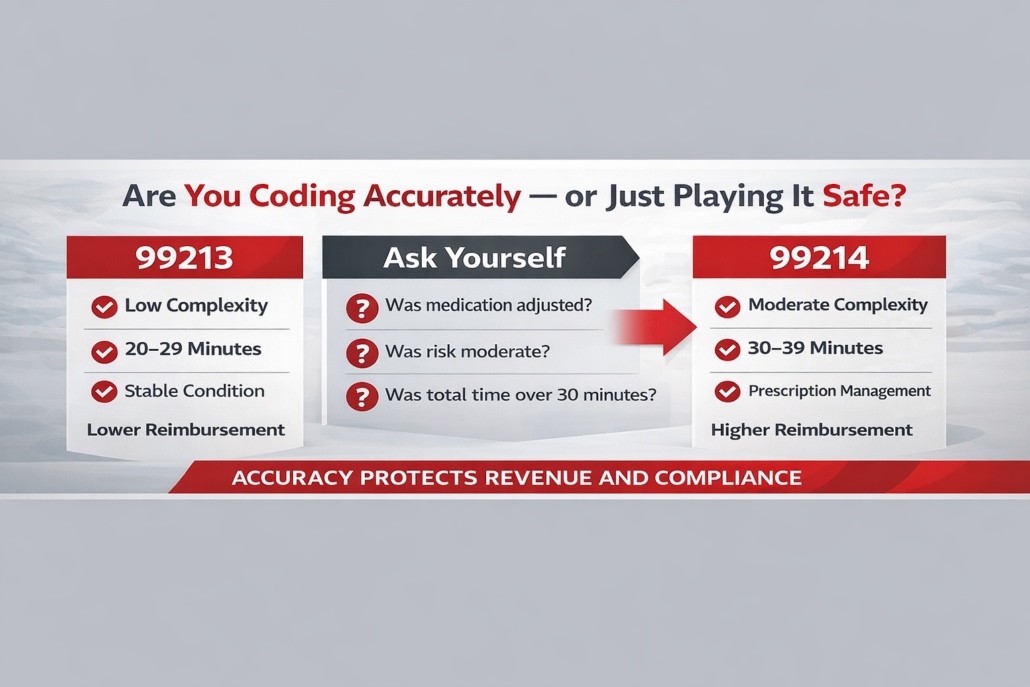
The Bigger Picture: Accuracy Over “Playing It Safe”
In my experience, CPT 99213 is one of the most commonly defaulted codes in outpatient practice. Providers often choose it because it feels “safe.” It represents low complexity, and many clinicians would rather undercode than risk scrutiny.
But accuracy — not fear — should guide coding decisions.
When visits legitimately meet moderate complexity or time requirements, consistently selecting a lower level of service can quietly erode revenue over time. On the other hand, billing above what documentation supports creates unnecessary compliance exposure.
The goal isn’t to code higher or lower. It’s to code correctly.
That balance requires clear documentation, consistent internal standards, and ongoing review of coding patterns. Small differences between 99213 and 99214 may not seem significant in isolation, but when multiplied across providers and months of patient visits, they can meaningfully impact overall reimbursement.
For practices that want to ensure their documentation aligns with payer expectations, structured oversight through professional billing and coding services can provide clarity and consistency. Regular review of coding patterns not only protects compliance, but also helps organizations understand whether revenue is being unintentionally left on the table.
Accurate coding protects both sides of the equation: reimbursement and risk.
Reimbursement Rates
Reimbursement rates for insurance also play a crucial role in determining the accuracy of your billing. At Integrity, we consider how reimbursement rates vary by location, insurance company, panel, network status, license, and so forth.
Contact us today for more information on our advanced services
Get your free forensic assessment today and ensure your medical billing is completely accurate!