

CPT code 99214 is one of the most frequently billed — and most frequently audited — evaluation and management (E/M) codes in outpatient care.
It’s commonly used in medical and behavioral health settings, especially in outpatient mental health and addiction treatment billing, where medication management and chronic condition follow-ups are routine. For organizations providing specialized behavioral health billing services, proper 99214 usage is critical for both compliance and reimbursement.
Used correctly, 99214 reflects moderate medical complexity and ensures appropriate payment. Used incorrectly, it can trigger denials, downcoding, or audit scrutiny.
What Is CPT Code 99214?
CPT 99214 is used for an established patient office or outpatient visit that qualifies under one of two criteria:
-
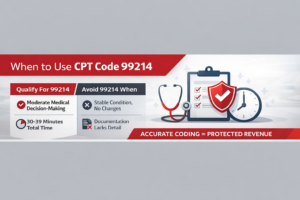
Moderate medical decision-making (MDM)
OR -
30–39 minutes of total provider time on the date of service
It sits between:
-
99213 (low complexity)
-
99215 (high complexity)
Understanding the difference is essential for accurate billing and risk protection.
Here’s how to know when it truly applies.
Use Code 99214 for patients with moderate complexity of treatment. The visit is completed within 30-39 minutes according to AMA (American Medical Association). Furthermore, use this code during a visit with an established patient that has a progressing illness or acute injury requiring medical management or potential surgical treatment. Integrity reviews your practice’s coding to ensure that your data accurately reflects current clinical practice and any innovation in medicine.
Don’t Apply The Wrong Code
Putting the incorrect code on the patient file can mean that your practice is under-representing or over-representing the level of care provided. Furthermore, you could be missing out on higher reimbursement rates. Don’t make that costly mistake. The 99214 calls for moderate-complexity medical decision making. Per the AMA, “CPT code set reflects the coding demands of digital health, precision medicine, augmented intelligence and other aspects of a modern health care system.”
Have you been coding “routine” office visits 99213 or 99214? Let Integrity Billing look over your level 4 visits to determine if the visits are properly coded. We identify the correct level of the visit with a few questions such as “Was the total time with the established patient between 30-39 minutes?” And another is “Did you order/review level 4 data and manage level 4 risk?” Our team looks at problems addressed, the data reviewed, and the level of risk documented on file. Make sure your staff is documenting either a detailed history or a detailed exam to support coding 99214.
How to Qualify for CPT 99214
Since the 2021 E/M updates, providers can select the level of service based on medical decision-making or total time.
Option 1: Moderate Medical Decision-Making (MDM)
Two of the following three elements must meet moderate complexity:
1. Problems Addressed
-
Chronic illness with exacerbation
-
Two or more stable chronic conditions
-
Acute illness with systemic symptoms
2. Data Reviewed
-
Reviewing labs or imaging
-
Ordering diagnostic tests
-
Independent interpretation of results
3. Risk of Complications
-
Prescription drug management
-
Escalation of care
-
Minor procedures with risk factors
Prescription drug management often supports moderate risk, which is why 99214 is common in medication management visits.
Option 2: Time-Based Coding (30–39 Minutes)
99214 may also be billed if total provider time on the date of service is 30–39 minutes, including:
-
Face-to-face time
-
Chart review
-
Documentation
-
Ordering tests
-
Care coordination
Time must be clearly documented in the medical record.
99213 vs 99214: What’s the Difference?
| Code | Time | MDM Level | Typical Scenario |
|---|---|---|---|
| 99213 | 20–29 min | Low | Stable condition, no changes |
| 99214 | 30–39 min | Moderate | Medication adjustment or increased risk |
If a condition is stable and management does not change, 99213 is typically appropriate.
If medication is adjusted or risk increases, 99214 may be justified.
When NOT to Use 99214
Avoid billing 99214 when:
-
The condition is stable with no management changes
-
Total time is under 30 minutes
-
Documentation does not support moderate risk
Overuse of Level 4 visits is a common audit trigger.
Common Documentation Mistakes
Even when a visit qualifies, documentation gaps can cause denials. Common issues include:
-
Not documenting total time
-
Failing to describe medication management clearly
-
Copy-forward notes without updated assessment
-
Weak explanation of risk
Clear documentation protects both reimbursement and compliance.
Real-World Examples
Example 1:
A patient with uncontrolled hypertension requires a medication dosage increase and lab work.
This likely supports 99214.
Example 2:
A patient with stable anxiety has no medication changes and no new symptoms.
This likely supports 99213.
Why Accurate 99214 Billing Matters
Correct use of 99214 impacts revenue and compliance.
Underbilling reduces reimbursement.
Overbilling increases audit exposure.
Striking the right balance requires clear documentation, consistent coding standards, and ongoing oversight.
Final Thoughts
CPT 99214 is appropriate when documentation supports moderate medical decision-making or 30–39 minutes of provider time.
When used properly, it ensures fair reimbursement. When used incorrectly, it creates unnecessary risk.
Careful coding protects both revenue and long-term stability.
Reach Out To Us
We hope that you have enjoyed reading our definitive guide to mastering code 99214 for medical professionals. Contact us today at (561) 355-5640 for more information on our advanced services.