

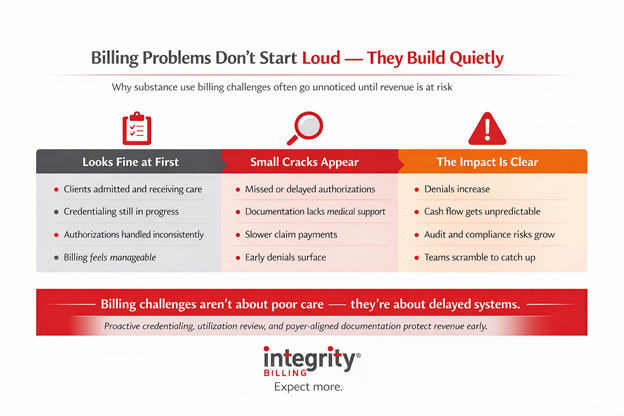
When substance use treatment centers open their doors, billing is rarely the piece that feels urgent. Instead, the focus is on things like programming, staffing, admissions, and client care. While there is nothing wrong with this, billing eventually demands attention because issues tend to build slowly and quietly. By the time they become noticeable, cash flow may be tight, denials are piling up, or audits have become a real concern.
Here are some of the most common substance use billing challenges providers wish they had addressed earlier. By learning from them, you don’t have to make the same mistakes!
Credentialing Delays That Stall Revenue
One of the earliest—and most underestimated—billing challenges is credentialing. Many providers begin serving clients before all payer enrollments are finalized, assuming claims can simply be submitted later. In reality, delayed or incomplete credentialing can lead to months of unrecoverable revenue.
Each payer has its own timelines, requirements, and effective dates. If services are provided before credentialing is active, those claims are often denied outright. Providers usually don’t realize the impact until they notice a gap between services delivered and payments received.
Learning this too late can mean starting operations already behind financially.
Authorization Missteps That Trigger Denials
Utilization review and prior authorizations are another major pain point. Authorizations must align precisely with the level of care, length of stay, and medical necessity criteria defined by each payer. Even small errors, such as missed re-authorizations, late submissions, or documentation that doesn’t fully support continued care, can result in denied or underpaid claims.
Many providers discover after the fact that strong clinical care alone is not enough. Without consistent, payer-aligned utilization review processes, even appropriate treatment can go unpaid.
Documentation That Doesn’t Support Billing
Clinical documentation and billing are deeply connected, but they often operate in silos. Providers may have solid clinical notes, yet still face denials because documentation doesn’t clearly demonstrate medical necessity in the way payers expect.
Common issues include notes that are too general, treatment plans that aren’t updated regularly, and progress notes that don’t reflect measurable improvement or continued need. These problems typically don’t become obvious until audits occur or denials increase. At that point, correcting documentation retroactively can be time-consuming and risky.
Payer Rules That Constantly Change
Substance use billing rules are not static. Payers regularly update requirements related to covered services, modifiers, authorization timelines, and documentation standards. Providers who rely on outdated billing knowledge often don’t realize they’re out of compliance until claims stop paying.
This is especially challenging for growing organizations. What worked during the first year may no longer be acceptable as payer scrutiny increases. Learning too late that “we’ve always done it this way” no longer works can have a serious impact on revenue stability.
Underestimating the Complexity of the Revenue Cycle
Many providers initially believe billing is primarily about submitting claims. In reality, the revenue cycle includes credentialing, authorizations, charge capture, coding accuracy, timely submissions, denial management, appeals, and payment posting.
When one part of the cycle breaks down, the effects ripple outward. A delay in authorizations leads to denials. Poor denial follow-up leads to lost revenue. Inaccurate reporting leads to bad financial decisions. Providers often don’t see the full picture until cash flow becomes unpredictable.
Waiting Too Long to Ask for Help
Perhaps the most common challenge providers learn too late is waiting until substance use billing problems feel overwhelming before seeking support. By that point, backlogs have formed, revenue has been lost, and internal teams are stretched thin.
Early intervention—through proactive audits, process reviews, and billing oversight—can prevent many of these issues from escalating. Addressing small gaps early is far less disruptive than trying to rebuild a broken revenue cycle.
Moving Forward with Clarity
Substance use billing is complex, and no provider gets everything right from day one. The key is recognizing that billing challenges are not a reflection of poor care but rather a sign that specialized systems and expertise are required.
Providers who succeed long-term are the ones who take billing seriously early, align clinical and billing workflows, and seek experienced support before issues become crises. Learning these lessons sooner rather than later can protect your financial stability and allow you to continue delivering high-quality care.
If any of these challenges sound familiar, it may be time for a closer look at your billing processes. Integrity Billing offers a Free Forensic Assessment where our team will examine your clinical documentation, billing codes, and reimbursement claims and identify areas of risk or improvement. Contact us today at 888-368-7461 to learn more.