

Every day that a claim sits in accounts receivable (AR) represents delayed revenue, added administrative stress, and less financial stability. For behavioral health providers, these long AR cycles not only affect cash flow but also create ripple effects that can limit resources, staffing, and the ability to expand services. With nearly 60 million U.S. adults (or 23.9%) receiving mental health treatment each year, behavioral health providers are not in a position to step back.
Fortunately, having the right systems in place allow providers to significantly reduce AR days and improve their bottom line. Let’s talk more about accounts receivable and five winning strategies that can help your behavioral health organization take control.
What Are Days in Accounts Receivable in Behavioral Health Billing?
Days in accounts receivable, often called days in AR, measure the average number of days it takes a provider to collect payment after services have been billed. In simple terms, it shows how long revenue stays tied up in unpaid claims before the money actually comes in.
For behavioral health providers, days in AR is one of the clearest indicators of revenue cycle performance. A lower number usually means claims are moving through the billing process efficiently, while a higher number may point to delays with payers, documentation issues, authorization problems, denied claims, underpayments, or slow follow-up.
Tracking days in AR helps providers understand whether their billing process is keeping cash flow steady or allowing balances to sit unresolved for too long. It also gives billing teams a way to spot trends before aging receivables turn into larger collection problems.
The basic formula for days in accounts receivable is:
Days in AR = Accounts Receivable ÷ Average Daily Charges
To calculate average daily charges, use this formula:
Average Daily Charges = Total Charges ÷ Number of Days
For example, if a behavioral health provider has $300,000 in accounts receivable and averages $10,000 in daily charges, the days in AR would be 30 days.
What Is a Good Days in AR Benchmark for Behavioral Health Providers?
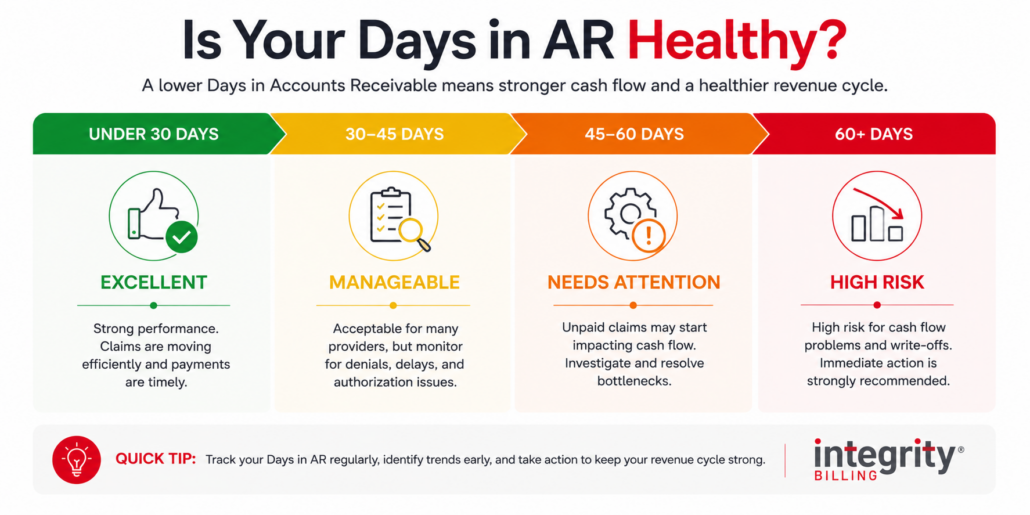
A “good” days in AR number can vary depending on payer mix, service type, authorization requirements, and services provided. Still, general benchmarks can help behavioral health providers understand when accounts receivable is moving efficiently and when it may need closer attention.
As a general guide:
- Under 30 days: Strong performance. Claims are generally moving through the revenue cycle quickly, and payment delays appear limited.
- 30–45 days: Manageable, but worth monitoring closely. This range may be acceptable for some providers, but billing teams should watch for payer delays, denials, or authorization issues.
- 45–60 days: Needs attention. At this point, unpaid claims may start affecting cash flow, especially if balances are concentrated with certain payers or service lines.
- 60+ days: Higher risk for cash flow issues. Claims in this range may indicate unresolved denials, slow payer follow-up, missing documentation, underpayments, or larger revenue cycle problems.
For behavioral health providers, days in AR should not be viewed in isolation. A higher number may point to problems with verification of benefits, utilization review, authorization management, claim submission, denial follow-up, or payer communication.
What Causes High Days in Accounts Receivable?
High days in accounts receivable usually means claims are not moving through the revenue cycle as quickly as they should. Common causes include:
- Slow claim submission: Claims sit too long before they are billed.
- Missing authorizations: Services are provided without the required prior authorization or continued stay approval.
- Eligibility errors: Coverage, benefits, or payer requirements are not verified correctly before services begin.
- Incorrect coding: Claims include inaccurate CPT codes, modifiers, diagnosis codes, or place-of-service details.
- Documentation gaps: Clinical records do not clearly support the services billed or the level of care provided.
- Denials and appeals: Denied claims take time to correct, resubmit, or appeal.
- Payer delays: Claims stall because of payer processing issues, requests for more information, or slow reimbursement timelines.
- Weak AR follow-up: Billing teams do not follow up consistently on unpaid or aging claims.
- Patient balance collection issues: Patient responsibility amounts remain unpaid after insurance processes the claim.
Why Days in AR Matters for Behavioral Health Providers
Days in AR is more than a billing metric. It’s a cash flow indicator that shows how quickly a provider turns billed services into collected revenue.
When days in AR stays low, cash flow is usually more predictable. That makes it easier to cover payroll, maintain staffing levels, pay vendors, invest in clinical programs, and plan for growth. When days in AR climbs too high, revenue may look strong on paper while actual cash collections lag behind.
High days in AR can also increase the workload for billing teams. Older claims often require more follow-up, more payer calls, more documentation review, and more time spent working denials or appeals. The longer a claim sits unpaid, the greater the risk that filing deadlines, appeal windows, or documentation gaps will turn a collectible balance into a write-off.
This metric can also matter during investor reviews, financing conversations, or acquisition due diligence. A high days in AR number may raise questions about payer relationships, denial management, utilization review, billing accuracy, and the overall health of the revenue cycle.
For behavioral health providers, tracking days in AR helps leadership see where cash flow is strong, where reimbursement is slowing down, and where the billing process may need attention before small delays become larger financial problems.
5 Ways to Reduce Days in Accounts Receivable
Accounts receivable is a critical measure of a practice’s financial health. Here are five proven strategies that can help reduce days in accounts receivable.
1. Strengthen Front-End Processes
The best way to shorten accounts receivable cycles is to prevent issues before they even begin. That means tightening up front-end processes such as patient intake, eligibility verification, and prior authorization. When insurance details are confirmed up front and documentation is accurate, providers minimize the risk of claim denials later on.
To make this happen, train your staff to double-check patient information, collect copays at the time of service, and verify coverage before appointments. Partnering with a reliable behavioral health billing company will also do you wonders, as they play a significant role in keeping claims clean and payments timely.
2. Submit Clean Claims the First Time
A “clean claim” is one that is accurate, complete, and properly coded when it’s first submitted to the payer. This means all patient demographics, provider information, diagnosis codes, treatment codes, and authorization details are correct and aligned with the payer’s requirements. When a claim is clean, it moves through the system smoothly, resulting in faster reimbursement.
To prevent delays, providers can take proactive steps such as investing in staff training and coding expertise, using claim-scrubbing software to catch errors before submission, and implementing internal quality checks to review claims in real time. These safeguards not only reduce rework but also improve cash flow and strengthen payer relationships.
3. Prioritize Consistent AR Follow-Up
Submitting a claim is only half the battle; follow-up is where the real work happens. Consistent monitoring ensures claims don’t fall through the cracks and denials don’t quietly pile up unnoticed.
For behavioral health providers, having a structured workflow for AR follow-up is essential. This should include regularly reviewing aging reports to identify outstanding balances, promptly resubmitting corrected claims to minimize delays, and escalating unresolved issues before they grow into revenue losses.
Timely follow-up also gives providers valuable insight into recurring problems, such as coding errors or payer-specific denial trends, allowing them to fix root causes instead of repeatedly addressing symptoms. By assigning dedicated staff—or partnering with a billing company like Integrity Billing—practices can ensure that follow-up is proactive and consistent.
4. Implement a Denial Management Process
Denials are inevitable in healthcare billing, but they don’t have to mean lost revenue. In fact, an effective denial management process can transform rejections into opportunities for recovery and process improvement.
The first step is to track and categorize denials consistently, so the most common issues can be identified. Whether it’s missing authorizations, incomplete documentation, or incorrect coding, patterns often emerge that point to where processes need to be strengthened. For example, if a large percentage of denials stem from authorization errors, adjusting intake workflows to verify coverage and approvals upfront can prevent repeated delays.
Equally important is responding quickly. Every day that a denied claim sits unresolved extends the AR cycle and increases the risk of write-offs. By appealing denials promptly and resubmitting corrected claims, providers keep revenue moving and demonstrate to payers that they are diligent and organized.
5. Consider Outsourcing for Expertise and Efficiency
For many behavioral health practices, limited staff and growing administrative demands make it difficult to manage accounts receivable effectively. Front office teams are often stretched thin, causing claims to linger unresolved and revenue to get delayed.
Outsourcing AR management to a trusted partner is an effective way to relieve this burden. By leveraging specialized expertise, advanced billing technology, and a structured follow-up process, practices can ensure claims are monitored and resolved without overwhelming their staff.
At Integrity Billing, we focus exclusively on revenue cycle management for behavioral health providers. Our team understands the unique challenges of the field, from complex payer requirements to sensitive patient relationships, and we handle claims, follow-up, and collections with both precision and care. By partnering with us, providers can reduce AR days, strengthen cash flow, and protect the patient experience
Closing Thoughts
Reducing days in accounts receivable isn’t just about improving the numbers—it’s about creating financial stability that allows behavioral health providers to focus on patient care. By strengthening front-end processes, submitting clean claims, prioritizing follow-up, managing denials, and considering outsourcing, practices can transform their AR from a persistent challenge into a streamlined, reliable process.
Integrity Billing is here to help you achieve that transformation. Let’s work together to keep your revenue cycle healthy, so you can focus on what matters most—your patients.