

Few billing and coding decisions carry the same impact as whether to assign 99213 or 99214 for an established patient behavioral health visit. Code too high and lack the necessary support on audit. Code too low and you leave money on the table with each and every encounter that qualifies for a more complex visit.
For practices that also handle the demands of utilization review, claims appeal, and credentialing, ensuring consistent coding accuracy at this crucial level is one of the most impactful ways to safeguard both revenue and your reputation.
The Two Roads: Total Time or Medical Decision Making (MDM)
With the overhaul of the 2021 E/M guidelines, history and physical exam no longer drive the code level for established patient visits. Now you’ve got two independent pathways you can choose from: total time spent on the date of service, or the complexity of Medical Decision Making (MDM), and you only need to satisfy the criteria of one to justify your code.
Total Time
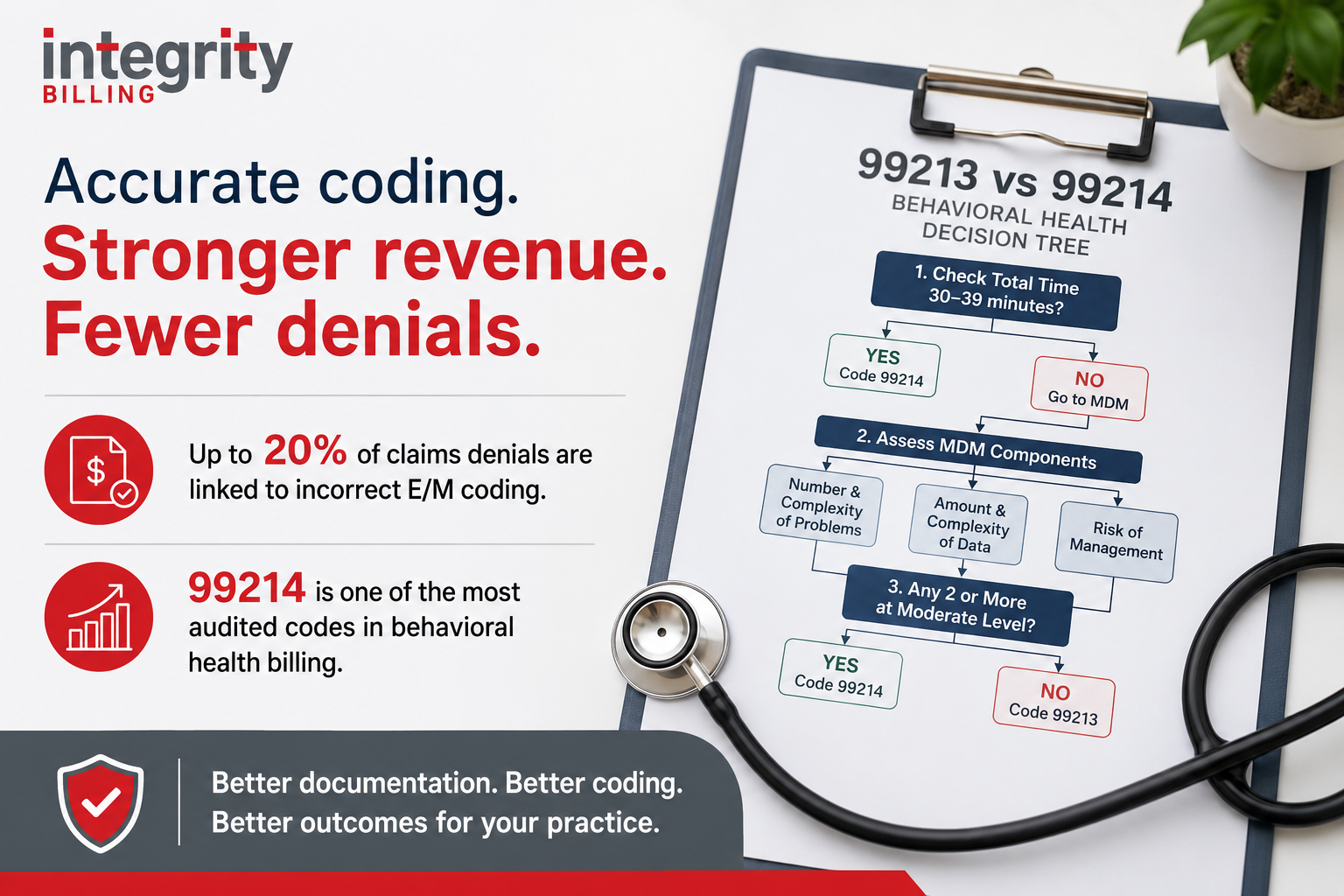
99213 requires a minimum of 20 to a maximum of 29 minutes of time documented for the visit date. 99214 requires a minimum of 30 to a maximum of 39 minutes. Should your visit exceed 39 minutes, check if it qualifies for a 99215.
Medical Decision Making
99213 reflects low complexity MDM. 99214 reflects moderate complexity MDM.
MDM consists of three components: the number and complexity of problems, the amount and complexity of data reviewed, and the risk associated with the management options and their complications.
The Behavioral Health Decision Tree
1. Check Review Time First
If the documentation clearly indicates 30 to 39 minutes of time, you’ve got a straightforward path to 99214 without even considering the MDM details. If the total time is under 30 minutes, move to step two.
2. Count the Number of Problems
One chronic, stable condition managed as is generally qualifies for 99213. Two or more chronic conditions that are stable, a condition that has exacerbated, or a new problem where the prognosis is unclear would typically fall into the 99214 realm.
3. Look at the Data Reviewed
Reviewing one data element such as a PHQ-9 score usually points toward 99213. Multiple data sources like records from another provider or consultations will generally indicate a higher level, supporting 99214.
4. Weigh the Risk
Continued maintenance of a medication at a stable dose, without change and with no complications or adverse effects, is low risk (99213). Adjusting medications, prescribing new psychiatric medications, managing side effects, or assessing for and managing risk of harm such as suicidal ideation indicates a higher risk profile, which supports 99214.
If any two out of these three MDM components rise to the level of moderate, the visit can be coded to 99214. If all three components remain at the low level, then 99213 is the appropriate, defensible choice, regardless of whether the visit felt more significant at the moment.
Two Illustrative Scenarios
Scenario 99213: Patient is established with stable major depression on the same SSRI dose for over six months. PHQ-9 scores remain within the baseline range. There are no medication side effects reported, and the current prescription regimen continues to be appropriate and stable. One stable chronic condition, minimal data review (current PHQ-9), and low risk all align with 99213.
Scenario 99214: In this case, the patient returns with reported increased depression and significant disruption in sleep patterns. The provider reviews the updated PHQ-9, consults with the patient regarding treatment options, and makes an adjustment to the current SSRI medication dosage. This situation involves one chronic condition with exacerbation and a moderate risk medication management change, supporting a 99214.
Why Proper 99213/99214 Coding Matters for Denials and Audits
Because behavioral health billing often involves frequent use of 99214, it becomes a high-visibility code to payers. Overcoding or incorrect coding at this level is a major source of denials and the dreaded post-payment audit, meaning getting this coding decision right the first time can have a massive impact on your claims appeal efforts and denial management process.
Ensuring the note includes which path-time or MDM-supported the chosen code level provides your billing staff with crucial ammunition to challenge any payer denials and can prevent many such denials from occurring.
Similarly, consistent, well-documented coding is vital for utilization review and credentialing processes. These reviewers and committees are looking for a pattern of clinical complexity matching the assigned code level. Proving that your practice’s coding is consistently appropriate and reflects the actual work done, rather than relying on default codes, can significantly strengthen your standing in these areas.
Get Your Coding Decisions Audit-Ready
Making the correct 99213 vs 99214 decision accurately and consistently is one of the highest impact habits your behavioral health practice can adopt. If your team would benefit from an analysis of your current coding practices to identify areas for improvement, don’t hesitate to reach out.
Integrity Billing offers free forensic assessments, or you can schedule a quick call with us to discuss your needs in more detail. Reach us by phone at 888-368-7461 or fill out our contact form online.
Frequently Asked Questions About 99213 and 99214
Can I code a visit to 99214 if I only meet the time requirements and not the MDM requirements?
Yes, you only need to satisfy the requirements of either time or MDM to code to 99214. You do not need to meet both.
What are the implications of consistently undercoding?
Undercoding doesn’t typically pose a compliance risk, but it consistently underpays your practice, leaving revenue unrealized for every visit that qualifies for a higher code level.
Does overcoding lead to an increased risk of audit?
Yes, particularly at the 99214 level in behavioral health, which is a frequent target for payer audits and recoupment efforts.
Can I code a psychotherapy add-on with 99213 or 99214?
Yes, if you provide a separately identifiable E/M service in addition to psychotherapy. Use your standard MDM rules for E/M selection, rather than time. Use modifier 25 when you bill both the psychotherapy add-on code and the E/M code.
Do the same telehealth rules apply for 99213 versus 99214?
Yes. Telehealth visits are coded using the same time and medical decision making logic as the face-to-face visit, so the decision tree will look the same.