

In behavioral health billing, 99214 is arguably the most widely submitted established patient E/M code—and also one of the most challenged. Many providers are sure of their placement of this code over a 99213, but they may falter on whether to use time with the patient or the complexity of the medical decision making to justify it.
In this guide, we’re going to break down how the decision works, the advantages and disadvantages of each route, and how to document appropriately.
The 99214 Coding Paths
In 2021, new guidelines were released that revamped the E/M codes and the criteria for established patient visits. One of the most significant changes to come out of these guidelines is that physical examination and history no longer impact the selection of the E/M level for an established patient visit.
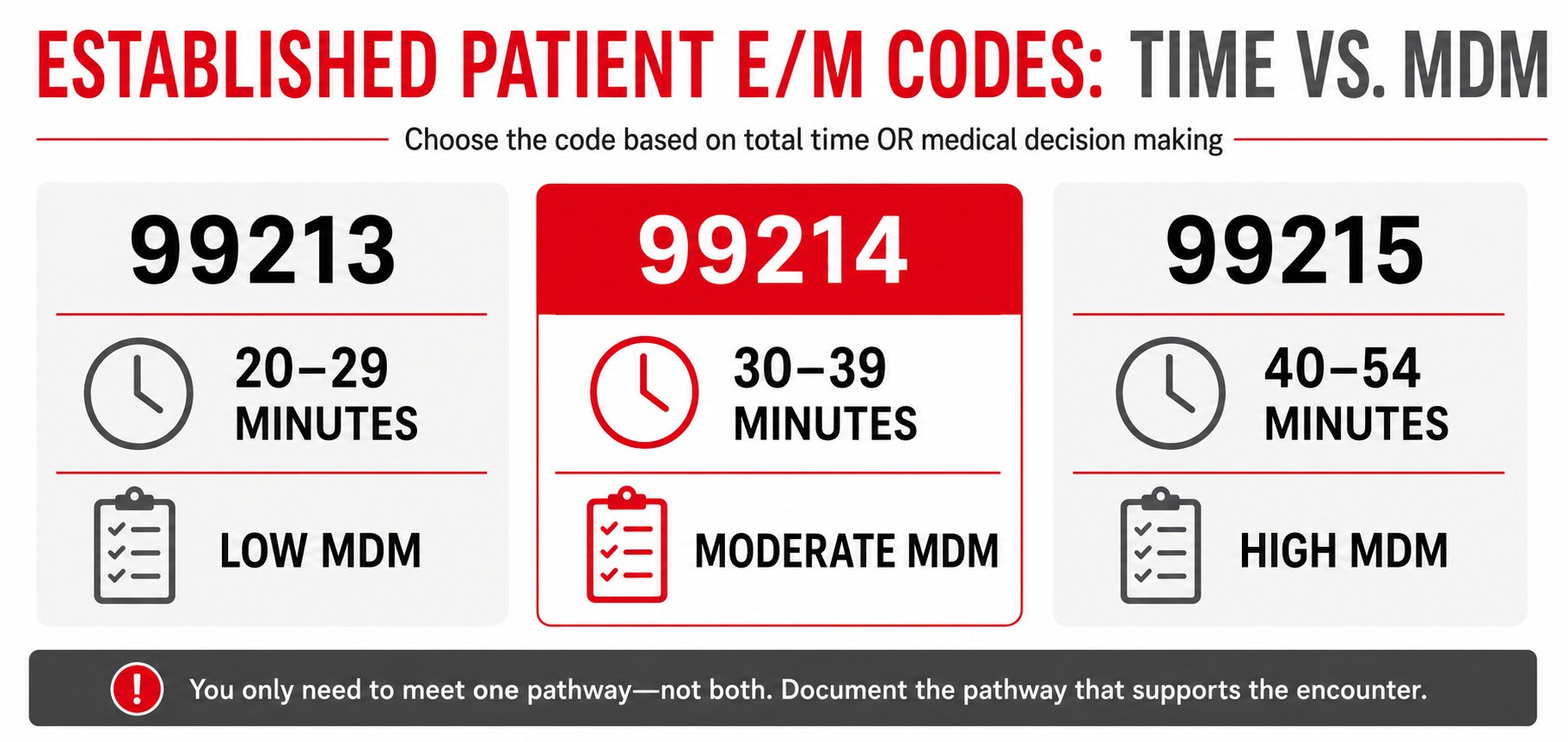
Now, there are two independent paths to coding a 99214: a time-based path or medical decision making (MDM), and you only need to fulfill the requirements for one.
Time-based
A visit for established patients must meet the minimum time threshold. A visit is classified as a 99213 when 20-29 minutes of total time are documented. For a 99214, providers must document between 30-39 minutes. If a provider documents 40+ minutes, they may want to check if documentation justifies a 99215 instead.
MDM-based
Each visit has a level of MDM assigned: 99213 requires a low level of complexity. For a 99214, a moderate level of MDM must be documented. MDM is broken down into three areas: number and complexity of problems addressed, amount and complexity of data to be reviewed and analyzed, and the risk of complications and/or mortality/morbidity of management.
When Is Time the Better Path?
Time is often the better choice for those managing the long-term treatment of clients where extended counseling or a more extensive conversation around options are needed.
Even if the patient is relatively stable from a clinical standpoint, time can be a legitimate justification. For example, if a provider spends 34 minutes with a patient talking about side effects of a medication and what to do to adjust expectations and manage symptoms, that time alone may qualify for a 99214.
Remember to document the total time spent for the date of the visit, including the time face-to-face with the patient and time on the phone and on other tasks related to the encounter.
When Is MDM the Better Path?
This route is generally favored when the visit itself may be short, but the medical decision making was complex. A visit with a patient dealing with two chronic, stable medical conditions or one exacerbating condition is a clear example that would be at least a moderate complexity when factoring in the number and complexity of problems addressed alone.
If the clinician reviewed recent outside records (like an evaluation or pharmacy report), or had to manage the risk associated with prescribing controlled substances, it could easily support a moderate level of MDM for a shorter visit. This path of billing and coding is less dependent on the time with the patient, rewarding more of the clinician’s thought process.
The Simplest Way to Decide on Coding
Start with which path is easiest to document for a given encounter. If a visit naturally evolved to be long because the provider spent significant time talking through issues or providing additional resources, documenting time is often the simplest.
Conversely, if the visit was relatively brief but the provider performed complex analysis, documented review of multiple external records, and made high-stakes decisions, MDM might be the more compelling justification.
One thing you don’t want to do is force the code. When documentation doesn’t cleanly support either time or MDM, err on the side of caution and code to a 99213. Trying to push the boundaries on borderline claims can open practices up to increased audits and denials.
Additionally, your documentation should explicitly state which pathway-time or MDM-you are using to code the visit. This provides clear justification if the payer questions the claim.
Denials and Reviews
99214 is the one most commonly cited during an audit. Many payers see 99214s billed from behavioral health practices as potentially being misused.
Failing to meet the requirements of a 99214 is a leading cause of claim denial, post-payment review, and medical necessity audits. If you’re finding that you are frequently coding a 99214 without documentation, the risk is a claim that could be denied retroactively.
This also ties directly to utilization review processes and credentialing, where auditors want to ensure the services being documented and billed are actually being provided.
Get a Clear Read on Your Coding Patterns
If you’re concerned about whether your behavioral health billing practices are optimized for revenue and compliance, a free forensic review by Integrity Billing can help identify potential gaps in your coding and documentation. Contact us at 888-368-7461 or fill out our contact form to schedule your review and learn more about how you can ensure accurate billing practices.
Frequently Asked Questions About 99214 Time and MDM Billing
Can I mix time and MDM in reporting for different visits?
Yes, you can mix time and MDM in reporting for different visits. The coding path used is selected on an encounter basis according to which guideline best fits that visit’s documented activities.
There is no rule about billing the same way for every patient on every visit.
What do I do if my charting doesn’t adequately meet either the time or MDM guidelines?
That suggests you should code cautiously at 99213, or consider meeting with your billing support staff to evaluate your current charting practices. A chart review of your most recently billed encounters is likely to be the quickest method to determine if it’s a one-off problem or systemic one that needs fixing.
What if documentation doesn’t clearly lead me down one path or the other?
Code cautiously on 99213 or audit your charting practices with your billing manager, as the most direct path to recognizing isolated errors vs systemic charting tendencies lies within forensic analysis of your billing reports from the past few months.