

Nothing makes a behavioral health provider’s stomach drop quite like the phrase “Cigna audit”. This formal review process can feel intimidating and overwhelming, like a surprise pop quiz—only in this case, the teacher is holding your paycheck. But here’s the good news: you can survive a Cigna audit in one piece. With the right preparation and support, you can turn what feels like a nightmare into just another part of running your practice.
At Integrity Billing, we work with behavioral health facilities every day, helping them navigate payor audits, recover lost revenue, and stay compliant. Here’s what you need to know.
What Is a Cigna Audit?
A Cigna audit is a review of claims, records, and supporting documentation to determine whether services were billed, documented, and paid correctly. These audits often happen after services have already been provided and claims have been submitted or paid.
During a Cigna audit, the payer may look at several parts of the claim. This can include whether the service met medical necessity requirements, whether the documentation supports the level of care or service billed, whether the correct codes were used, and whether the payment matched the patient’s benefits and Cigna’s reimbursement rules.
For behavioral health providers, a Cigna audit may involve clinical notes, treatment plans, authorization records, progress notes, discharge summaries, billing records, and communication with the payer. The goal is to confirm that the care provided, the documentation submitted, and the claim billed all line up. If the payer finds gaps or inconsistencies, the provider may face payment delays, refund requests, recoupments, or additional documentation demands.
Why Am I Being Audited?
First things first—don’t take it personally. A Cigna audit doesn’t automatically mean you’ve done something wrong or that your practice is under suspicion. In most cases, it’s part of the insurer’s routine process to verify that claims are accurate and supported. Think of it as a system of checks and balances: Cigna wants to confirm that the services billed were actually provided, that they were medically necessary, and that the documentation matches the codes submitted.
Sometimes audits are random, like drawing straws. Other times, they may be triggered by patterns in billing, such as frequent use of certain codes, higher-than-average claim amounts, or even missing documentation. In other words, an audit may happen because of the way the data looks, not because you or your team made a mistake.
The important thing to remember is this: audits are less like a detective movie and more like a medical check-up. They might be uncomfortable and inconvenient, but they’re a way of ensuring the system stays healthy. Granted, they’re not as fun as leaving the doctor’s office with a lollipop, but with the right preparation, they don’t have to be a disaster either.
Common Reasons Cigna Audits Behavioral Health Providers
Cigna audits can happen for many reasons, but certain billing and utilization patterns may draw closer review. For behavioral health providers, audits often focus on whether the services billed match the patient’s documented clinical need, the authorization on file, and the payer’s reimbursement rules.
Common audit triggers may include:
- High utilization patterns: Cigna may review providers with unusually high service volume, frequent sessions, or repeated use of higher levels of care.
- Extended lengths of stay: Residential treatment, PHP, IOP, or other extended episodes of care may receive additional scrutiny, especially when documentation doesn’t support ongoing medical necessity.
- High reimbursement amounts: Claims with large payment totals, repeated high-dollar services, or a pattern of costly treatment episodes may prompt review.
- Missing or incomplete documentation: Audits often focus on whether clinical notes, treatment plans, progress updates, authorization records, and discharge documentation support the services billed.
- Frequent use of certain CPT codes: Heavy use of specific therapy, testing, evaluation, or add-on codes may raise questions if the records do not clearly justify the billing pattern.
- Authorization inconsistencies: Cigna may review claims when the authorization dates, level of care, units, provider, or billed service do not match the approved authorization.
- Billing trends outside peer benchmarks: If a provider’s billing patterns differ significantly from similar providers, the payer may take a closer look.
Not every audit means the provider did something wrong. In many cases, an audit simply means the payer wants more information to verify medical necessity, documentation quality, coding accuracy, or payment accuracy. The stronger and more organized the records are, the easier it is to respond clearly and protect reimbursement.
Cigna Audit Checklist
Documents requested during a Cigna audit may include:
- Intake assessments: Initial records showing why the patient presented for care and what concerns needed evaluation.
- Biopsychosocial assessments: Clinical assessments that document the patient’s history, symptoms, risks, diagnoses, support system, and treatment needs.
- ASAM evaluations: Level-of-care documentation showing why the patient met criteria for residential treatment, PHP, IOP, or another behavioral health service.
- Treatment plans: Records outlining the patient’s goals, interventions, services, frequency of care, and expected progress.
- Progress notes: Ongoing documentation showing how the patient responded to treatment and why continued care remained necessary.
- Group therapy notes: Records showing group participation, topics covered, interventions used, and clinical relevance to the patient’s treatment plan.
- Individual therapy notes: Documentation of one-on-one therapy sessions, clinical interventions, patient response, and progress toward treatment goals.
- Authorization records: Prior authorization approvals, concurrent review notes, authorization dates, approved levels of care, and payer communication.
- Verification of benefits: Records showing the patient’s coverage, benefits, limitations, deductibles, and any authorization requirements confirmed before or during treatment.
- Claims history: Submitted claims, payment records, denial notices, remittance advice, and any corrected or appealed claims.
- Discharge summaries: Final documentation showing treatment outcomes, discharge recommendations, aftercare planning, and the patient’s status at discharge.
Step One: Don’t Panic
Easier said than done, right? But panicking won’t make the audit go away. The best thing you can do is stay calm and start organizing. That means pulling together the documentation Cigna is most likely to request, such as treatment notes, signed and updated treatment plans, intake assessments, billing records, and prior authorizations.
It also helps to make sure your files are complete, legible, and easy to follow. When records are neatly organized, reviewers can see at a glance that the services billed match the care provided, which makes the process smoother for everyone.
Take the audit request seriously, but remember, this is survivable. Many providers have been through it before and come out just fine.
Step Two: Get Your Documentation in Order
Cigna will likely request clinical records, treatment notes, and billing documentation during an audit. This is where thorough and accurate recordkeeping becomes your best friend. If the documentation clearly supports the services you billed, you’re already in a strong position.
To prepare, make sure progress notes align with the services billed, confirm that all required authorizations are on file, and ensure treatment plans are properly signed, dated, and updated as needed. If you’ve been keeping up with compliance along the way, this step becomes less of a scramble and more of a straightforward “gather and send” exercise.
Step Three: Respond Promptly (and Professionally)
Deadlines matter. Delayed responses can create red flags or lead to claim denials, and no one wants to lose reimbursement over a missed date. The best approach is to treat the audit request like a priority project. Make sure your submission is complete, organized, and sent in on time.
Double-check your records before sending so nothing important slips through the cracks. If something in the request is unclear, don’t hesitate to reach out for clarification. Insurance companies may not be known for their sparkling customer service, but asking the right questions upfront can save you major headaches down the road.
Clear communication also shows that you’re taking the process seriously, which can help the audit move along more smoothly.
Step Four: Learn From the Process
Once the audit is complete, review the results carefully. Even if everything checks out, there may be areas where your documentation or processes could be improved. Think of it as free feedback (okay, maybe free isn’t the word you’d choose, but you get the idea).
An audit can highlight gaps you didn’t know existed, like progress notes that need more detail, treatment plans that could be updated more consistently, or billing workflows that could use tightening. Instead of seeing it as criticism, view it as an opportunity to strengthen your systems and make future audits less stressful.
The truth is, every audit is a learning experience, and the more you take from it now, the better prepared you’ll be the next time one comes around.
What Happens If You Fail a Cigna Audit?
If Cigna determines that the records don’t support the services billed, the audit can lead to several different outcomes.
One possible outcome is a claim recoupment. This happens when Cigna asks the provider to return money it already paid because the payer believes the claim should not have been paid, was overpaid, or lacked enough documentation to support reimbursement.
Cigna may also place the provider under prepayment review, which means future claims receive additional review before payment is released. This can slow down cash flow and create more administrative work for billing and clinical teams.
In more serious cases, repeated audit findings can create contract concerns. Cigna may question billing practices, documentation quality, utilization patterns, or compliance with payer requirements.
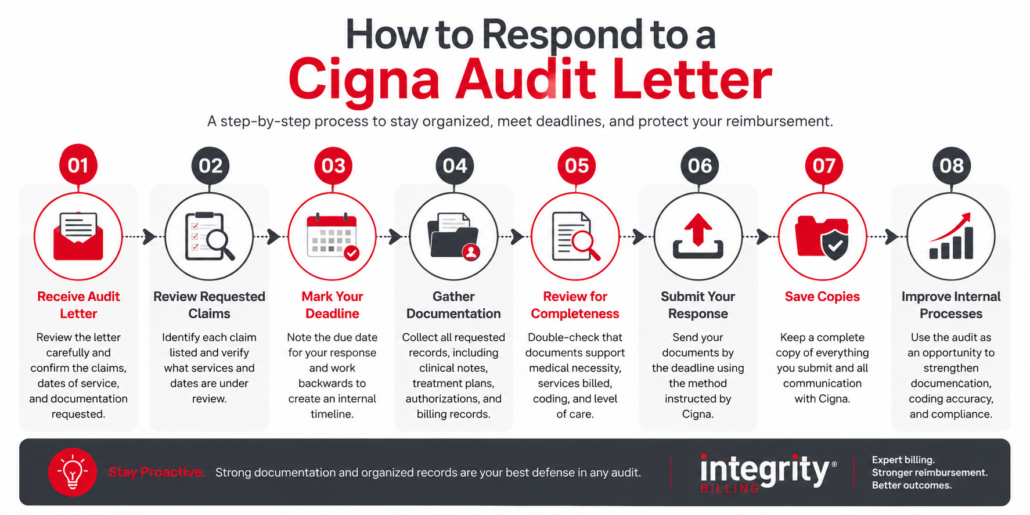
How to Respond to a Cigna Audit Letter
It’s never fun to receive a Cigna audit letter, but a clear response process can help your team stay organized.
Step 1: Read the request carefully
Start by reviewing the audit letter in full. Identify which claims, dates of service, patients, providers, and records Cigna is requesting. Don’t assume the request applies to every claim or every service unless the letter says so.
Step 2: Identify the deadline
Find the response due date and confirm how Cigna wants the records submitted. Audit timelines can be strict, so your team should calendar the deadline right away and allow enough time for internal review.
Step 3: Gather the requested records
Collect the clinical, billing, authorization, and administrative records tied to the claims under review. This may include assessments, treatment plans, progress notes, authorization records, verification of benefits, claims history, and payer communication.
Step 4: Conduct an internal review
Before submitting records, compare the documentation against the services billed. Make sure the records support the level of care, dates of service, CPT codes, authorization details, and medical necessity requirements.
Step 5: Identify documentation gaps
Look for missing signatures, incomplete notes, inconsistent dates, unclear treatment plans, or documentation that does not fully support the claim. If gaps exist, identify them before submission.
Step 6: Submit organized records
Send the records in the format Cigna requested. Label documents clearly, keep the packet organized, and make it easy for the reviewer to connect the claim to the supporting documentation.
Step 7: Retain copies of everything
Keep a complete copy of the audit response, proof of submission, and any communication with Cigna. If the audit leads to a denial, recoupment request, or appeal, that paper trail can be important.
Where Integrity Billing Comes In
Here’s the thing: surviving a Cigna audit doesn’t mean you have to do it alone. At Integrity Billing, we help behavioral health providers prepare for and navigate audits, manage compliance, and strengthen their revenue cycle so surprises are less disruptive.
Our team knows the ins and outs of payer audits and can step in to support you before, during, and after the process. Because at the end of the day, your focus should be on patient care, not wrestling with insurance paperwork.
Stay Ahead of a Cigna Audit by Staying Organized
A Cigna audit might not be the highlight of your year, but it doesn’t have to derail your practice either. With preparation, organization, and the right support, you can come out on the other side with your sanity intact.
Facing an audit? Integrity Billing is here to help you keep your revenue cycle strong and your focus on the people you serve. Give us a call today at 800-683-5640 or fill out our contact form to learn how we can support your practice.