

Billing for substance use disorder (SUD) is often combined with broader behavioral health billing, and while there is definitely overlap, assuming SUD billing is the same as regular behavioral health is a mistake that can cause a number of billing practices to falter.
The structure of SUD treatment—multiple levels, rapid transitions from one to another, a payer environment that is far more intense in scrutinizing SUD claims—adds layers of complication to billing that many general behavioral health practices have never had to navigate. Knowing what makes SUD billing different is the first step to fewer denials and a healthier revenue cycle.
Levels of Care Complicate Everything
The rapid patient movement through different treatment settings is uniquely difficult for billing. A given patient can be detoxed on day 1, enrolled in residential on day 2, treated in PHP on days 3-9, IOP on days 10-24, and outpatient on day 25.
That means each shift in level of care requires a whole new billing process, with new billing codes, documentation requirements, and authorization procedures. Moving from residential to PHP in a day isn’t just a clinical step; it’s a new billing event, complete with its own utilization review deadline.
This differs significantly from general outpatient care, where a patient might be in weekly outpatient counseling for months on end and jump from Insurance A to Insurance B in between without every transition triggering something new on the billing end.
More Utilization Review Closer Together
Because patients often bounce back and forth between these levels, utilization review becomes a fairly constant pressure—almost an ongoing part of the billing cycle rather than an occasional checkpoint. Especially with the common practice of concurrent review, clinics might have to document medical necessity before they even get paid.
Missing a utilization review response deadline is one of the most common reasons SUD claims get denied. Frankly, the clinic simply didn’t get the documentation into the payer’s hands in time.
More Credentialing Difficulties
Because SUD treatment is often a relatively new service line for many practices, credentialing can take significantly longer than usual and involve different state licensure statuses and additional certifications, especially for counselors. Payer credentialing processes can take even longer than the initial credentialing, meaning practices need to build SUD credentialing timelines into a practice expansion schedule.
Different Denial Management Strategies
Denials are more prevalent in SUD claims compared to general behavioral health claims, with most stemming from missing or late utilization review deadlines or documentation, denied or delayed step-down processes, and provider disputes over continuing therapy in a particular level of care. Having a plan that tracks authorization deadlines, ensures detailed documentation at levels-of-care transitions, and prepares appeals in advance can dramatically reduce denials.
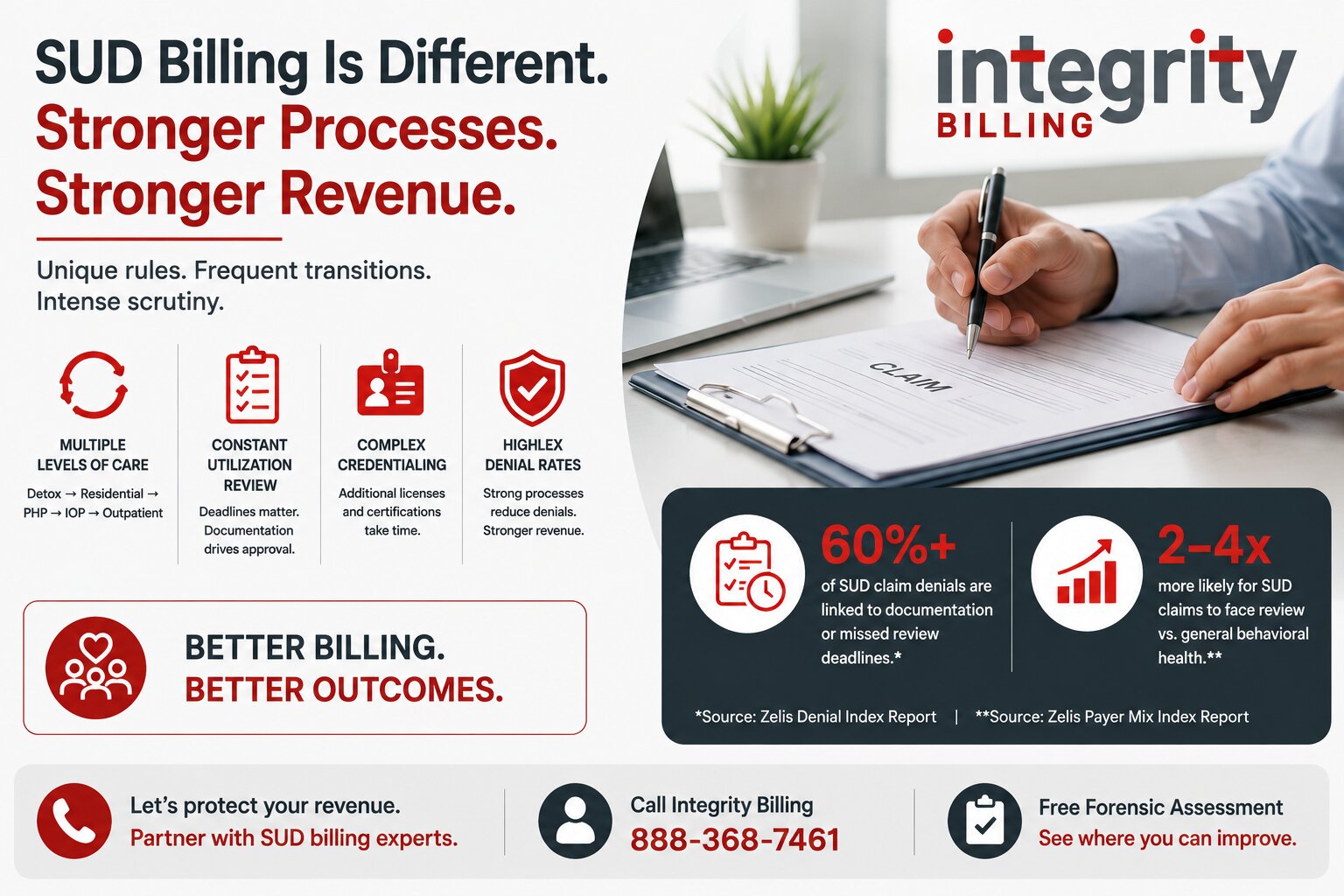
Appeals for SUD claims may require presenting a more comprehensive clinical picture than typical behavioral health appeal documentation, particularly to substantiate whether a step-down or continued care was medically necessary.
Alternative Billing Strategies: Bundle and Per Diem
Unlike most outpatient behavioral health codes, many SUD levels, especially residential or PHP, use a per-diem or bundled rate structure. This affects how clinics build these claims and how billing staff manage documentation to ensure that numerous services received in a day aren’t captured as a single billing line that leads to audits or a clawback.
How This Impacts Your Practice
If you treat substance abuse billing as simply another branch of general behavioral health billing, problems can surface quickly. Authorizations may lapse between levels of care, appeals may lack the clinical detail needed to support medical necessity, credentialing delays can hold up reimbursement, and denial management strategies may fail to address patterns that are specific to SUD treatment.
Maintaining a healthy revenue cycle requires billing and practice management processes built around the realities of SUD care. That includes frequent utilization reviews, transitions between levels of care, layered credentialing requirements, and billing structures that demand careful coordination from admission through final payment.
Let’s Strengthen Your SUD Billing Process
You shouldn’t guess at your SUD billing. The stakes are too high; denied claims and prolonged reimbursement times aren’t worth it. Integrity Billing understands the details of SUD billing—transitions between levels of care, utilization review, and appeals that actually get your money back. Give Integrity Billing a call at 888-368-7461 or fill out our contact form online for a free forensic assessment of your SUD billing system.
Frequently Asked Questions About Substance Abuse Billing
Is billing for SUD similar to general behavioral health billing?
Not really. There is overlap, but SUD billing involves a host of additional factors: more rapid level-of-care changes, concurrent utilization review, denial management patterns specific to SUD services, and much more extensive credentialing requirements.
How often does utilization review happen in SUD?
All the time. Moving multiple times through detox, residential, PHP, and IOP in just a couple of weeks makes concurrent review a common and demanding part of the billing cycle.
Why do SUD claims get denied more often?
Denials usually occur due to missed deadlines on concurrent utilization review, incomplete documentation of medical necessity, and issues with step-down citations in authorizations. Developing a denial management process built specifically for these issues is the best approach.
How does SUD credentialing differ from general behavioral health?
SUD providers may have to satisfy additional state licensing criteria and individual certifications that are different from standard behavioral health requirements. Credentialing timelines also tend to be much longer when building a new SUD specialty.
What makes appeals for SUD claims more difficult?
In the majority of instances, appealing SUD denials requires several layers of detailed clinical documentation substantiating the clinical justification for the type of treatment and the timing of step-down decisions, rather than simply re-initializing the claim.
Can my billing grow with my practice?
Absolutely. Using a billing partner with SUD-specific expertise can help streamline your billing processes and optimize your revenue cycle. Contact Integrity Billing for a free forensic assessment to review your current billing for SUD services and how to improve them.