
If you’re running a behavioral health facility, you didn’t get into this work because you love insurance contracts. You got into it to help people. But here’s the reality: the rates you’re reimbursed directly impact your ability to hire quality staff, expand your services, and keep your doors open. That’s why understanding behavioral health insurance contracting isn’t just a business skill. It’s a survival skill.
Fortunately, you have more leverage than you might realize. And with the right strategy, you can stop accepting whatever rates the payers hand you and start negotiating like the valuable provider you are.
Understand What You’re Actually Negotiating
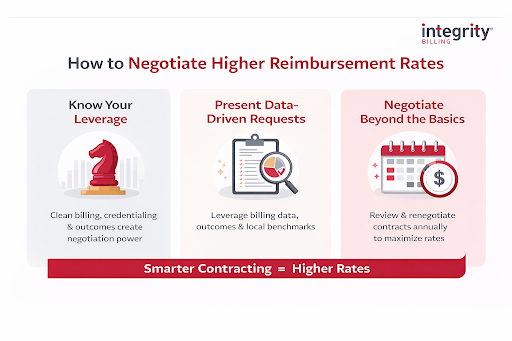
Before you sit down at the table, you need to know exactly what’s on it. Reimbursement rates in behavioral health are tied to billing and coding, specifically, the CPT codes your clinicians use to document services. If your billing and coding isn’t precise and consistent, you’re likely leaving money on the table before the negotiation even begins. Payers track your billing patterns, and clean, well-documented claims signal that you’re a credible, organized provider worth investing in.
Start by pulling a clear picture of your current fee schedule versus what payers are actually reimbursing. Where are the gaps? Which payers are underperforming compared to others? This data becomes your foundation.
Get Your Credentialing in Order First
You can’t negotiate with a payer you’re not properly contracted with, and you can’t get contracted if your credentialing isn’t airtight. Credentialing is the process by which insurance companies verify your providers’ qualifications, licenses, and history before allowing them to bill under a contract. It’s tedious, it’s time-consuming, and errors or delays can cost you months of lost revenue.
Make sure every provider in your facility is fully credentialed with every payer you bill. Gaps in credentialing mean claims get denied and your negotiating position weakens. A clean credentialing profile also signals to payers that your organization is professionally managed, which matters when you’re asking for higher rates.
Build Your Value Proposition Before the Conversation
Payers respond to data and outcomes. When you go into a rate negotiation, come armed with evidence of your facility’s value. How many members do you serve in their network? What’s your treatment completion rate? Do you have outcomes data showing reduced hospitalizations or ER visits? These numbers tell a story: your facility saves the payer money downstream.
You should also know your market. What are comparable behavioral health facilities in your area being reimbursed? If you’re below market rate, that’s a legitimate argument. Research matters here and going in informed signals that you take contracting seriously.
Use Utilization Review to Your Advantage
Utilization review (the process payers use to evaluate whether the services you’re providing are medically necessary) is often seen as a headache by providers. But it can actually be a strategic asset if you approach it correctly. When your utilization review documentation is thorough, timely, and consistent, it reduces denials and demonstrates clinical integrity to the payer.
Hands down, payers are more willing to offer favorable rates to facilities with low denial rates and strong utilization review track records. Think of every authorization and concurrent review as a mini-negotiation that either builds or erodes your long-term leverage. Facilities that manage this process well are viewed as low-risk partners, leading to better contracts.
It’s also worth noting that if your facility conducts forensic assessments, ensuring these are properly documented is critical. Accurate completion of forensic assessment forms directly impacts reimbursement and can play a role in supporting medical necessity determinations during utilization review. Request your free forensic assessment from Integrity Billing today.
Negotiate Smart — Not Just Hard
A common mistake in contracting is treating it like a one-time event. It’s not. Contracts typically renew annually or every few years, and each renewal is an opportunity. Here are a few practical approaches that work:
- Request a rate increase in writing. Be sure to include supporting documentation so that you can justify your request.
- Bundle your ask. If you’re offering something new, such as a new level of care, expanded hours, or a new program, use it as leverage.
- Know which codes matter most. Focus your negotiation on the CPT codes that represent your highest volume of services. Even a modest rate improvement on your top billed codes can mean significant revenue over a year.
- Don’t accept the first offer. Payers have room to move. They expect you to push back, most facilities just don’t.
Ready to Start Getting Paid What You’re Worth?
At Integrity Billing, we specialize in helping behavioral health facilities take the complexity out of contracting, credentialing, billing and coding, and utilization review so that you can focus on what you do best: delivering quality care.
Whether you’re looking to renegotiate existing contracts, get newly credentialed with payers, clean up your billing processes, or build a stronger utilization review strategy, our team has the expertise and the relationships to get results.
Contact Integrity Billing today at 888-368-7461 for a conversation about where your facility stands and how we can help you grow. There’s no obligation—just real answers from people who understand behavioral health billing inside and out.