

If you’ve ever tried to navigate insurance credentialing for a mental health provider, you know it’s not a quick process. It’s paperwork-heavy, timeline-dependent, and unforgiving of errors. And, if something goes wrong or gets delayed, the financial consequences show up fast. Providers can’t bill. Revenue doesn’t come in. And the facility absorbs the gap.
The good news is that credentialing, for all its complexity, follows a process. Once you understand the steps, the common pitfalls, and what to expect at each stage, it becomes something you can manage proactively rather than reactively.
Here’s a clear, practical walkthrough of how insurance credentialing works for mental health providers in 2026, along with what to watch out for along the way.
Credentialing and Why It’s Important for Behavioral Health Billing
Insurance credentialing is the process by which a provider is formally approved to participate in a payer’s network. Until that approval is in place, the provider cannot bill that payer for services. This means that any claims submitted for their patients come back denied, regardless of how clean the billing and coding is or how thorough the clinical documentation is.
In behavioral health, this matters more acutely than in many other specialties. Mental health and substance use disorder treatment relies heavily on insurance reimbursement, and facilities often operate with tight margins. A single provider who is delayed in getting credentialed can represent weeks or months of lost revenue. This can be especially devastating to smaller practices or newer programs that are still growing.
Getting credentialing right, and getting it done efficiently, is one of the most direct levers a behavioral health facility has on its revenue cycle.
Step 1: Gather and Organize Provider Documentation
Before any credentialing application goes out, you need a complete, up-to-date provider file. Missing or outdated documents are one of the most common reasons applications get delayed or rejected. Since credentialing timelines can already run 90 to 180 days with some payers, you don’t want to add weeks to the clock by submitting an incomplete packet.
The standard documentation required typically includes:
- Current license and any specialty certifications
- NPI number (both individual Type 1 and, where applicable, organizational Type 2)
- DEA certificate (if relevant)
- Malpractice insurance certificates with coverage history
- Curriculum vitae with no unexplained gaps in employment or training
- Education and training verification
- Completed CAQH profile (more on that below)
For mental health providers specifically, make sure licenses are current and in good standing in every state where the provider will be practicing. Payers verify this directly, and a lapsed or pending renewal will stop an application in its tracks.
Step 2: Set Up and Maintain a CAQH ProView Profile
CAQH ProView is the centralized database most commercial payers use to collect and verify provider credentialing information. Think of it as the single source of truth for a provider’s credentials. Rather than submitting a full documentation packet to every payer individually, providers complete one comprehensive CAQH profile that participating payers can access directly.
Setting up a complete, accurate CAQH profile is a prerequisite for credentialing with virtually every major commercial payer. It needs to be thorough, consistent with the provider’s other documentation, and current. CAQH requires providers to re-attest their information every 120 days. If a profile goes stale, payers can’t access current information, and applications get held up.
For practices managing multiple providers, CAQH maintenance is an ongoing administrative responsibility that’s easy to let slip. Building a reminder system or delegating profile management to a dedicated team member or billing partner is worth the effort.
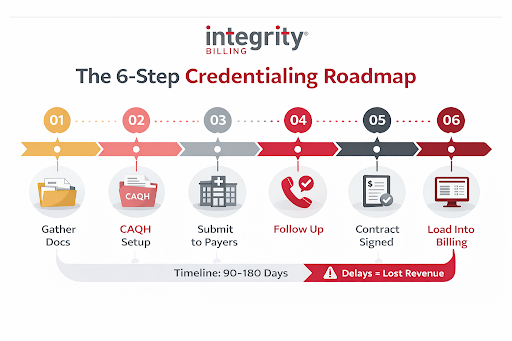
Step 3: Identify Target Payers and Submit Applications
Not every provider needs to be credentialed with every payer, but identifying the right payer mix for each provider is an important step. This means looking at your patient population, which payers represent the majority of your census, which payers are dominant in your geographic market, and whether there are specific plans that patient referral sources tend to use.
Once the target payer list is set, applications go out. Some payers accept CAQH-based applications directly. Others have their own application processes. State Medicaid programs typically have their own enrollment systems entirely, separate from commercial credentialing.
Substance use disorder programs may also need to navigate additional enrollment requirements through managed behavioral health organizations (MBHOs) that administer behavioral health benefits on behalf of insurers.
Track every application: submission date, confirmation of receipt, assigned representative or reference number if available, and any follow-up deadlines. This tracking is what lets you manage the process proactively rather than discovering problems when claims start coming back denied.
Step 4: Follow Up Consistently
Credentialing applications don’t process themselves, and payer credentialing departments are not known for proactive communication. Following up regularly (typically every two to three weeks) is ideal. It’s how you catch missing documents before they cause a months-long delay, identify when an application has been sitting in a queue without movement, and keep your timeline on track.
Document every follow-up call: who you spoke with, what the status is, and what the next step or expected timeline is. If an application requires additional information, turn that around immediately. Every day of delay extends the overall timeline.
This is the stage where most credentialing processes stall for facilities managing it in-house. Consistent follow-up requires dedicated time and bandwidth that most administrative teams don’t have to spare, especially when they’re also managing billing and coding, utilization review, and the general demands of running a program.
Step 5: Negotiate Contracts and Confirm Effective Dates
When a payer approves a provider’s credentialing application, the next step is executing a participation agreement. This is the contract that establishes the terms under which the provider will participate in that payer’s network, including fee schedules and reimbursement rates.
Don’t skip the contract review step. Reimbursement rates are sometimes negotiable, particularly for specialty services, and the rates established in this agreement are what you’ll be billing against going forward. Understanding what you’re agreeing to matters.
Once a contract is executed, confirm the effective date in writing and document it. This is the date from which you can bill for services. Any claims submitted for services rendered before the effective date will be denied, even if the credentialing process is otherwise complete.
Step 6: Load Provider Information Into Your Billing System
Once credentialing is active, provider enrollment information needs to be correctly loaded into your practice management or behavioral health billing platform. Errors at this stage are a surprisingly common source of claim denials even after successful credentialing.
Verify that every payer-specific provider ID is entered correctly, that taxonomy codes match the provider’s credentialed specialty, and that billing under the correct NPI (individual vs. group) aligns with how the provider was credentialed. A small data entry error here can produce a wave of denials that takes time to diagnose and correct.
Ongoing Credentialing Maintenance: What Happens After Approval
Credentialing isn’t a one-time event but rather an ongoing process. Payers re-credential providers on a cycle, typically every two to three years, and require updated documentation at that time. Licenses, certifications, and malpractice coverage all have their own renewal timelines. CAQH profiles need regular attestation. And any time a provider’s information changes, payers need to be notified.
Building a credentialing maintenance calendar that tracks every provider’s key dates across every payer is the foundation of proactive credentialing management. Letting renewals slip creates the same problem as delayed initial credentialing: providers who can’t bill, and revenue that doesn’t come in.
Managing Credentialing Across a Behavioral Health Team
For practices with multiple providers, such as therapists, psychiatrists, NPs, and counselors at different licensure levels, credentialing management becomes a significant ongoing operational function. Each provider has their own documentation, their own payer enrollment status, and their own renewal calendar. Tracking all of it accurately requires dedicated systems and attention.
This is one of the core reasons behavioral health facilities partner with specialized billing companies like Integrity Billing. Credentialing is one piece of a complete behavioral health billing solution, alongside billing and coding, utilization review, and denial management. Managing it as part of an integrated revenue cycle process produces far better outcomes than treating it as a standalone administrative task.
Want to Make Sure Your Credentialing Is Actually Airtight?
Credentialing gaps are one of the most common sources of revenue loss in behavioral health. If you’re not sure whether your current providers are fully enrolled with every relevant payer, or if you have new providers coming on board and want to make sure the process is handled correctly from day one, a free forensic assessment from Integrity Billing is a great place to start.
Integrity Billing specializes exclusively in behavioral health. We handle the credentialing, the billing, and the utilization review so that you can focus on running your program. Contact us online or by phone at 888-368-7461 and let’s talk about what a cleaner credentialing process could mean for your revenue cycle.