

You started your treatment center with a mission: to provide compassionate, life-changing care to people struggling with mental health and substance use challenges. In the beginning, everything felt manageable. Your billing team—maybe just one or two people—could keep up with claims. Payments came in steadily enough. Life was good.
But now? You’re growing. More patients, more providers, more insurance contracts. And suddenly, your billing process feels like it’s held together with layers of duct tape.
This is a familiar story we hear from behavioral health treatment centers. It’s not uncommon to hit a wall when their billing systems can’t keep pace with growth. On the bright side, you can usually fix the problem before it derails your progress. The key is being able to recognize the warning signs early.
Let’s talk about the red flags that indicate your behavioral health billing process isn’t built to scale—and what you can do about it.
Your Denial Rate Keeps Climbing
A healthy denial rate for behavioral health claims sits somewhere between 5-10%. If yours is creeping higher, that’s a major sign your billing process is struggling to keep up.
Why does this happen during growth? When you’re onboarding new providers, adding services, or contracting with new insurance companies, the complexity of billing and coding increases exponentially. Your team might not have the bandwidth to stay current on payer-specific requirements, new CPT codes, or credentialing nuances for each provider. Mistakes slip through, and denials pile up.
Each denied claim represents delayed revenue—sometimes by months. And if your team is already stretched thin, they don’t have time to appeal denials or resubmit corrected claims quickly. The backlog grows, cash flow suffers, and suddenly you’re worried about making payroll.
Claims Are Sitting Longer Before Submission
In an ideal world, claims go out within 24-48 hours of service. But when your billing team is overwhelmed, claims start sitting in queues for days—or even weeks—before submission.
This delay costs you money in two ways. First, the longer you wait to submit, the longer you wait to get paid. Second, some insurance companies have filing deadlines. Miss that window, and you’ve lost the revenue entirely.
If your average time-to-submission is stretching beyond a week, it’s a clear signal that your current system can’t handle your patient volume. Your team is drowning, and your revenue is suffering as a result.
You’re Constantly Playing Credentialing Catch-Up
Credentialing is one of those behind-the-scenes processes that’s easy to overlook—until it becomes a crisis.
As you hire new providers or expand into new insurance networks, credentialing becomes increasingly complex. Each provider needs to be credentialed with each payer, and the process can take 90-120 days or more. If you’re not tracking expiration dates and starting renewals early, you’ll find yourself with providers who can’t bill for their services.
Here’s what that looks like: A therapist sees 20 patients in a week. Their credentialing with a major insurer lapses without anyone noticing. You submit claims for those sessions, and every single one gets denied. Now you’re scrambling to fix the credentialing issue while those claims sit in limbo.
If credentialing feels like a constant scramble rather than a managed process, your billing infrastructure isn’t scalable.
Your Billing Team Is Burned Out
Let’s talk about the human side of this. Your billing staff didn’t sign up to work 60-hour weeks, constantly fixing urgent problems and drowning in claim corrections.
When a billing team is stretched too thin, mistakes increase. Morale drops. Turnover happens. And then you’re stuck trying to hire and train new staff while simultaneously managing an already overwhelming workload.
If your behavioral health billing team is consistently stressed, working overtime, or expressing frustration about their workload, that’s not just a staffing problem—it’s a scalability problem. Your current process can’t support your growth without burning people out.
You Don’t Have Real-Time Visibility Into Your Revenue Cycle
Can you pull up a dashboard right now and see exactly where you stand financially? Do you know your current accounts receivable aging? Can you identify patterns in your denials?
If the answer is “not really” or “I’d have to ask someone to pull a report,” you don’t have the infrastructure to scale. As you grow, you need real-time data to make informed decisions about cash flow, hiring, expansion, and operations.
Without visibility, you’re flying blind. You might not realize you have a problem until it’s a crisis, like discovering you’re owed $200,000 in unpaid claims from six months ago that are now past the filing deadline.
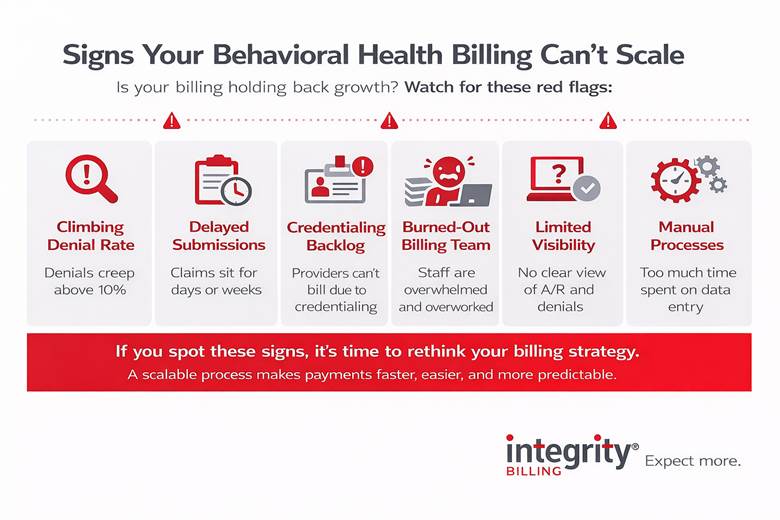
Manual Processes Are Eating Up Time
Are your billers still manually entering data? Manually checking claim status with each insurer? Manually tracking credentialing renewals in a spreadsheet?
Manual processes worked when you had 20 patients a month. They don’t work when you have 200. Every manual step is a bottleneck, a potential error point, and a drain on productivity.
Scalable billing relies on automation and technology. If your process still looks like it did five years ago, it’s time for an upgrade.
Is your billing holding back your growth? A free forensic assessment can reveal exactly where your process is breaking down and show you how to fix it before it costs you more revenue.
Revenue Is Growing, But Cash Flow Isn’t
This is perhaps the most frustrating sign of all. You’re seeing more patients than ever. Your census is up. Your providers are busy. But your bank account doesn’t reflect that growth.
Why? Because your billing process can’t keep pace. Claims are delayed, denials aren’t being appealed, credentialing issues are creating gaps, and money that should be in your account is stuck in the system.
You’re working harder but not getting paid for it. That’s not sustainable, and it’s a clear sign your billing infrastructure has hit its limit.
What Scalable Behavioral Health Billing Looks Like
So what’s the alternative? Scalable billing systems have a few key characteristics:
- Specialized technology that automates routine tasks, flags errors before submission, and provides real-time reporting.
- Dedicated teams with deep expertise in behavioral health billing and coding who stay current on regulatory changes and payer requirements.
- Proactive credentialing management with tracking systems that ensure no provider ever has a lapse.
- Quick, accurate claim submission with thorough follow-up on every dollar owed.
- Built to grow with you – when you add providers, expand services, or increase patient volume, the system adapts without breaking.
Ready to Scale Without the Growing Pains?
At Integrity Billing, we specialize in behavioral health billing for treatment centers at every stage of growth. We understand the unique challenges you face, and we’re here to help you build a revenue cycle that supports your mission instead of holding it back.
Contact Integrity Billing today at 888-368-7461 to learn more about how we can help your treatment center scale successfully. Your patients deserve your full attention. Let us handle the billing.