

Picture this: You’ve just helped someone complete 90 days of treatment. Their family is grateful. Their life has changed. But when you submit the claim for those services? Denied. The reason? A simple coding error that could take months to resolve.
Unfortunately, coding errors are one of the most common culprits behind delayed payments, claim denials, and cash flow disruptions. When your billing and coding aren’t accurate, it doesn’t just slow down revenue—it can impact your ability to serve patients who desperately need your help.
Let’s talk about why coding errors happen, how they delay your payments, and what you can do to protect your practice from these costly mistakes.
Why Are Coding Errors So Common in Behavioral Health?
Behavioral health billing is uniquely complex. Unlike other areas of healthcare, you’re not just coding for a procedure or a diagnosis—you’re documenting ongoing treatment, therapy modalities, levels of care, and sometimes co-occurring disorders. Add in the fact that coding guidelines are constantly evolving, and it’s easy to see why even experienced billers make mistakes.
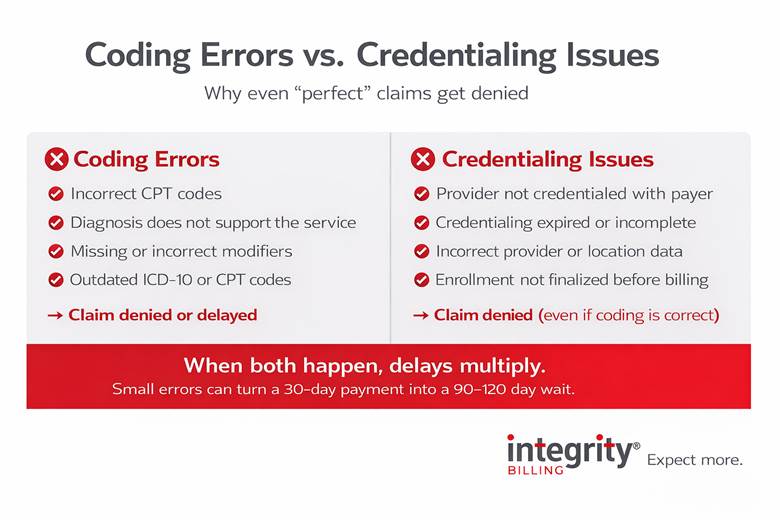
Here are some of the most common coding errors we see:
Incorrect CPT Codes
Using the wrong CPT code for the service provided is incredibly common. For example, confusing individual therapy codes with group therapy codes, or selecting the wrong time increment for a session, can trigger an automatic denial.
Mismatched Diagnosis Codes
The diagnosis code (ICD-10) must align with the treatment being provided. If there’s a mismatch—say, billing for substance use treatment but listing an unrelated mental health diagnosis—the claim will likely be rejected.
Missing or Incomplete Modifiers
Modifiers provide crucial context about the service, like whether it was provided via telehealth or by a specific type of provider. Forgetting a modifier or using the wrong one can mean the difference between a paid claim and a denied one.
Outdated Codes
ICD-10 and CPT codes are updated regularly. If your team isn’t staying current with these changes, you could be submitting claims with codes that are no longer valid, leading to automatic rejections.
The Domino Effect: How Coding Errors Delay Payments
When a claim is submitted with a coding error, the insurance company typically won’t just pay it anyway—though wouldn’t that be nice? Instead, the claim gets flagged, denied, or sent back for correction. Here’s what happens next:
- Your claim gets denied. The insurer sends a denial notice, often weeks after the original submission. Now you’re starting from square one.
- You have to identify the error. Someone on your team has to review the claim, figure out what went wrong, and determine the correct code. This takes time and expertise.
- You resubmit the claim. After correcting the error, the claim goes back into the queue. But you’re not at the front of the line anymore—you’re starting the waiting process all over again.
- Payment is delayed by weeks or months. What should have been a 30-day payment cycle has now stretched into 60, 90, or even 120 days. Your cash flow takes a hit, and your team is stuck playing catch-up.
And here’s the kicker: some claims are denied multiple times for different reasons, creating a frustrating loop that drains resources.
How Credentialing Issues Make Things Worse
Coding errors aren’t the only thing that can delay payments. If your providers aren’t properly credentialed with insurance companies, even a perfectly coded claim will be denied.
Credentialing is the process of verifying that your providers meet the insurance company’s standards and are authorized to bill for services. It’s a lengthy process (often taking 90 to 120 days) that requires meticulous attention to detail. If there’s a lapse in credentialing, or if a provider’s information isn’t updated after a change, claims will be rejected until the issue is resolved.
The combination of coding errors and credentialing problems? That’s a recipe for serious cash flow disruption.
Protecting Your Practice: Prevention Is Everything
The encouraging part is that most coding errors are preventable. Here’s how to protect your practice and keep payments flowing:
- Invest in ongoing training. Behavioral health billing and coding rules change frequently. Make sure your billing team receives regular training on updates to CPT codes, ICD-10 codes, and payer-specific requirements.
- Implement a claims review process. Before submitting claims, have a second set of eyes review them for accuracy. Catching errors before submission saves time and money.
- Stay on top of credentialing. Track credentialing expiration dates and start the renewal process early. Don’t wait until a provider’s credentialing lapses to address it.
- Use specialized billing software. Invest in billing software designed for behavioral health. These systems often include built-in coding checks and alerts that catch common errors before claims go out the door.
- Partner with experts. If your in-house team is overwhelmed or lacks specialized expertise, consider outsourcing your behavioral health billing to professionals who live and breathe this work every day.
When You Need a Fresh Set of Eyes
Sometimes the best way to identify gaps in your billing process is to have an expert review your current systems. That’s where a forensic assessment comes in.
A forensic assessment is a deep dive into your billing and coding processes, credentialing status, and claims management. It uncovers hidden issues, such as patterns of denials, overlooked revenue opportunities, or credentialing gaps, and provides a clear roadmap for improvement.
If you’ve been struggling with delayed payments, frequent denials, or cash flow challenges, it might be time to take a closer look under the hood.
Get Your Free Forensic Assessment Today
At Integrity Billing, we specialize in behavioral health billing and substance use treatment billing. We understand the unique challenges you face, and we’re here to help you get paid faster and more accurately so that you can focus on making a difference for others.
Ready to identify what’s holding up your payments? We’re offering a free forensic assessment to treatment centers like yours. We’ll review your billing processes, identify problem areas, and show you exactly how to fix them.
Don’t let coding errors and credentialing issues drain your resources any longer. Let’s get your revenue cycle back on track—together.
Contact Integrity Billing today at 888-368-7461 to schedule your free forensic assessment.