

When you’re running a behavioral health facility, you know all too well that claim denials aren’t just a billing problem. They’re also a patient care problem. Every dollar tied up in a denial or write-off is a dollar that can’t go back into staffing, programming, or expanding access to treatment. And when denials are high enough, they don’t just hurt the bottom line. They create instability that makes it harder to show up consistently for the people who need you most.
The frustrating part? Most behavioral health claim denials are preventable. They’re not random, and they’re not inevitable. They follow patterns, and once you understand those patterns, you can start closing the gaps that are generating them.
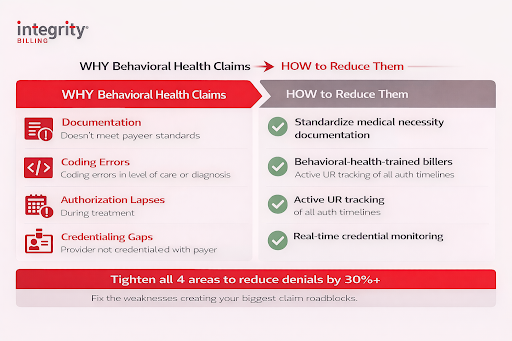
Here’s a breakdown of the most common reasons behavioral health claims get denied, and what actually moves the needle on reducing them.
The Denial Drivers Most Facilities Don’t Fully See
Medical Necessity Documentation That Doesn’t Match Payer Expectations
This is the single biggest driver of denials in behavioral health billing. The clinical record might clearly support the level of care being billed, but if the documentation doesn’t reflect that in the specific language and format that payer is looking for, the claim gets denied anyway.
It’s important to keep in mind that payers aren’t reading your notes the way a clinician would. They’re looking for specific indicators: standardized assessment scores, functional impairment language, documented risk factors, and evidence that the current level of care is medically necessary—not just clinically appropriate. When that documentation is missing, vague, or structured in a way the payer doesn’t recognize, denial follows.
The fix is building documentation standards into the clinical workflow itself, not reviewing claims for completeness after the fact. Clinicians need to know what payers are looking for before they write the note, not after the claim comes back.
Billing and Coding Errors Specific to Behavioral Health
General billing errors cause denials in every specialty. But behavioral health billing and coding has its own layer of complexity that trips up even experienced billers who aren’t specifically trained in this field.
The level of care distinctions (outpatient, IOP, PHP, MAT, residential) each carry different code sets, different documentation requirements, and different payer expectations. Coding a PHP session incorrectly, mismatching a procedure code to a diagnosis, or failing to include required modifiers are all fast tracks to denials.
And because behavioral health payers tend to audit these claims more aggressively than general medical claims, errors here have a longer tail than they might elsewhere. Therefore, specialized behavioral health billing and coding isn’t a luxury. It’s the baseline requirement for keeping denial rates manageable.
Authorization and Utilization Review Breakdowns
Prior authorizations in behavioral health aren’t a one-time step but rather an ongoing process that runs parallel to treatment. When a utilization review process isn’t functioning well, authorizations lapse, continued stay reviews get missed, and claims come back denied for services that were clinically necessary and appropriately delivered.
What makes this especially painful is that these denials are almost entirely administrative in origin. The treatment was right. The documentation may have been solid. The only problem is that authorization wasn’t active when the claim went out. Retroactive authorizations are difficult to obtain, and payers have little sympathy for them.
Strong utilization review means proactively managing every authorization timeline, submitting continued stay reviews before existing authorizations expire, and speaking the payer’s language when documenting clinical progress. Done well, it will reduce denials and keep your facility in a much stronger position during audits.
Credentialing Issues Flying Under the Radar
If a provider isn’t credentialed with a payer, claims for their services won’t be paid. This is the case even if the billing and coding is clean or the documentation is thorough. And in behavioral health, where staff turnover tends to run higher than in other healthcare settings, credentialing gaps are a persistent and often underestimated denial driver.
The problem is that credentialing issues don’t always announce themselves loudly. A new provider starts seeing patients, claims go out, and denials trickle in weeks later. By the time the pattern is recognized, there may be a significant backlog of unpayable claims sitting in the system. Proactive credentialing management is the only reliable way to prevent this.
What Does a 30%+ Reduction in Denials Look Like?
Reducing denials by 30% or more isn’t about working harder on one piece of the revenue cycle. It’s about tightening up all four of the areas above simultaneously because they compound each other. A clean claim that’s well-coded and well-documented, submitted under an active authorization by a credentialed provider, clears at a dramatically higher rate than a claim with even one of those elements out of alignment.
Facilities that get there typically make a few structural changes: they separate denial tracking from denial management, they build documentation standards into clinical workflows, and they either dedicate specific expertise to behavioral health billing or bring in a specialized partner like Integrity Billing.
The math on that improvement is significant. If your facility is writing off $50,000 a month in denials and you reduce that by 30%, that’s $15,000 a month in recovered revenue. And the best part is that you get to do this without even adding a single new patient.
What’s Your Denial Rate Costing You? Find Out Today.
Many behavioral health facilities have a general sense that denials are a problem, but they don’t have clear visibility into exactly how much revenue they’re losing or where it’s coming from.
A free forensic assessment from Integrity Billing is designed to answer exactly that question. We’ll take a close look at your claims history, billing and coding practices, utilization review workflows, and credentialing status and give you a specific, honest picture of where your revenue is going and what it would take to get it back.
Contact Integrity Billing today to get started with our services. You can reach us by phone at 888-368-7461 or fill out our online contact form. We look forward to hearing from you and talking more about what denial management could mean for your facility.