
For new behavioral health providers, few administrative steps are as important as credentialing. Whether you’re opening a private practice, launching a treatment center, or expanding your clinical team, credentialing is what connects your services to insurance networks and ultimately ensures you get paid.
As important as credentialing is, it also happens to be one of the most misunderstood parts of running a behavioral health facility. Things like missing details, slow follow-up, or incomplete paperwork can delay approval for months, putting cash flow and patient care at risk.
At Integrity Billing, we’ve seen it all, from credentialing applications sitting untouched for 90 days to centers unknowingly billing under the wrong taxonomy code. Fortunately, every credentialing challenge has a fix. Let’s look closer at what new providers often get wrong and how to do it right from the start.
Mistake #1: Underestimating the Timeline
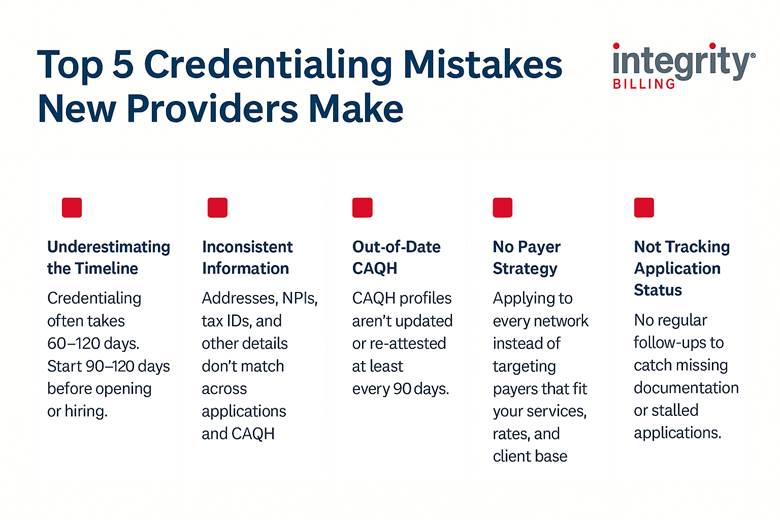
One of the most common mistakes is assuming credentialing is a quick process. In reality, credentialing can take up to 120 days, and contracts can take up to 1 year from application to loading. These timelines depend on the state and the payer.
Each insurance company has its own verification process, and every application goes through multiple stages, such as a review, background check, primary source verification, and committee approval. Missing even one document (like a W-9, license, or insurance certificate) can send your application back to the bottom of the pile.
To avoid this issue, start credentialing early. At Integrity Billing, we recommend starting 90 to 120 days before your anticipated opening or before bringing on a new clinician. Also keep digital copies of all essential documents (licenses, DEA registration, liability insurance, and certifications) in a centralized location so they’re ready when needed.
Mistake #2: Using Incorrect or Inconsistent Information
Even small inconsistencies in your application, like using “Suite 200” on one form and “Ste. 200” on another, can delay approval. Insurance companies rely heavily on matching systems and databases, and mismatched information can trigger red flags or denials.
This is especially common when centers list multiple addresses, NPIs, or tax IDs without keeping records synchronized. Consistency is key. Make sure every credentialing document is matching, including your CAQH profile, NPI registration, and insurance applications. Think of it as making sure every detail in your paperwork “matches perfectly,” so payers can process it without hesitation.
Mistake #3: Forgetting to Keep CAQH Up to Date
If you’re credentialing with commercial payers, you’ll need an up-to-date CAQH (Council for Affordable Quality Healthcare) profile. Many providers assume their CAQH profile automatically updates, but it doesn’t.
Insurance networks pull data directly from CAQH, so if your licenses, malpractice insurance, or attestation dates are outdated, your application may stall.
Log in to your CAQH account every 90 days to verify your information and re-attest that it’s accurate. This simple step prevents unnecessary delays and shows payers that your treatment center’s information is current.
Mistake #4: Credentialing Before Understanding Your Network Goals
New treatment centers often apply to every payer “just to get started,” only to realize later that their preferred patient base uses entirely different plans, or that certain payers reimburse below sustainable rates. Without a clear strategy, you can waste time and resources pursuing networks that don’t align with your services or client demographics.
Before submitting applications, evaluate which payers make sense for your program. Review your current and expected patient insurance mix, talk to referral partners about which networks they see most often, and research reimbursement rates. Strategic credentialing ensures your contracts actually support your financial and clinical goals.
Mistake #5: Not Tracking Application Status
Many new providers submit applications and assume “no news is good news.” Unfortunately, silence often means your file is sitting in limbo. Insurance panels receive hundreds of applications monthly. Without proactive follow-up, yours can easily get lost or delayed due to missing documentation.
Set reminders to follow up every 10–14 days after submission. Document every point of contact, including reference numbers, dates, and the name of the representative you spoke with. Staying organized shows payers you’re serious about compliance and helps you catch small issues before they turn into major delays.
Mistake #6: Confusing Credentialing with Contracting
Many providers use the terms “credentialing” and “contracting” interchangeably, but they’re not the same thing.
- Credentialing verifies your qualifications (licenses, education, malpractice coverage).
- Contracting is the step where you negotiate rates and sign agreements to officially join the network.
Missing the contracting step means you’re still out-of-network, even if credentialing is approved.
To fix this problem, track your progress through both stages. Once you receive your credentialing approval, confirm that your contract has been fully executed and that your information appears correctly in the payer’s system before seeing patients.
Mistake #7: Trying to Do It All Alone
Credentialing requires time, organization, and detailed knowledge of each payer’s process and for new behavioral health facilities, that can take focus away from patient care, utilization review, and program development. Many centers try to handle credentialing internally, only to face long delays, cash flow disruptions, and compliance risks.
For the best results, partner with professionals who understand behavioral health billing inside and out. At Integrity Billing, we specialize in helping treatment centers navigate every step of the process, from gathering documentation to following up with payers, so you can focus on what matters most: delivering quality care.
Setting Your Center Up for Success
Credentialing is one of the first major administrative hurdles for behavioral health providers, but it doesn’t have to be overwhelming. By starting early, staying consistent, and seeking expert support, you can establish payer relationships that strengthen your operations and build long-term sustainability.
At Integrity Billing, we take the guesswork out of behavioral health credentialing. Whether you’re opening a new facility or expanding your provider network, our team ensures accuracy, efficiency, and full compliance every step of the way.
Contact Integrity Billing today at 888-368-7461 or fill out our contact form to learn how we can help you simplify credentialing and start serving clients with confidence.