

If you’ve ever handed your behavioral health billing off to a general medical billing company, or tried to manage it in-house with staff who weren’t specifically trained in the field, you’ve probably felt the frustration firsthand. Claims coming back denied. Reimbursements that seem lower than they should be. A backlog that never quite clears. The problem usually isn’t effort. It’s specialization.
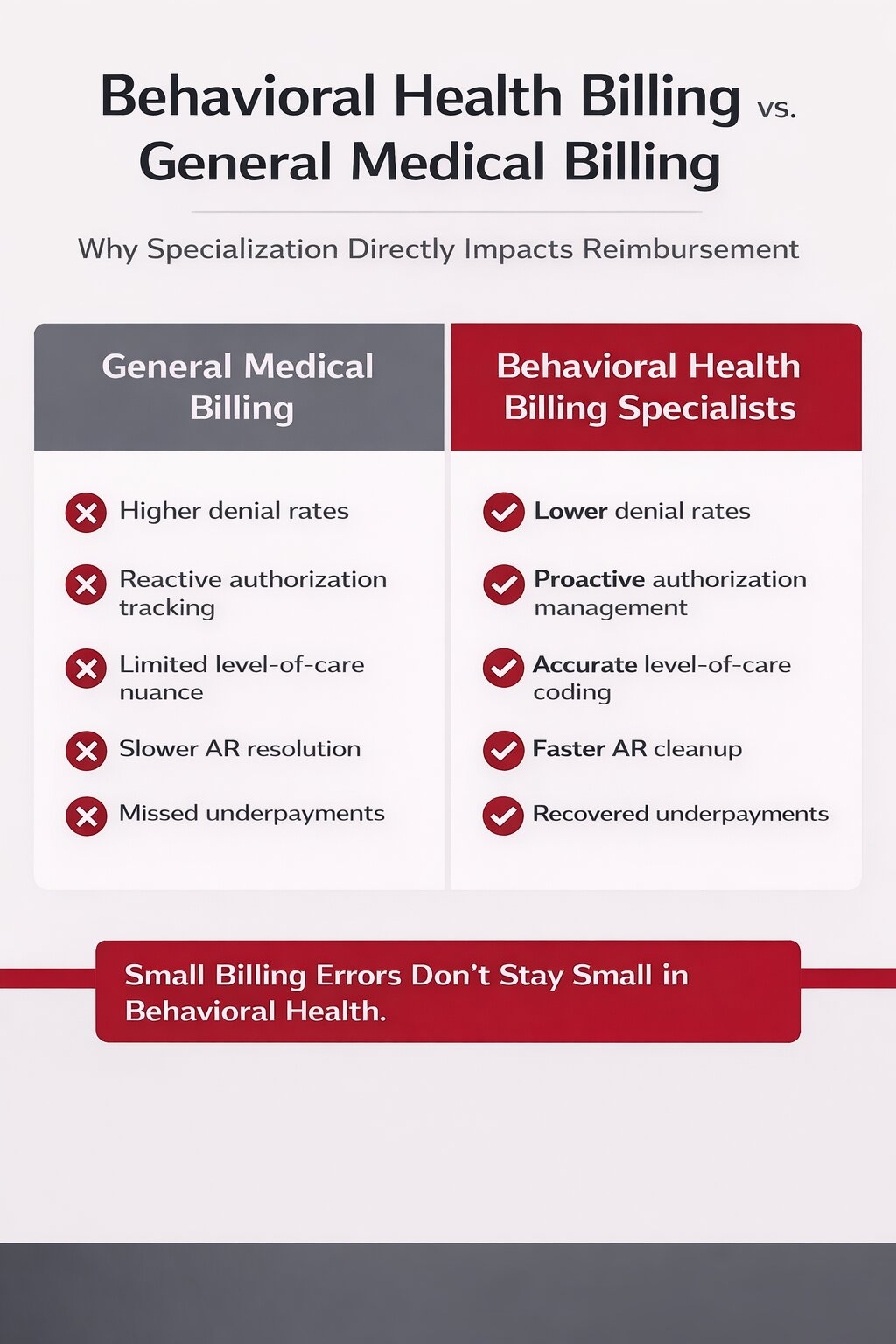
Behavioral health billing operates by its own set of rules, and those rules are genuinely different from general medical billing in ways that have a direct, measurable impact on how much your facility gets reimbursed and how quickly.
It’s Not Just Different. It’s More Complex.
General medical billing is no walk in the park, but it tends to follow a more predictable structure. A patient comes in, receives a procedure, the procedure gets coded, and a claim goes out. The coding and coverage rules are well-established and widely understood by most billing professionals.
Behavioral health billing doesn’t work like that. Mental health and substance use disorder treatment involves multiple levels of care—outpatient, intensive outpatient (IOP), partial hospitalization (PHP), medication-assisted treatment (MAT), residential—each with their own coding requirements, documentation standards, and coverage rules. Payers treat behavioral health claims differently than medical claims, often applying more scrutiny, stricter authorization requirements, and more complex medical necessity criteria.
The codes themselves are also different, as are documentation and prior authorization processes. And the rules vary significantly from payer to payer. What one insurer requires for an IOP claim is not necessarily what another requires. A substance use billing team that doesn’t live and breathe these distinctions every single day is going to miss things. And those missed things add up to real money left on the table.
Where General Billers Tend to Fall Short
There are a few specific places where non-specialized billing most commonly costs behavioral health facilities reimbursement—and they’re worth understanding.
Incorrect level of care coding.
The difference between billing PHP and IOP, or between residential and outpatient, isn’t just a coding technicality. These distinctions carry significantly different reimbursement rates, and getting them wrong results in either underpayment or claim denial. A behavioral health billing specialist knows exactly how to document and code each level of care to match what the clinical record supports and what the payer expects to see.
Missed or lapsed authorizations.
Prior authorization management in behavioral health is an ongoing process, not a one-time step. Authorizations need to be tracked, renewed, and managed in real time as treatment continues. When authorizations lapse, the claims tied to those gaps come back denied. This is one of the most common and preventable sources of revenue loss in behavioral health facilities. Strong utilization review practices are what keep this from happening.
Inadequate documentation for medical necessity.
Insurance companies scrutinize behavioral health claims carefully, and medical necessity is the primary lens they use. Claims that don’t include the right clinical language, the right assessment tools, or the right level of detail to justify the level of care being billed get denied. Experienced behavioral health billers know what documentation payers are looking for before a claim ever goes out.
Credentialing gaps.
A provider who isn’t properly credentialed with a payer can’t bill that payer. Credentialing in behavioral health involves specific license types, specific provider categories, and specific requirements that vary by payer and by state. Staying on top of credentialing across a clinical team requires expertise and attention that general billing teams rarely have bandwidth for.
Wondering How Much You Might Be Leaving Behind?
If any of this sounds familiar, a free forensic assessment from Integrity Billing is a great place to start. We’ll take a close look at your current billing processes, claims history, and reimbursement patterns and give you a clear picture of where revenue may be slipping through the cracks—with no obligation and no pressure.
Claim your free forensic assessment today.
What Specialized Billing Looks Like
At Integrity Billing, behavioral health is all we do. Our team works exclusively with mental health practices and substance use disorder treatment facilities, handling billing and coding, credentialing, and utilization review across the full spectrum of care from outpatient to residential SUD programs. That focus means we’re not applying general medical billing principles to a specialized field. We’re working from deep, current knowledge of exactly how behavioral health claims need to be built, documented, and submitted to get paid accurately and on time.
The difference shows up in reimbursement rates, in denial rates, in the time your clinical and administrative staff spend dealing with billing issues, and ultimately, in your facility’s financial health. You shouldn’t have to be a billing expert to run a great behavioral health program. That’s what we’re here for. Contact Integrity Billing today at 888-368-7461 or fill out our contact form and let’s talk about what specialized behavioral health billing could mean for your facility.