

If you’ve spent time in healthcare billing, you’ve likely seen the terms preauthorization and precertification used in similar ways. Some payers use them interchangeably, while others make distinctions based on the plan, service type, or internal review process. That inconsistency can create confusion for providers, billers, and utilization review teams trying to confirm requirements before services are delivered.
This guide breaks down what each term means, how they may differ, and what providers and billing teams need to know to protect reimbursement, avoid authorization gaps, and reduce denials before a claim is ever submitted.
What Is Preauthorization?
Preauthorization is the process of obtaining approval from an insurance payer before delivering certain services, medications, procedures, or levels of care. For providers and billing teams, it’s one of the most important steps in the revenue cycle because it helps confirm whether the payer considers a service potentially covered based on plan rules and medical necessity criteria.
Preauthorization is especially common in behavioral health billing, where services like residential treatment, partial hospitalization, and intensive outpatient programs typically require payer approval before treatment begins. Submitting a claim for a service that required authorization but didn’t have it is one of the most consistent sources of preventable denials.
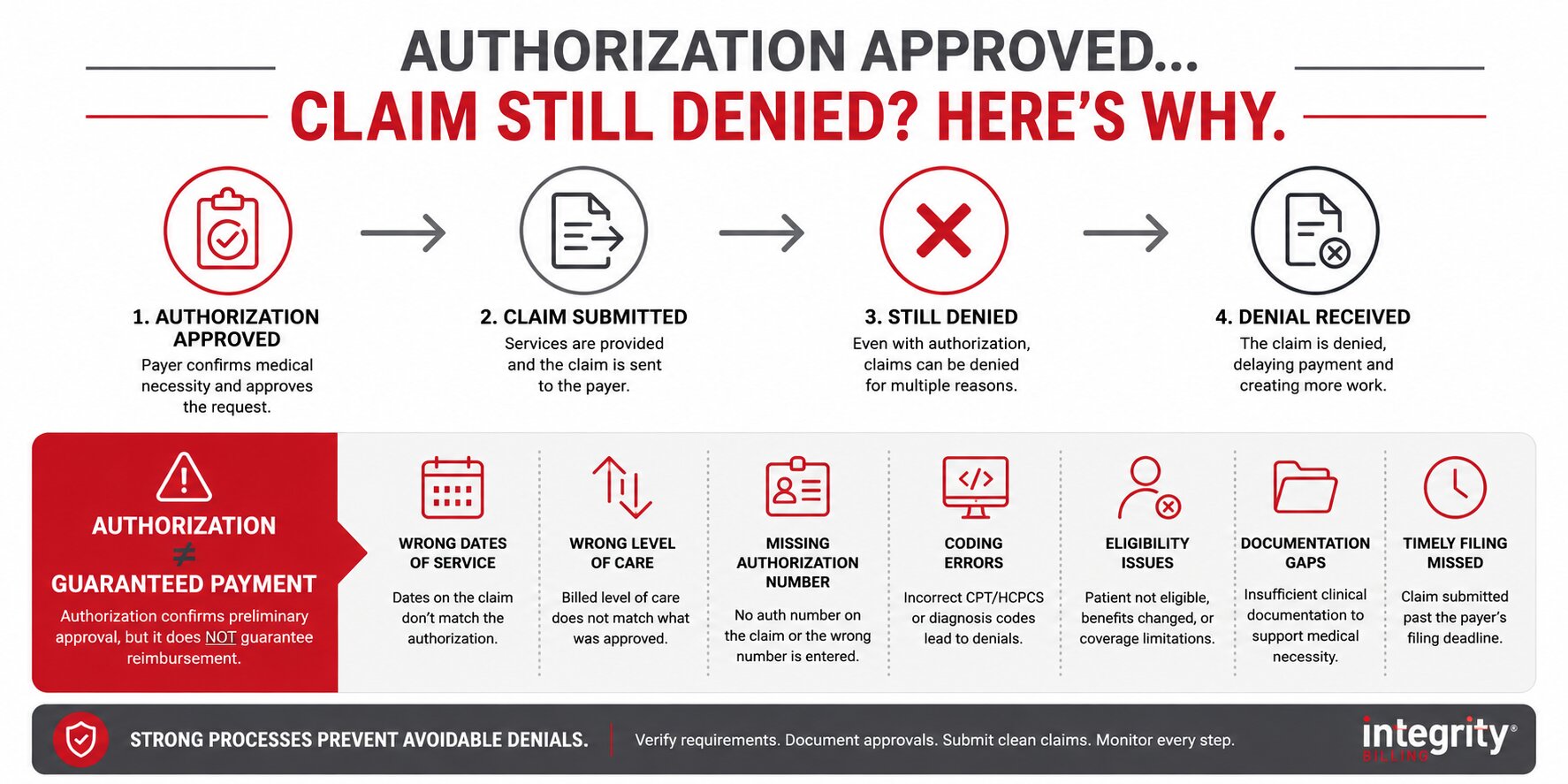
One critical point: preauthorization does not guarantee payment. Even with an authorization in place, a claim can still be denied due to eligibility issues, coding errors, documentation gaps, benefit limitations, or missed filing deadlines. Authorization confirms the payer’s preliminary agreement, but it does not eliminate the need for clean claims and strong documentation.
What Is Precertification?
Precertification is also a payer approval process, typically used before planned services, inpatient admissions, procedures, or higher levels of care. Like preauthorization, it involves confirming that the proposed service is medically necessary and meets the payer’s requirements before care is delivered.
In practice, precertification is often associated with facility-based care, such as inpatient admissions, residential treatment, PHP, or IOP. The goal is the same as preauthorization: to establish upfront that the service aligns with the patient’s benefit plan and the payer’s medical necessity criteria.
It’s worth noting that precertification also does not guarantee final payment. The same documentation, billing and coding, and eligibility requirements still apply when the claim is submitted.
What’s the Difference Between Precertification and Preauthorization?
Preauthorization and precertification are both approval processes used by insurance payers before certain services are provided. In many cases, payers use the terms interchangeably. In others, there are subtle distinctions based on service type, setting of care, or plan structure.
Here’s a general way to think about it:
- Preauthorization tends to be used more broadly, covering services, medications, procedures, and treatment approvals across a range of settings.
- Precertification tends to be associated more specifically with planned care, facility admissions, and services where the payer wants a clinical review before treatment begins.
Term |
Simple Meaning |
Common Use |
| Preauthorization/Prior Authorization | Approval before a covered service is provided | Medications, procedures, therapy, behavioral health services, higher levels of care |
| Precertification | Confirmation before planned care or admission | Inpatient, residential, PHP, IOP, surgery, facility-based services |
| Prior Approval | Another payer term for advance approval | May be used interchangeably depending on the plan |
| Predetermination | A payer review that estimates coverage or benefits before care | Often used when coverage or payment is uncertain |
Common Problems With Preauthorization and Precertification
Even when providers make a good-faith effort to obtain the right approvals, authorization-related denials are still common. Most of them trace back to process gaps that are preventable with the right workflows in place.
These are the issues billing and utilization review teams encounter most often:
- No authorization is found in the payer’s system, even when the provider’s team believes one was secured.
- Authorization expires before services are completed or before the claim is submitted.
- Approved dates of service do not match the dates on the claim, triggering a denial even when an authorization number is present.
- Level of care approved by the payer does not match what was billed. For example, authorization was obtained for IOP, but the claim was submitted for PHP.
- Additional clinical documentation is requested after the fact, delaying the claim and creating extra work for clinical and billing teams.
- Missing authorization numbers on the claim lead to automatic denials that require correction and resubmission.
- Claims are approved upfront but later denied for a separate issue, such as a coding error, eligibility problem, or documentation gap.
- Staff assume precertification and preauthorization mean the same thing under a specific plan without confirming the payer’s requirements first.
How Providers Can Avoid Authorization-Related Denials
Most authorization-related denials are preventable when providers have a clear process in place before services begin. That starts with verifying benefits, confirming the payer’s specific approval requirements, and asking directly which process applies, whether the plan calls it preauthorization, precertification, prior approval, or something else.
Once approval is obtained, the details need to be documented carefully. This includes the authorization number, approved dates, approved service type, level of care, applicable procedure codes, and any payer-specific instructions. Clinical documentation should clearly support medical necessity, and claims should match the approved service, level of care, and date range before submission.
Tracking matters just as much as obtaining the authorization in the first place. Expiration dates, renewal deadlines, and authorization-related denial patterns should be monitored proactively so problems can be addressed before they affect reimbursement.
How a Billing and Utilization Review Team Can Help
Managing preauthorization and precertification requirements across multiple payers, plan types, and levels of care is one of the more demanding parts of running a behavioral health practice or treatment center. It requires payer knowledge, clinical coordination, documentation discipline, and consistent follow-through, all of which take time and expertise that not every provider team has in-house.
A dedicated billing and utilization review team supports providers by handling the authorization workflow from start to finish:
- Verifying patient benefits and identifying authorization requirements before services begin
- Determining what the payer calls the approval process and what documentation is required
- Submitting preauthorization and precertification requests on the provider’s behalf
- Tracking authorization numbers, approved dates, service details, and expiration deadlines
- Communicating with payers to follow up on pending approvals or respond to documentation requests
- Gathering and organizing clinical documentation to support medical necessity
- Coordinating continued stay reviews for ongoing or extended treatment
- Identifying authorization-related denial patterns and addressing root causes
- Appealing authorization-related denials with supporting clinical and administrative documentation
- Improving overall revenue cycle performance by reducing avoidable denials before they occur
Frequently Asked Questions About Precertification and Preauthorization
Are precertification and preauthorization the same thing?
They are closely related and are sometimes used interchangeably by insurance payers. Both refer to approval processes that may be required before certain services are provided. The exact meaning depends on the payer, plan, and service type.
What is the purpose of preauthorization?
The purpose of preauthorization is to confirm that the payer has reviewed the requested service before it’s provided and determined that it may meet the plan’s requirements for coverage and medical necessity.
What is the purpose of precertification?
The purpose of precertification is to review planned care before it begins, often for admissions, procedures, or higher levels of care. It helps the payer determine whether the service meets clinical and plan requirements.
Does preauthorization guarantee payment?
No. Preauthorization does not always guarantee payment. Claims can still be denied for eligibility problems, coding errors, documentation issues, benefit limits, timely filing, or services that do not match the authorization.
Who is responsible for getting preauthorization or precertification?
Responsibility can vary by payer and contract. In many provider workflows, the provider, facility, billing team, or utilization review team helps request and track approval before services are delivered.
When is preauthorization required?
Preauthorization may be required for certain procedures, medications, behavioral health services, testing, specialty care, out-of-network care, or higher levels of treatment.
When is precertification required?
Precertification may be required before planned admissions, inpatient care, residential treatment, PHP, IOP, surgery, or other services that require review before care begins.
What happens if a provider skips preauthorization or precertification?
The claim may be denied, delayed, or paid at a lower rate. In some cases, the provider may have limited appeal options if the payer required approval before the service was provided.
What information should providers document?
Providers should document the approval number, payer representative, approved service, dates of service, level of care, codes when applicable, medical necessity notes, and any payer instructions.
Partner With a Team That Understands Authorizations
Whether a payer calls it preauthorization, precertification, or prior approval, the goal is the same: ensuring the right approvals are in place before care begins. Understanding each payer’s requirements, documenting authorizations carefully, and monitoring approvals throughout treatment can help reduce preventable denials and protect your organization’s revenue. With the right processes—and the right support—providers can spend less time resolving authorization issues and more time focusing on patient care.