

The behavioral health sector has seen a significant wave of investment activity in recent years. Private equity firms, health systems, and strategic acquirers have taken a strong interest in behavioral health practices, drawn by growing demand, favorable reimbursement trends, and the essential nature of mental health and substance use services. For practice owners, that interest creates an opportunity to bring in capital, scale operations, or transition ownership.
But opportunity and readiness are two different things. When an investor or acquirer comes to the table, they bring a due diligence process that is thorough, systematic, and unforgiving of financial disorganization. The practices that navigate that process successfully are the ones that have their behavioral health RCM in order long before the first meeting.
Revenue Cycle Health Is the First Thing Investors Examine
Before anything else, investors want to understand how well the practice collects the revenue it earns. That means a close look at the full revenue cycle, from claim submission to payment posting, and the metrics that reveal how efficiently it runs.
Key indicators they will scrutinize include:
- Clean claims rate: A high rate of first-pass claim acceptance signals a well-run billing operation. A low rate raises immediate questions about documentation quality, billing and coding accuracy, and staff competency.
- Days in accounts receivable: How long does it take to collect what’s owed? A high days-in-A/R figure suggests cash flow problems, payer issues, or insufficient follow-up on outstanding claims.
- Denial rate and denial reason breakdown: Investors want to know not just how many claims are denied, but why. Patterns in denial reasons reveal systemic problems that affect long-term revenue potential.
- Collection rate: What percentage of allowable charges is the practice actually collecting? A lower-than-expected collection rate is a red flag.
A practice with strong revenue cycle metrics shows investors that it can consistently turn clinical work into collected revenue. That matters because investors are not just looking at what the numbers say today. They want to know whether that financial performance is dependable and likely to continue after the transaction closes.
Payer Mix and Contract Quality
Investors pay close attention to where a practice’s revenue comes from. A diversified payer mix is typically viewed as more stable and less vulnerable to disruption. This means not being overly reliant on a single insurance company or funding source. Heavy concentration in a single payer raises questions about what happens if that contract changes or is lost.
Beyond the mix itself, the quality of payer contracts matters. Are rates at market? Have contracts been renegotiated recently? Are there carve-outs or exclusions that limit the services that can be billed? Investors and their advisors will examine payer contracts in detail, and practices with well-maintained, competitively rated contracts are in a significantly stronger negotiating position.
Documentation and Compliance: Where Deals Get Complicated
This is often where due diligence uncovers the biggest surprises. Practices that have not been closely monitoring documentation, coding, and billing compliance can quickly find themselves in a difficult position. Investors understand the compliance risks that come with behavioral health billing. They know that poorly documented claims, services that do not clearly meet medical necessity criteria, and coding errors can create problems that last long after the transaction closes.
During due diligence, reviewers will usually compare clinical documentation against billing records. They want to see that the documentation supports the level of service billed, that medical necessity standards have been applied consistently, and that there are no patterns suggesting billing irregularities. A practice with clean, consistent documentation across its records presents a much lower risk to a potential buyer.
On the other hand, documentation gaps, inconsistent coding, or unresolved compliance questions can lower valuations, tighten deal terms, or even cause a transaction to fall apart. Compliance is not something to clean up after a letter of intent is signed. It needs to be part of the foundation long before the practice enters the transaction process.
Free Forensic Assessment
Thinking about investment, a merger, or a sale? Don’t wait for due diligence to reveal problems you could have addressed in advance. Integrity Billing offers a complimentary forensic assessment to identify revenue cycle gaps, documentation vulnerabilities, and compliance exposures before investors find them first. Contact us today to get started.
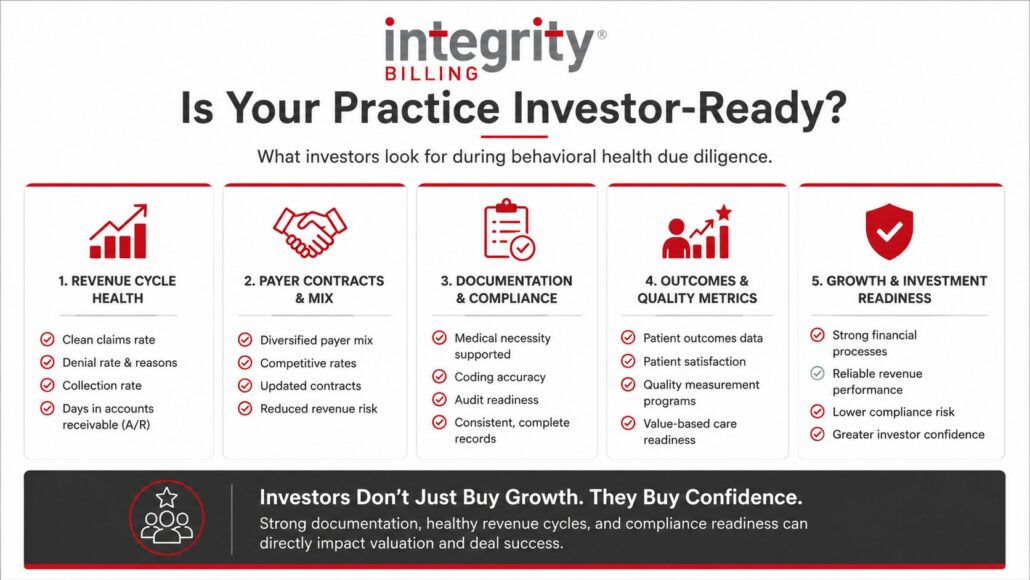
Outcomes Data and Quality Metrics
As the behavioral health sector moves further toward value-based care, investors are increasingly looking beyond traditional financial metrics to assess a practice’s long-term viability. Outcomes data, which is documented evidence that the practice’s clinical interventions produce measurable patient improvement, is becoming an important part of the due diligence conversation.
Practices that have invested in outcomes tracking, patient satisfaction measurement, and clinical quality programs have a story to tell that goes beyond the balance sheet. They can demonstrate not just that they generate revenue, but that they generate revenue by delivering care that works. In an environment where payers and regulators are placing increasing emphasis on demonstrated value, that is a competitive advantage that sophisticated investors recognize and reward.
Getting Your Practice Investment-Ready
The difference between a practice that attracts strong investment interest and one that struggles through due diligence is usually not the quality of care. In many cases, the clinical work is excellent. The issues tend to show up behind the scenes: incomplete financial processes, inconsistent documentation, compliance gaps, or revenue cycle problems that make investors less confident in what they are buying.
The good news is that these problems can be fixed, but they take time. Practices that start preparing for a potential transaction 12 to 24 months in advance are in a much stronger position than those that wait until a buyer is already at the table. Cleaning up the revenue cycle, strengthening documentation, resolving compliance concerns, and building better outcomes tracking systems all require planning. But that work can make a real difference in transaction value, negotiation strength, and the overall smoothness of the deal.
Let’s Get Your Practice Ready for What’s Next
At Integrity Billing, we work with behavioral health practices at every stage of the investment and acquisition process. We know what investors look for, where vulnerabilities often hide, and how to help practices get their financial, billing, documentation, and compliance systems in order before due diligence begins.
Whether you’re actively exploring investment opportunities or simply want to build a stronger, more resilient practice, Integrity Billing is here to help. Contact us today to learn more about how we partner with behavioral health practices to strengthen revenue cycles, sharpen documentation, and build a strong financial foundation that performs under scrutiny.