

In behavioral health billing, most people focus on the back-end of the revenue cycle, which includes claim submission, denial management, appeals, and collections. It’s understandable to focus your attention here because this is where the visible problems live. But the root cause of most of these problems doesn’t happen at the back-end. Rather, they happen on the front-end, often during patient intake before a single session has been scheduled.
Unlike back-end mistakes, front-end mistakes are quiet. They don’t trigger an immediate error message or a same-day denial. Rather, they travel through the system undetected and tend to surface at the worst possible times, such as when a claim is already in adjudication, a patient has already completed treatment, or an authorization has expired. By then, the damage is done and the options for recovery are limited.
What Does Front-End Intake Cover?
Front-end intake involves far more than collecting a patient’s name and insurance card. In behavioral health RCM, this stage sets the foundation for the entire claims process. It typically includes:
- Eligibility verification
- Benefits investigation
- Prior authorization initiation
- Patient financial responsibility review
- Demographic and insurance data collection
Each of these steps plays a direct role in whether a claim gets paid cleanly, delayed, denied, or underpaid. Because the revenue cycle is interconnected, even one missed detail at intake can create a domino effect. Incorrect insurance data, unclear benefits, missed authorization requirements, or inaccurate patient responsibility estimates can all create problems that follow the claim from submission through payment.
Breaking Down the Most Costly Front-End Mistakes
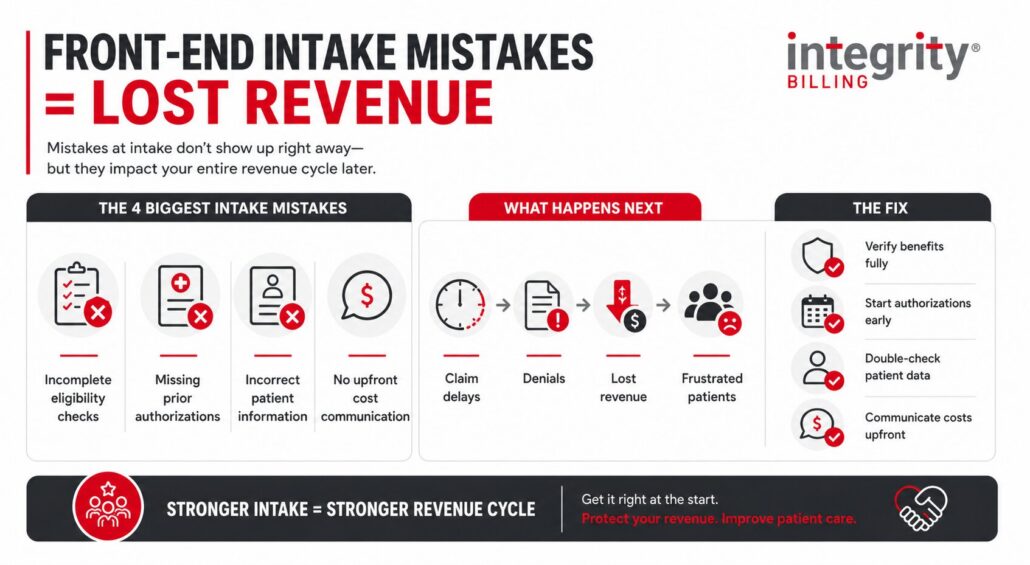
Incomplete or Inaccurate Eligible Verification
Verifying that a patient has active insurance is not the same as verifying that their plan covers behavioral health services, what their deductible and out-of-pocket costs are, whether a referral is required, and whether the specific provider and service type are in-network. Surface-level eligibility checks can easily miss one or several of these details, setting the practice up for a denial that could have been prevented.
Failure to Initiate Authorization Before the First Session
Many behavioral health services require prior authorization, such as inpatient hospitalizations, residential treatment, and psychological testing. The authorization process, including utilization review criteria that payers use to determine medical necessity, takes time. When intake staff assume authorization can be handled after the fact, or when the responsibility for initiating isn’t clearly assigned, sessions get rendered without coverage in place. This can cause revenue loss from day one.
Incorrect or Incomplete Patient Demographic Data
A transposed digit in a member ID, a misspelled name, or a missing date of birth may seem minor at first. But once that error causes a claim to be rejected at the clearinghouse level, it becomes a delay in payment. These small intake mistakes are easy to overlook on the front-end, but they can create unnecessary rework, slow down the cash flow, and disrupt the entire revenue cycle.
Failure to Communicate Patient Financial Responsibility
When patients are not informed upfront about their deductible, copay, or coinsurance obligations, collecting payment becomes much harder after care has already been provided. This creates more than a revenue problem. It can also lead to confusion, frustration, and a breakdown in trust between the patient and the practice. Clear financial conversations during intake help patients understand what to expect.
Why These Mistakes Can Be Hard to Catch
One of the biggest challenges with front-end intake errors is that the people making them are rarely the ones who have to deal with the consequences. Intake staff collect patient information, billing and coding teams submit claims, and denial management teams work the rejections. When intake, authorization, billing, and collections operate in silos, front-end mistakes often don’t get connected to back-end revenue problems until the damage has already been done.
That disconnect makes it easy for intake processes to go overlooked as a source of revenue cycle trouble. When denials increase, the first instinct is usually to look at claim submission, payer behavior, or documentation issues. Practices may not look back far enough to ask whether the eligibility check completed three weeks earlier was thorough, accurate, or properly documented. As a result, the practice keeps treating the symptoms and not the root cause.
Is your practice losing revenue to front-end intake gaps you haven’t identified yet?
Integrity Billing’s forensic assessment takes a comprehensive look at your revenue cycle from intake through collections. We pinpoint exactly where breakdowns are occurring and what they’re costing you. Request your free forensic assessment today.
What Stronger Front-End Intake Looks Like
Practices with strong behavioral health RCM do not treat intake as a simple administrative step—they treat it as the foundation for the entire revenue cycle. That starts with standardized eligibility verification protocols that look beyond whether coverage is active. It also requires clear ownership of authorization initiation, timelines that align with the appointment schedule, and open communication between intake and billing.
Strong intake processes also include regular audits of data quality. A practice should not have to wait for a denial to discover that something went wrong at the front-end six weeks earlier. In behavioral health billing, the practices that perform best financially are often the ones that invest the most effort into getting intake right the first time.
Integrity Billing Fixes the Full Revenue Cycle, Starting at the Front End
A billing partner that only works denials is only solving half the problem. At Integrity Billing, we address behavioral health RCM from intake to collections, identifying the front-end gaps that are generating your back-end problems and building the processes to close them. If your denial rate is climbing or your collections are inconsistent, the answer may be earlier in the cycle than you think. Contact us today to learn more at 888-368-7461 or fill out our contact form and someone from our team will reach out to you!