

If you’ve recently outsourced your behavioral health billing, or you’re considering it, one of the first questions on your mind is probably: how long before this actually pays off? While each facility is different, most start to see results faster than they expect. That’s because strong billing partners tend to identify problems quickly, communicate what’s happening, and improve your revenue cycle.
Understanding what drives ROI and what a reasonable timeline looks like can help you set the right expectations and make a confident decision about outsourcing.
The Challenges of In-House Billing
Before we discuss ROI timelines, it’s important to know what many behavioral health and mental health treatment facilities are working against when they manage their billing internally. Staffing, training, software licensing, claim errors, denials left unworked, and the endless complexity of insurance verification and authorization all require time and money. When these issues fall through the cracks, they can compound over time and leave significant revenue on the table.
Mental health billing and coding is a specialized discipline. Payers apply different rules to behavioral health claims than they do medical claims, and the margin for error is narrow. A single coding mistake can trigger a denial, while an authorization that wasn’t properly obtained can result in a write-off. When your internal team is stretched thin, these gaps often go unnoticed until an audit is done or a cash flow problem shows up.
What Changes When You Outsource
When you partner with a qualified behavioral health billing company, you’re not only offloading administrative work but also plugging into a team whose entire focus is maximizing your reimbursement. This means that you’ll see faster claim submission, cleaner claims with lower denial rates, aggressive follow-up on unpaid balances, and billing and coding expertise that keeps pace with payer policy changes so your team doesn’t have to.
You also gain access to utilization review support, which is a critical piece of the revenue cycle that directly affects whether your services get authorized and paid. Utilization review done well means fewer interrupted authorizations, fewer unexpected denials mid-treatment, and more predictable revenue across your programs. For facilities running residential, PHP, IOP, or outpatient levels of care, this can be the key to a thriving revenue cycle.
From Onboarding to Results: A 90-Day Snapshot
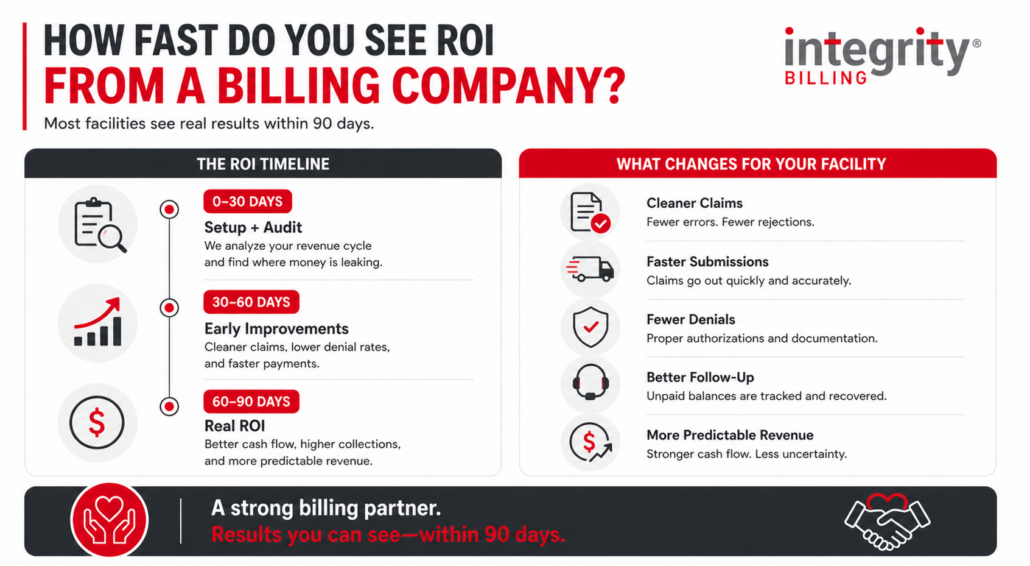
Here’s what a realistic ROI timeline looks like for most mental health and behavioral health treatment facilities:
Days 1 to 30: Setup and Assessment
The first month is about making a successful transition. It involves auditing your current claims, identifying outstanding balances, correcting credentialing issues, and establishing clean billing workflows. You may not see a dramatic revenue spike yet, but a good billing partner will tell you exactly where your money has been leaking.
Days 30 to 60: Early Wins
By the second month, cleaner claims begin moving through the system faster. Denial rates start to drop. Aging accounts receivable begin to be worked systematically, often recovering revenue that had been sitting untouched. Many facilities begin to see measurable improvement in their collection rates during this window.
Days 60 to 90: Sustained Impact
By the end of the third month, the full picture comes into focus. Reimbursement rates improve, cash flow becomes more consistent, and the administrative burden on your internal team drops significantly. For most facilities, the ROI by this point is not only visible but substantial.
Success Depends on What You Know Before You Start
One of the most important things a behavioral health billing company can do before any engagement begins is give you an honest picture of where your current revenue cycle stands. Are claims being filed correctly? Are denials being appealed? Is your team keeping up with payer-specific billing and coding requirements? Are authorizations being managed proactively through utilization review?
If you don’t know the answers to these questions, a free forensic billing assessment is the fastest way to find out. It shows you the gaps, quantifies the losses, and gives you a clear baseline so that when you do outsource, you know exactly what you’re solving for and can measure the results accurately.
Outsourcing Billing Is a Smart Revenue Strategy
For mental health and behavioral health treatment facility leaders, the decision to outsource billing is ultimately a business decision, which data consistently supports. Less administrative overhead, fewer claim errors, lower denial rates, better utilization review outcomes, and a team of specialists working your revenue cycle every day. The ROI is real, it comes faster than most expect, and it compounds over time.
The better question isn’t if outsourcing will deliver returns. It’s how much revenue are you leaving on the table by waiting? Contact Integrity Billing today at 888-368-7461 or fill out our contact form to learn more about our comprehensive behavioral health RCM services.