

Billing is never simple in healthcare, but when you compare traditional medical billing to behavioral health billing, the differences are significant. While both fields require accuracy, compliance, and attention to detail, behavioral health billing brings an entirely different level of complexity to the table due to unique documentation rules, fluctuating payer requirements, and the clinical nature of the services provided.
Understanding the differences between these two billing processes can help you set realistic expectations and highlight the value of partnering with a behavioral health billing company like Integrity Billing. Let’s explore why behavioral health billing is not only different from general medical billing, but also significantly more complex.
Behavioral Health Services Are Highly Individualized
In traditional medical billing, services are typically straightforward: an office visit, a diagnostic test, a procedure, or a defined follow-up. These services often have clear CPT codes and predictable documentation requirements.
Behavioral health, however, looks very different. Services may include:
- Individual therapy
- Family or group therapy
- Residential treatment
- Partial hospitalization
- Intensive outpatient programs
- Medication management
These sessions vary widely in length, frequency, and content. Because treatment is personalized, payers often require more detailed documentation to support medical necessity, including progress notes, treatment plans, assessments, and outcomes. If any detail is missing, misstated, or outdated, reimbursement is delayed or denied.
Medical Necessity Requirements Are More Subjective
In medical billing, diagnostic criteria and treatment recommendations tend to be well-defined. A test result, a blood pressure reading, or a physical exam can directly support medical necessity.
In behavioral health billing, medical necessity is more subjective. Clinicians must show why a client requires a specific level of care, what symptoms justify continued treatment, and how therapy or services address clinical needs. They must also document progress to show treatment is effective.
Payers expect detailed notes, measurable goals, and ongoing evidence that the level of care is justified. Any gaps can trigger denials, not because the care wasn’t valuable, but because the documentation wasn’t precise enough.
More Frequent Authorization and Review Requirements
Most medical services require periodic authorization, but behavioral health takes this much further. Many levels of care require prior authorizations, ongoing concurrent reviews, clinical updates, session limits, and even regular reauthorization.
Payers want to closely monitor client progress, often requesting detailed clinical information every few days for higher levels of care. This is where utilization review becomes critical, as without consistent, accurate submissions, reimbursement can stall.
The intensity of these requirements is one of the biggest reasons behavioral health billing is so complex. Providers must track deadlines constantly and ensure every authorization lines up with each date of service.
Session Length and Time-Based Codes Add Complexity
Medical billing often uses flat rates or simple coding structures. Behavioral health billing is heavily tied to time. For example:
- A 30-minute session vs. a 60-minute session
- A therapy intake vs. ongoing counseling
- Add-on codes for extended therapy
- Group session time vs. individual session time
At Integrity Billing, we know that each minute matters. Even documenting “start/stop times” incorrectly can trigger denials. Payers also frequently change time-based coding rules, which makes tracking updates even more important.
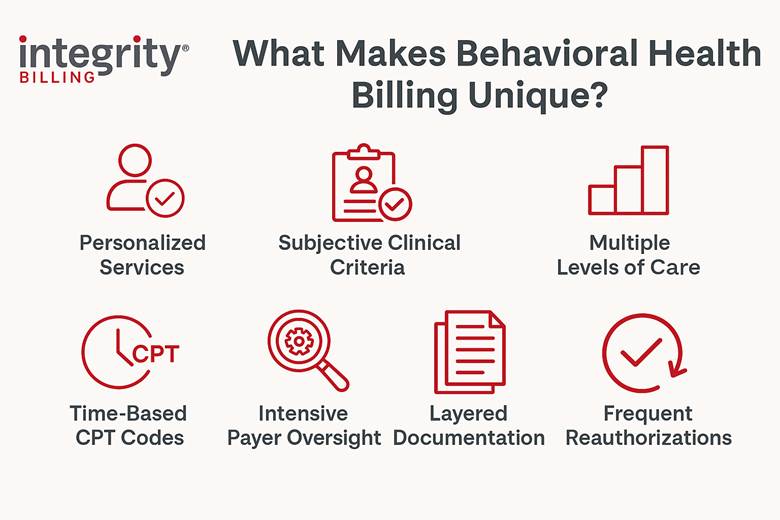
Residential and IOP/PHP Billing Requires Layered Documentation
While medical billing may include inpatient care, behavioral health residential treatment and intensive outpatient programs add several layers of complexity. These levels of care often require daily documentation, frequent treatment team reviews, and multiple services delivered on the same day, each with strict medical necessity standards.
On top of that, clinicians must navigate varied billing rules based on individual payer contracts. With so many moving parts, even a single incorrect detail can derail an entire week—or month—of claims. This is why consistent documentation and meticulous billing oversight are absolutely essential.
Payer Rules Vary Widely for Behavioral Health
Another major challenge in behavioral health billing is inconsistency. Medical billing tends to follow similar guidelines across payers, with fewer variations.
Behavioral health is a different story. Every payer may have different authorization timelines, CPT code requirements, documentation expectations, accepted levels of care, and reimbursement structures. This unpredictability requires specialized knowledge and constant adaptation.
A billing team that understands behavioral health can identify payer patterns, respond proactively, and avoid costly delays.
Credentialing Plays a Bigger Role
While credentialing is important in all healthcare fields, it can be particularly impactful in behavioral health. Because behavioral health providers often offer a wide variety of services, each clinician must be properly credentialed for each payer, at each location, and for each service type.
A single missing credential can halt reimbursement entirely. This is why many treatment centers partner with experts to help manage credentialing and keep their operations running smoothly.
Denials Are More Common
Because documentation demands are higher and medical necessity is more subjective, behavioral health sees far more denials than most medical specialties. These denials often require detailed appeal letters, corrected claims, updated documentation, and multiple rounds of follow-up.
Without a knowledgeable team, recovering this revenue becomes extremely difficult. In fact, many providers unknowingly leave significant money uncollected.
Master the Complexities of Behavioral Health Billing With Expert Help
Behavioral health billing is complex because behavioral health care itself is complex. The deeply personal nature of treatment, fluctuating payer rules, and stringent documentation demands make it far more challenging than traditional medical billing.
The good news is that with the right expertise and systems in place, treatment centers can streamline their billing processes, reduce denials, and receive more consistent, timely reimbursement. To learn more about our comprehensive billing services, contact us by phone at 888-368-7461 or fill out our online contact form.