

When a behavioral health claim comes back denied, the reason code on the explanation of benefits may seem like it should tell you exactly what went wrong. In practice, it often only tells part of the story.
That’s because denial reason codes are standardized categories built for claims processing systems. They’re not designed to give behavioral health providers a clear, detailed diagnosis of what actually needs to be fixed. A code may point to eligibility, authorization, coding, medical necessity, or documentation, but it often doesn’t explain the deeper issue behind the denial.
That gap between what a denial says and what it actually means is one of the biggest challenges in behavioral health revenue cycle management. Understanding that difference directly affects whether your team fixes the right problem or spends valuable time and resources chasing the wrong one.
Denial Codes Need a Closer Look
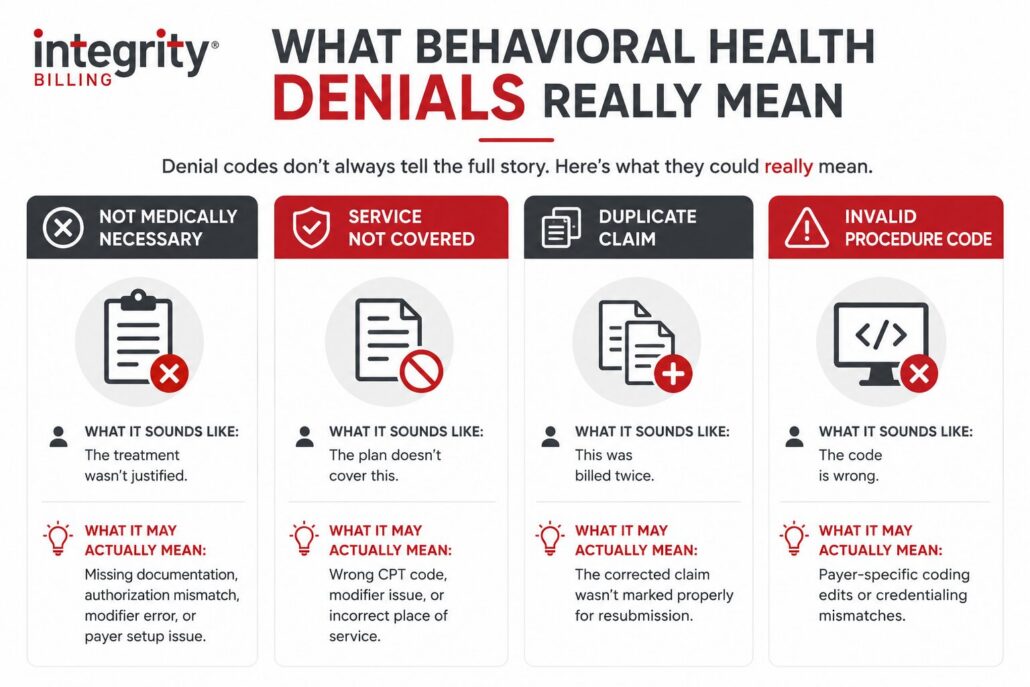
When a claim is denied with a reason code like “not medically necessary,” “service not covered,” or “invalid procedure code,” that code tells you how the denial was classified, not why the claim failed. A “not medically necessary” denial, for example, might reflect a medical necessity dispute. But it might also reflect a documentation gap, an authorization mismatch, or a credentialing issue. All of those very different problems can produce the same denial reason code.
Following the denial code alone leads practices to address the surface of the problem rather than the underlying cause. For instance, you might spend time strengthening clinical documentation for a denial that was actually caused by a mismatched modifier. Or, you might file a medical necessity appeal for a claim that was denied because the rendering provider’s NPI wasn’t linked correctly in the payer’s system.
The effort is real. The outcome is a wasted appeal and a claim that still isn’t paid.
“Not Covered” Doesn’t Always Mean Not Covered
One of the most common misleading denials in behavioral health billing is the “service not covered” denial. This code leads many practices to accept the denial at face value, assuming the client’s plan simply doesn’t cover the service. They then write the balance off without further investigation.
In many cases, that assumption is wrong. A “service not covered” denial frequently results from a billing and coding error that caused the claim to be misidentified, such as a wrong procedure code, an incorrect place of service, or a modifier that changed how the service was categorized by the payer. The service itself may be fully covered under the client’s plan. The claim just wasn’t submitted in a way that allowed the system to recognize it as such.
Medical Necessity Denials Are Frequently Appealable
“Medical necessity not established” is another denial that behavioral health practices often accept too quickly. Payers issue medical necessity denials based on an initial review of the information available to them at the time of adjudication, and that information is frequently incomplete.
A strong appeal that presents the full clinical picture overturns medical necessity denials at a higher rate. But those appeals require time, expertise, and a clear understanding of what the payer’s clinical criteria actually require. Practices that don’t have dedicated denial management resources often let these denials stand, forfeiting revenue that was earned.
If your practice is seeing a high volume of medical necessity denials and isn’t systematically appealing them, a free forensic billing assessment will quantify exactly how much revenue is sitting in that category and what a targeted appeal strategy could recover. Request yours today.
Duplicate Denials That Aren’t Actually Duplicates
A “duplicate claim” denial is another category that misleads more often than it should. When a claim is flagged as a duplicate, the instinct is to check whether the same claim was accidentally submitted twice and move on. But duplicate denials are also generated when a resubmitted claim isn’t coded correctly as a resubmission. This ends up causing the payer’s system to treat a legitimate corrected claim as a duplicate of the original denied one.
The fix isn’t to stop resubmitting. It’s to understand the specific resubmission requirements of each payer and ensure that corrected and resubmitted claims are coded in a way the payer’s system can properly recognize. This is an area where behavioral health billing expertise directly affects how much revenue is recovered.
Denials Point to Problems, But They Don’t Explain Them
The right way to read a behavioral health denial is as a starting point, not a conclusion. The reason code tells you where to begin looking. The actual cause of the denial is determined by investigating the claim, the authorization record, the clinical documentation, the credentialing file, and the payer’s specific billing requirements.
That investigation requires time, expertise, and a systematic process that most behavioral health practices don’t have the resources for. It’s exactly the kind of work a specialized behavioral health billing partner handles on your behalf—identifying the real cause of each denial, correcting it at the source, and building the processes that prevent the same issue from recurring.
At Integrity Billing, we help behavioral health practices see past the surface of their denials and get to the revenue that’s actually recoverable. If your denial rate feels higher than it should be, reach out to our team today at 888-368-7461. Let’s find out what your denials are actually telling you, and build a billing process that responds to the right information.