

Billing for outpatient therapy is complex enough on its own, but adding higher levels of care creates an entirely new level of revenue cycle complexity. That is one reason general medical billing companies often fall short in behavioral health. Many behavioral health organizations provide multiple levels of care, including Partial Hospitalization Programs (PHP), Intensive Outpatient Programs (IOP), and Residential Treatment Centers (RTC), and each one comes with its own billing requirements.
These programs serve some of the most vulnerable patients in the mental health system, and their care must be billed accurately and thoroughly. They also tend to generate some of the most complex claims in behavioral health billing. Understanding how a specialized billing company handles PHP, IOP, and RTC billing can make a big difference in whether a program struggles financially or has the support it needs to grow and succeed.
Why PHP, IOP, and RTC Billing Is Different
At the outpatient level, billing is relatively straightforward. A clinician provides a service, a CPT code is selected, and a claim goes out. PHP, IOP, and RTC billing doesn’t work like this.
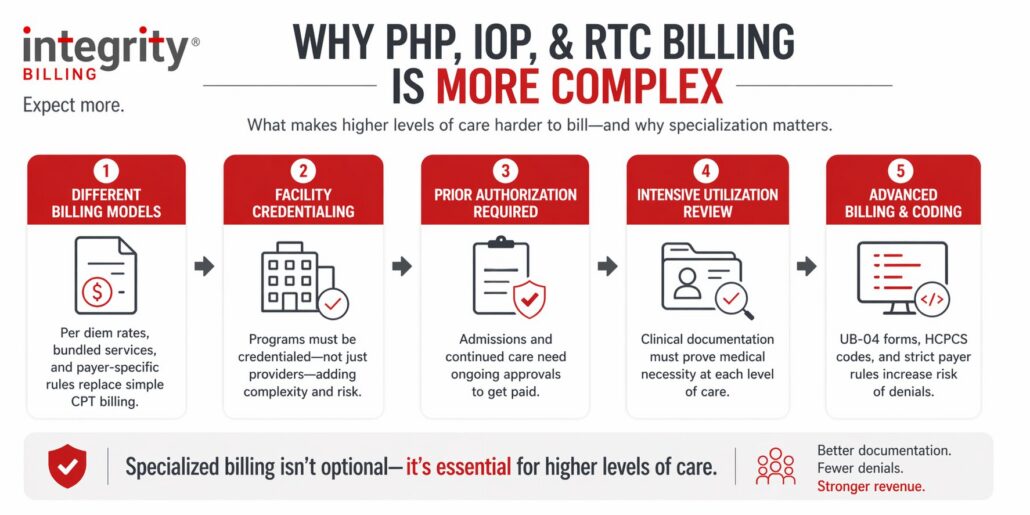
These programs bill using per diem rates, daily service codes, and bundled billing structures that require a precise understanding of what each payer considers billable within a specific level of care. For instance, a PHP claim might include a daily rate that bundles group therapy, individual sessions, and case management, but only if the documentation supports every component and the payer’s criteria for medical necessity are met.
Each payer also defines these levels of care differently. What one insurer considers a qualifying PHP day, another may classify as a lower level of care and deny accordingly. That is why deep, payer-specific knowledge is so important. Relying on general billing knowledge can easily lead to underbilling, overbilling, or denied claims.
Credentialing at the Program Level
Individual provider credentialing is only one part of the puzzle for PHP, IOP, and RTC programs. These facilities must also be credentialed, which is a separate and often more involved process that establishes the program itself as an in-network provider with a contracted payer.
Facility credentialing is a detailed process that may require accreditation documentation, state licensure, proof of appropriate staffing ratios, and program descriptions that align with each payer’s definitions for the level of care being offered. A lapse in facility credentialing can lead to widespread claim denials across multiple payers at once. For some organizations, that kind of disruption can be financially devastating.
A specialized behavioral health billing company helps manage both provider and facility credentialing, tracks renewal timelines, and works to ensure each payer relationship is properly maintained before claims are ever submitted.
Authorization, Utilization Review, and Level of Care Justification
No area of behavioral health billing requires more hands-on expertise than authorization and utilization review. PHP, IOP, and RTC admissions almost always require prior authorization. Continued stay authorizations must also be obtained on a regular basis to continue receiving treatment.
Utilization review for these programs involves submitting clinical documentation that demonstrates medical necessity at each level of care, using the payer’s own criteria. Reviewers look for evidence that the patient requires the intensity of the services being provided. When that documentation is incomplete, poorly organized, or doesn’t speak the right clinical language, reviewers might assume that a lower level of care is adequate and deny the claim.
A specialized billing team works closely with clinical staff to ensure that documentation is thorough, timely, and structured in a way that satisfies the payer. This reduces denials, supports appeals, and avoids gaps in treatment.
Billing and Coding for Bundled and Per Diem Services
The billing and coding demands of PHP, IOP, and RTC programs are different from what’s seen in outpatient practices. The standard CMS-1500 that’s used in many billing scenarios is instead replaced with revenue codes, Healthcare Common Procedure Coding System (HCPCS) codes, and UB-04 claim forms. Additionally, per diem rates must be applied correctly, unbundling rules must be understood, and payer-specific billing guidelines must be followed precisely.
Errors in any of these areas doesn’t just produce single-claim denials, but rather can trigger payer audits, recoupment demands, and compliance reviews that put the entire program at risk.
The Right Billing Partner Makes the Difference
PHP, IOP, and RTC programs exist because some patients need more than weekly therapy. They deserve a billing operation that matches the complexity and importance of the care being delivered. A specialized behavioral health billing company brings the credentialing infrastructure, utilization review expertise, and billing and coding knowledge these programs require.
Most billing companies treat behavioral health like a subcategory. Integrity Billing was built around it. From PHP and IOP programs to solo practitioners, our team brings the specialized expertise that mental health organizations need to get paid accurately, compliantly, and on time. Contact us today for a free forensic assessment and find out exactly where your revenue cycle stands.