

If you’ve ever started the credentialing process with an insurance payer, you know it can feel like submitting paperwork into a black hole. Weeks turn into months, follow-up calls lead nowhere, and meanwhile, you’re seeing patients but can’t bill their insurance for your services.
Credentialing delays are frustrating, but they’re also costly in ways that extend far beyond the obvious. For behavioral health practices especially, where margins can be tight and patient volume is critical, credentialing bottlenecks can seriously impact your bottom line and your ability to grow your practice.
Let’s talk about the real costs of credentialing delays and why getting this process right from the start matters so much for your practice’s financial health.
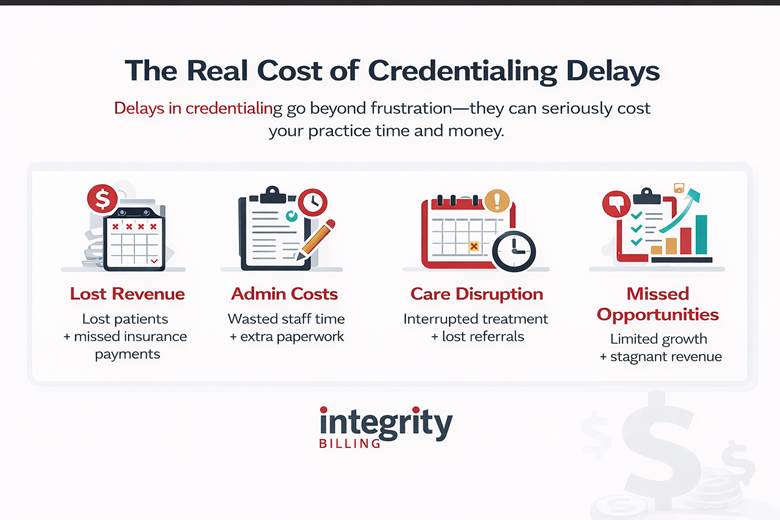
The Most Obvious Cost: Lost Revenue
The most immediate impact of credentialing delays is straightforward—you can’t bill insurance for services you’re providing, which means you’re either working for free or asking patients to pay out of pocket until credentialing is complete.
For many behavioral health patients, out-of-pocket payment isn’t an option. They rely on their insurance coverage to make treatment affordable. If you’re not yet credentialed with their insurance plan, they might choose to see a different provider who is already in-network, or they might delay treatment altogether.
Even if patients agree to pay out of pocket temporarily with the understanding that you’ll submit claims retroactively once credentialed, there’s no guarantee the insurance company will reimburse for services provided before your effective credentialing date. Some payers do allow retroactive billing within certain timeframes, but others don’t, leaving you to absorb those costs entirely.
When you consider that the average credentialing process takes 90 to 120 days (and sometimes much longer), that’s three to four months of potential revenue sitting in limbo. For a solo practitioner or small group practice, that can create serious cash flow problems.
Administrative Time and Resources
Credentialing isn’t a “set it and forget it” process. It requires meticulous attention to detail, constant follow-up, and a deep understanding of each payer’s specific requirements.
Every hour your administrative staff spends chasing down credentialing applications, resubmitting incomplete paperwork, or trying to get status updates from insurance companies is time they’re not spending on other revenue-generating activities like billing and coding, patient scheduling, or managing accounts receivable.
If you’re handling credentialing in-house without dedicated expertise, mistakes are common. A single missing document, an incorrect form version, or a small error in your application can send you back to square one, adding weeks or months to an already lengthy process.
The cost of these delays isn’t just the direct revenue you’re missing—it’s also the salary and resources you’re paying to staff who are spinning their wheels trying to navigate a complicated, bureaucratic process.
Impact on Patient Care and Retention
Here’s something that doesn’t always show up on a balance sheet but absolutely affects your practice: credentialing delays can disrupt patient care and damage your reputation.
Imagine a patient who’s finally ready to seek help for anxiety, depression, or substance use. They find your practice, connect with you during an initial consultation, and are ready to begin treatment. Then they find out you’re not yet credentialed with their insurance, and they’ll either need to pay hundreds of dollars per session out of pocket or wait several months to start treatment.
Many patients will choose to find another provider rather than wait or pay out of pocket. You’ve lost not just that immediate revenue, but potentially years of ongoing care for that patient—and any referrals they might have made to friends or family members.
For behavioral health practices, continuity of care is especially important. Delays caused by credentialing issues can interrupt treatment momentum, damage therapeutic relationships, and ultimately lead to worse outcomes for patients.
Challenges Specific to Behavioral Health Billing
Behavioral health billing already comes with its own set of challenges. Claims are frequently denied due to medical necessity questions, prior authorization requirements, and complex billing and coding rules that vary by payer and by state.
When you add credentialing delays on top of these existing challenges, you’re compounding the problem. You might finally get credentialed, only to discover that your claims are being denied because of errors in how services were coded or billed, or because you weren’t aware of specific documentation requirements for that payer.
Effective credentialing needs to be paired with solid knowledge of behavioral health billing and coding practices. Otherwise, you’re trading one bottleneck for another—you’ll be credentialed but still not getting paid because your claims aren’t being submitted correctly.
Opportunity Costs
Every month you’re delayed in credentialing is a month you can’t fully grow your practice. You might have to turn away patients with certain insurance plans. You might delay hiring additional clinicians because you’re not generating enough revenue to support expanded staff. You might miss out on contracts or partnerships with other healthcare organizations that require you to be credentialed with specific payers.
These opportunity costs are harder to quantify but just as real. Credentialing delays don’t just affect your current revenue—they limit your practice’s potential for growth and expansion.
How to Minimize Credentialing Delays
While some delays are inevitable given the complexity of the process, there are steps you can take to minimize them:
Start the credentialing process as early as possible, ideally several months before you need to begin billing. Make sure all your documentation is complete, accurate, and up to date before submitting applications. Familiarize yourself with each payer’s specific requirements—they’re not all the same. Follow up regularly and keep detailed records of every interaction with payer credentialing departments.
Better yet, work with a billing partner who specializes in behavioral health billing and has dedicated credentialing expertise. They know the process inside and out, have established relationships with payer representatives, and can navigate roadblocks much more efficiently than someone doing it for the first time.
Wondering how credentialing delays might be impacting your practice’s revenue? Fill out our form to request a free forensic assessment. We’ll analyze your current credentialing process, identify bottlenecks and missed opportunities, and show you exactly where you could be saving time and money—with no obligation.
Get Credentialing Right From the Start
Credentialing delays are costly, frustrating, and entirely avoidable with the right expertise and proactive approach. Your time is better spent seeing patients and growing your practice, not chasing down paperwork and navigating insurance bureaucracy.
At Integrity Billing, we specialize in behavioral health billing and credentialing services that keep your revenue flowing and your practice running smoothly. Our team handles the entire credentialing process from start to finish, ensuring accuracy, speed, and ongoing compliance with payer requirements. Don’t let credentialing delays cost you another month of revenue.
Contact Integrity Billing today at 888-368-7461 to learn how we can streamline your credentialing and take the administrative burden off your plate.