

Here’s a frustrating truth about behavioral health billing: most facilities are losing money they’ve already earned. Not because they’re doing anything wrong clinically, and not because they’re running a bad operation, but because somewhere in the revenue cycle, money is quietly slipping out through gaps that nobody has had the time or bandwidth to track down and close.
Behavioral health RCM (revenue cycle management) is genuinely complex, and the leaks aren’t always obvious. But they’re almost always fixable. Here are the seven most common places we see revenue walking out the door and what to do about each one.
1. Credentialing Gaps You Don’t Know About
If a provider is rendering services before their credentialing is active with a payer, those claims aren’t getting paid—period. And in behavioral health, where clinical staff turnover is high and provider rosters change frequently, credentialing gaps are more common than most facility managers realize.
The fix: Build a credentialing tracker that maps every provider to every relevant payer, with renewal dates flagged well in advance. New providers should have credentialing initiated on day one and not after they’ve already started seeing patients. Partnering with a behavioral health billing specialist who manages credentialing as part of a complete revenue cycle solution is the most reliable way to keep this airtight.
2. Lapsed Authorizations and Missed Continued Stay Reviews
Authorization management is ongoing. Payers don’t automatically extend authorizations—they need to be requested, tracked, and renewed throughout the course of treatment. When an authorization lapses, even briefly, every claim tied to that gap is at risk. And retroactive authorizations? Payers are not particularly sympathetic about those.
The fix: Strong utilization review practices are the answer here. That means proactively managing authorization timelines, submitting continued stay reviews before existing authorizations expire, and documenting clinical progress in the specific language payers want to see. A robust utilization review process doesn’t just protect revenue but also keeps your facility audit-ready at all times.
3. Incorrect Level of Care Coding
The difference between billing PHP and IOP, or between residential and outpatient, isn’t just a technicality. These distinctions carry significantly different reimbursement rates and very different documentation requirements. Getting level of care wrong in either direction costs money: undercoding leaves reimbursement on the table, and overcoding invites audits and takebacks.
The fix: Billing and coding in behavioral health requires people who know the specific code sets, documentation standards, and payer expectations for each level of care. This isn’t a job for a generalist. Make sure whoever is handling your behavioral health billing and coding has deep, current knowledge of how each level of care needs to be built and documented before claims go out.
4. Inadequate Medical Necessity Documentation
Payers scrutinize behavioral health claims carefully, and medical necessity is their primary tool for denial. Claims that don’t include the right clinical language, the right assessment tools, or sufficient detail to justify the level of care being billed get denied, even when the underlying clinical record clearly supports the treatment being provided.
The fix: Medical necessity documentation needs to be built into your clinical workflow, not retrofitted after the fact. That means training clinical staff on what documentation payers are actually looking for, using standardized assessment tools consistently, and having someone review claims for documentation completeness before submission.
5. Timely Filing Denials
This one is purely administrative, but it’s surprisingly common, especially in facilities where billing backlogs develop. Every payer has a timely filing window, and once that window closes, the claim is gone regardless of how clinically solid it is. There’s no appeal that gets you paid on a timely filing denial.
The fix: Claims need to go out fast and consistently. If your billing team is running behind due to staffing, software issues, or just volume, that’s a revenue problem, not just an operational one. Identifying and clearing backlogs quickly, and building processes that prevent them from developing, is a straightforward fix with immediate revenue impact.
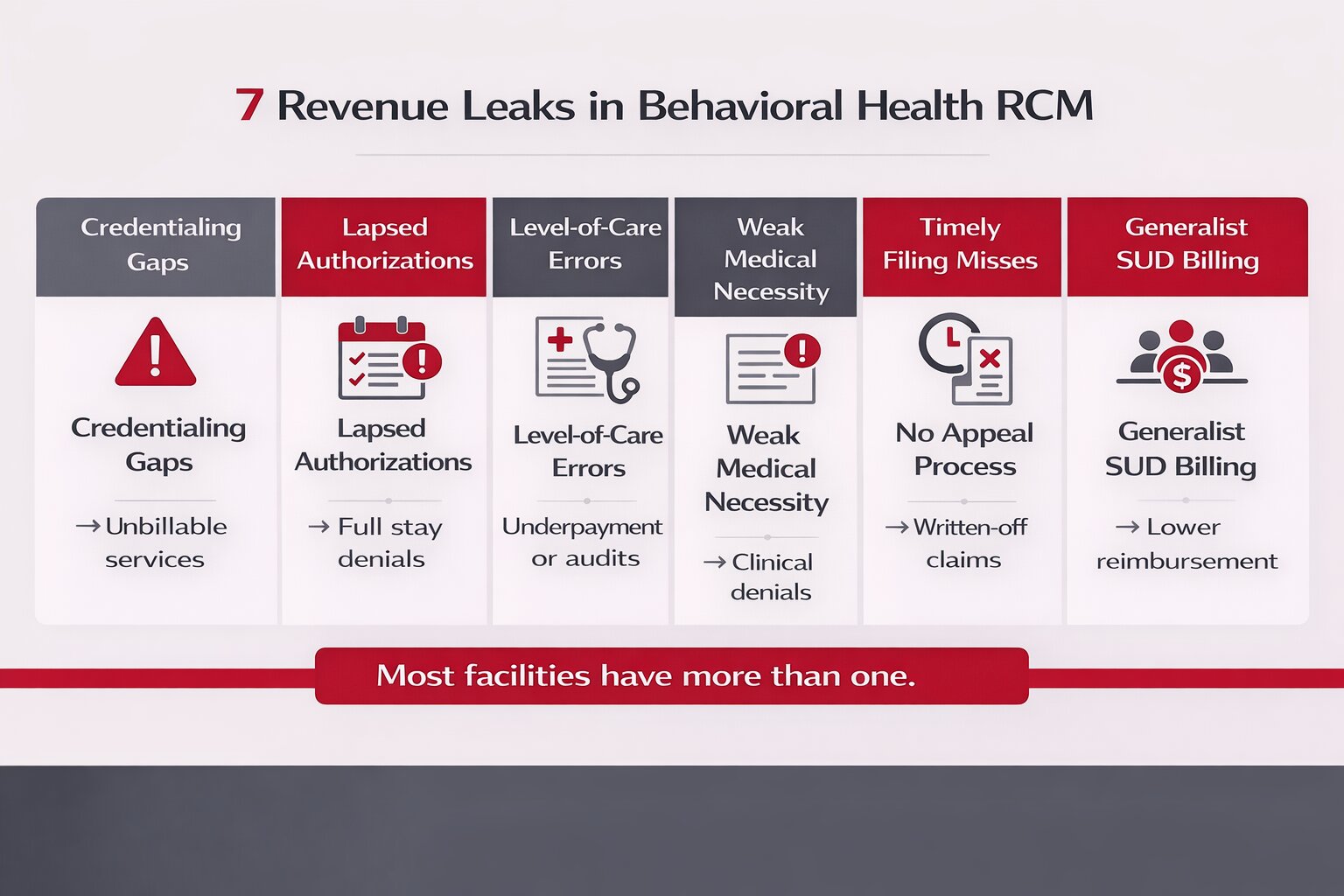
6. Failing to Appeal Denied Claims
Denials are not final, but a surprising number of facilities treat them that way. Claims get denied, they get written off, and the revenue disappears. In behavioral health billing, where denial rates tend to run higher than in general medical billing, that’s a significant amount of money being left behind.
The fix: Every denial deserves a second look. Build a denial management process that categorizes denials by reason, prioritizes appeals by dollar amount, and tracks outcomes. Many behavioral health denials are successfully overturned on appeal when the right documentation and clinical language is included. Don’t leave that money on the table without a fight.
7. Substance Use Billing Handled Like General Medical Billing
Substance use billing has its own specific coding requirements, documentation standards, and payer nuances that are distinct even from mental health billing. Facilities that apply general behavioral health billing practices to their substance use disorder programs consistently underperform on reimbursement for those services.
The fix: Substance use billing needs to be handled by people who specialize in it. The codes are different, the documentation requirements are different, and the payer landscape is different. If your SUD program isn’t getting reimbursed at the rates you’d expect, that’s often the first place to look.
Wondering How Many of These Are Affecting Your Facility?
The honest answer is that most behavioral health facilities are dealing with at least a few of these leaks at any given time, and most don’t have a clear picture of how much they’re costing. That’s exactly what a free forensic assessment from Integrity Billing is designed to uncover. We’ll dig into your claims history, billing and coding practices, utilization review processes, and credentialing status and give you a clear, specific picture of where your revenue is going.
At Integrity Billing, behavioral health RCM is all we do—mental health practices, substance use disorder treatment, and everything across the continuum of care. We know where the leaks are because we’ve seen them all, and we know how to close them. Contact our team today at 888-368-7461 or fill out our contact form and let’s talk about getting your revenue cycle working the way it should.