

Running a treatment center is complicated enough. Between managing clinical staff, maintaining compliance, navigating licensing, and actually delivering quality care to patients—the last thing you want is to lose sleep over whether your billing operation is working the way it should. Yet for many facility leaders, behavioral health billing is exactly the thing keeping them up at night.
Revenue cycle problems don’t always announce themselves. Sometimes they show up as a slowly rising denial rate. Other times it’s a cash flow gap you can’t quite explain. It can even just be the nagging feeling that you’re leaving money on the table. The question of whether to manage billing internally or outsource it is worth examining carefully, because the structure you choose has a direct impact on your reimbursement, staff capacity, and ability to sustain and grow your programs.
Let’s break it all down so that you can get the full picture on whether to choose in-house or outsourced behavioral health billing.
Keeping Billing In-House: The Pros and Cons
There are real advantages to managing your revenue cycle internally, and for some facilities, in-house billing is the right call. It may not be this way forever, but it could be for the time being.
The biggest argument for in-house billing is proximity. Your billing staff is right there, in the building (or at least on your team’s Slack). They can walk down the hall to ask a clinician about a note, flag a credentialing issue before it becomes a denial, and develop deep institutional knowledge about your payers, your programs, and your patient population.
In-house billing also gives facility leaders a sense of direct control. You can see exactly what’s happening in real time, set priorities, and course-correct quickly when something’s off. For leaders who like visibility into every part of their operation, this can be reassuring.
At Integrity Billing, we generally see in-house billing work well when:
- Your facility has sufficient volume to justify full-time billing staff
- You have access to experienced behavioral health billing specialists and not just general medical billers
- You’ve invested in robust practice management software and staff training
- Leadership has the bandwidth to oversee billing performance and hold the team accountable
- Your payer mix is relatively stable and your contracts are well-established
The Challenges of In-House Billing
Here’s where things get complicated. Behavioral health billing is not the same as general medical billing. It is a specialized discipline with its own payer quirks, authorization requirements, documentation standards, and coding rules. The learning curve is steep, and the cost of mistakes is high.
Many treatment centers build their billing teams organically, often promoting someone internally or hiring a general biller and hoping they’ll figure out the nuances of billing and coding for behavioral health along the way. That approach sometimes works. More often, it creates slow revenue leakage that’s difficult to detect until real damage is done.
Turnover is another significant challenge. When your one experienced biller leaves, they take institutional knowledge with them. Rebuilding that knowledge base takes time your revenue cycle doesn’t have. And then there’s the issue of oversight. Who is watching the billing team’s work? In many facilities, the answer is no one.
As a result, denial patterns go unaddressed, credentialing lapses slip through, and authorization workflows break down. These aren’t signs of negligence but rather signs of a system that’s under-resourced for the complexity it’s being asked to handle.
When Outsourced Behavioral Health Billing Is the Clear Winner
The word “outsourcing” can make facility leaders nervous—and understandably so. Handing over your revenue cycle to an outside company requires trust, and trust has to be earned. But when the right partner is in place, outsourced behavioral health billing can look very different from what many people imagine.
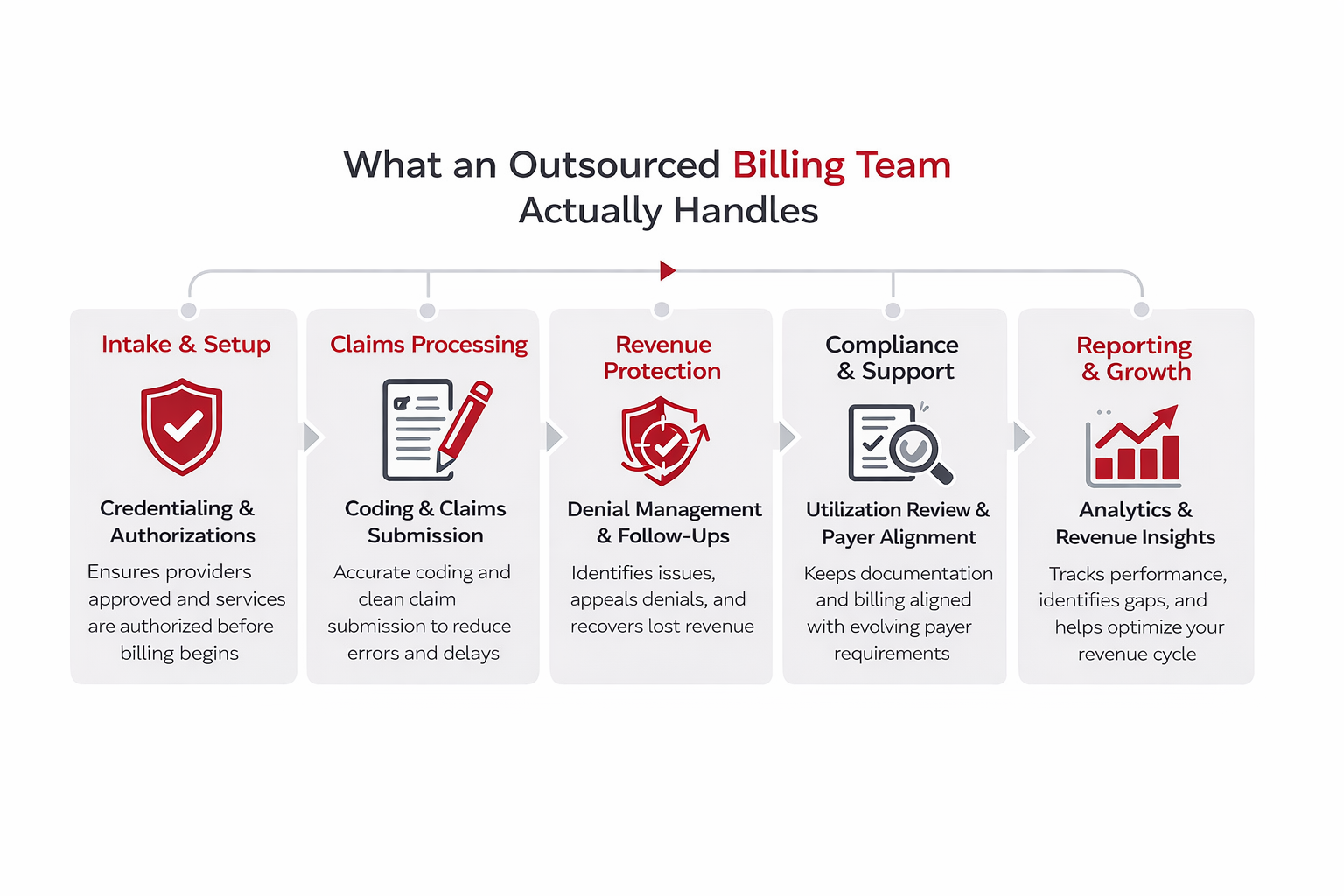
A specialized behavioral health billing company brings a team (not just one person) with expertise across billing and coding, utilization review support, denial management, and credentialing. That depth is hard to replicate in-house unless you’re running a very large facility. They also bring systems, workflows, and reporting infrastructure that most treatment centers haven’t built internally.
Good outsourced billing partners function as an extension of your team, not a replacement for communication. You should still have visibility into your key metrics, and your billing partner should be proactively surfacing problems and solutions, not just processing claims in the background.
Perhaps most importantly, a specialized partner stays current. Payer policies change. Behavioral health reimbursement rules evolve. Coding guidelines update. An in-house biller who is also managing authorizations, following up on denials, and handling patient billing inquiries simply may not have the bandwidth to stay on top of all of it. A team dedicated to nothing but behavioral health billing does.
Questions to Ask Before You Decide
Rather than prescribing a one-size-fits-all answer, here are the questions every treatment center leader should be honest about before choosing a path:
- What is our current denial rate, and do we know why? If you can’t answer this question in under a minute, that’s telling.
- How long does it take a claim to move from service to payment? Benchmarks vary, but consistent delays usually signal a process problem.
- Do we have behavioral health billing specialists, or general billers? The distinction matters tremendously in this space.
- What happens to our billing when our key biller is out sick or leaves? Fragility is a risk factor.
- Are our credentialing files current for every active provider with every contracted payer? If you’re not sure, the answer is probably no.
- Is leadership getting regular, meaningful reporting on revenue cycle performance? You can’t manage what you can’t measure.
The right structure for your facility is the one that produces consistent, accurate reimbursement while allowing your clinical and administrative teams to focus on what they do best. For some facilities, that’s a well-resourced, well-supervised internal team. For many, it’s a specialized outsourced partner who brings the depth, bandwidth, and expertise that’s difficult to build from scratch.
What it’s never okay to do is leave your revenue cycle on autopilot and hope for the best. The stakes are too high for that.
Not Sure Where Your Revenue Cycle Stands? Find Out Today.
Our free forensic billing assessment gives you a clear, honest look at how your current billing structure is performing. There is no obligation and no sales pitch, just straightforward insight into where things are working and where revenue may be slipping through the cracks.
At Integrity Billing, we specialize exclusively in behavioral health revenue cycle management because this field requires more than general billing knowledge. It takes a team that understands the documentation, payer expectations, and operational challenges unique to behavioral health.
If you are weighing your options, we would be glad to take a closer look with you. Contact us today by phone at 888-368-7461 or through our online contact form to request your free forensic assessment.