

If you’ve ever tried to apply standard medical billing logic to a behavioral health practice, you learn quickly that the two don’t line up quite the way you might expect. Maybe the codes don’t fit, payer pushback happens more often, or the documentation requirements seem to multiply overnight. It’s not your imagination—behavioral health billing really is a different beast, and understanding why can save your facility a significant amount of time, money, and frustration.
Let’s break down why behavioral health billing is more complex than traditional medical billing.
Not All Codes Are Created Equal
In traditional medical billing, you’re usually dealing with straightforward procedure codes. A patient comes in, a service is performed, and a code is submitted. The clinical picture is far more concrete—a broken bone, a lab result, or a surgical procedure.
Behavioral health doesn’t work that way.
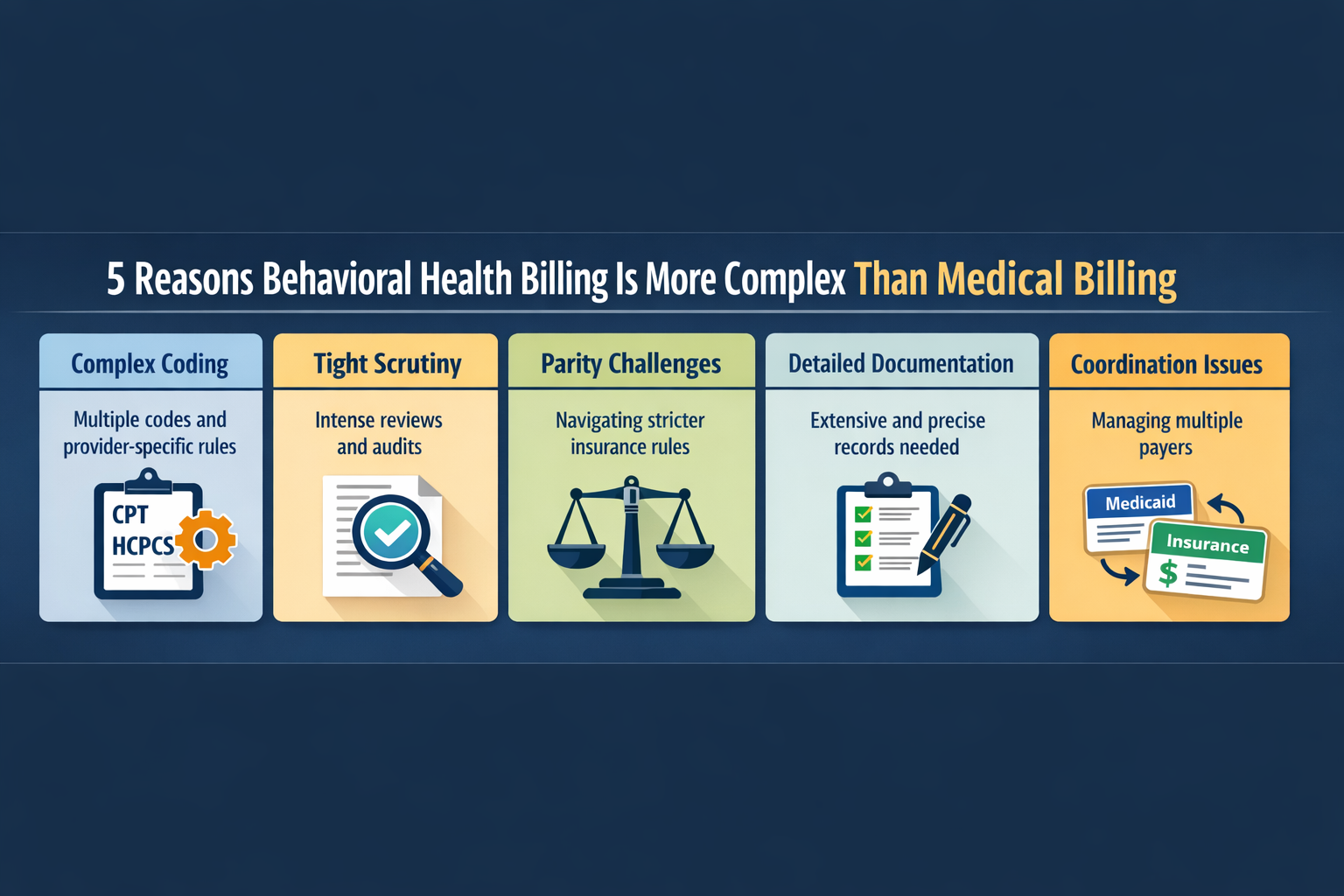
Mental health and substance use disorder services are billed using a mix of CPT codes, HCPCS codes, and in some cases, facility-specific billing structures that vary by payer. You’ve got individual therapy, group therapy, psychiatric evaluations, medication management, case management, crisis stabilization, and more. Each of those can have different billing rules depending on whether you’re a licensed clinical social worker, a psychiatrist, a counselor, or a peer support specialist.
That credentialing piece makes a huge difference. Who provides the service directly impacts how—and whether—it gets reimbursed.
Medical Necessity Gets Put Under the Microscope
In traditional medical settings, medical necessity is often tied to a clear diagnosis and a documented clinical need. Straightforward enough, right?
Behavioral health is different. Here, payers scrutinize medical necessity at a completely different level. Insurers frequently require detailed clinical documentation showing not just a diagnosis, but ongoing proof that the level of care is still appropriate. For residential treatment, partial hospitalization, or intensive outpatient programs, expect utilization reviews, concurrent reviews, and retrospective audits. In fact, all three can sometimes appear on the same claim.
If your documentation doesn’t clearly support why a patient needs that level of care right now, you’re looking at a denial. And those denials can be retroactive, meaning services already delivered go unpaid.
Parity Laws Add a Layer of Complexity
You’ve likely heard of the Mental Health Parity and Addiction Equity Act (MHPAEA). In theory, it requires insurers to cover behavioral health services at the same level as medical and surgical benefits. In practice, behavioral health facilities can spend enormous energy fighting for that parity every single day.
Payers often apply stricter prior authorization requirements, more aggressive utilization management, and more frequent claim audits to behavioral health than they would to comparable medical services. Understanding how to navigate these requirements involves specialized billing and coding expertise that most general medical billers simply don’t have.
Payers Will Comb Through Every Note You Write
Traditional medical billing documentation is already demanding, but behavioral health documentation creates added challenges. Treatment plans must remain current, progress notes need to show how the patient is responding to treatment, and discharge planning often has to begin almost from day one.
Claims can be denied when documentation is too vague, too templated, or does not clearly show clinical progress. That is why behavioral health billing requires tight coordination between clinical and billing teams. It is also one of the easiest places for revenue to quietly slip through the cracks. Many facilities have no idea how much they are losing until someone thoroughly reviews their billing history.
Multiple Payers Don’t Make Life Easier
Many behavioral health patients have dual coverage—Medicaid and a commercial plan, for example. Coordinating benefits between payers in a behavioral health context involves understanding which services each payer covers, how benefits stack, and how to sequence claims correctly. Get it wrong, and you’re either leaving money uncollected or creating compliance exposure.
Ready to See Where Your Revenue Stands?
Behavioral health billing requires specialized knowledge, specialized coders, and a deep understanding of payer behavior specific to this space. Running a facility is already a full-time job. Trying to manage complex billing without the right expertise is one of the fastest ways to see your revenue cycle quietly fall apart.
At Integrity Billing, we offer a free forensic billing assessment to help behavioral health facilities uncover lost revenue, identify billing gaps, and get a clear picture of where their claims process stands. Claim your free forensic assessment today to see where you stand. You’re here to help people heal—let us help make sure your billing process supports that mission.