

Deciding to hand your billing over to professionals is not always easy. It’s natural to want full visibility into your billing practices, but managing everything in-house can also lead to more denials, growing accounts receivable, and claim issues. For many organizations, this is the point when partnering with a mental health billing company starts to make sense. Once you make that decision, though, you may be wondering what happens next.
Hiring a billing company that specializes in mental health isn’t a magic fix but rather the beginning of a structured process designed to clean up what’s broken, optimize what’s working, and build a revenue cycle that runs efficiently in the background. As a result, you get to provide exceptional care while knowing that your facility is well supported. While each billing company may run a bit differently, here’s a general and realistic step-by-step look at what you can expect.
Week One: The Discovery Phase
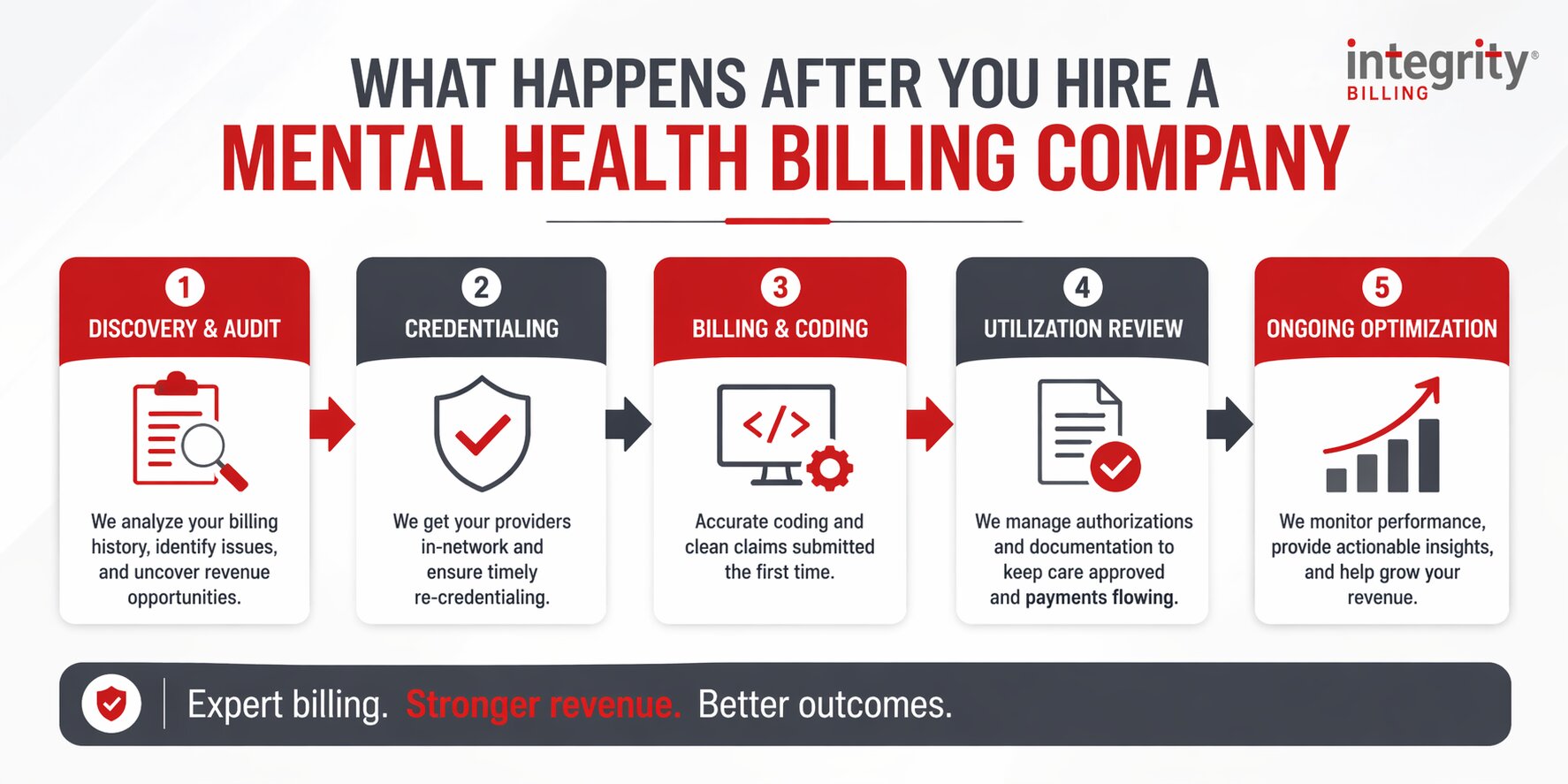
The first thing a reputable mental health billing company will do is assess where you currently stand. This often begins with a forensic assessment, which is a deep-dive review of your billing history, claims data, denial patterns, and existing payer contracts. You can think of it as a “financial physical” for your practice.
Many practice owners are surprised to learn of the hidden revenue leaks that are happening right in front of them. At Integrity Billing, it’s not uncommon for us to find claims that were submitted with incorrect modifiers, sessions that were never billed, reimbursements that came back underpaid, and payer-specific rules that were ignored. The findings from this review form the foundation of everything that follows.
Not sure if your practice is leaving revenue on the table? Integrity Billing offers a free forensic assessment to help you find out. There’s no obligation or pressure to continue. Simply fill out our contact form and we can give you better insight into your revenue cycle.
Credentialing: The Foundation You Can’t Skip
Before you can submit any claims and get paid correctly, your providers must be credentialed with insurance panels. Credentialing is a process where insurance companies verify a provider’s qualifications, licensure, malpractice history, and practice information before agreeing to reimburse their services. It’s an important step that protects everyone involved, but it can lead to unnecessary headaches if not done in a timely manner.
In fact, credentialing tends to be the most underestimated step in the entire revenue cycle. This process can take anywhere from 60 to 180 days or more, depending on the payer, and a single missing document or outdated detail can reset the clock entirely. A skilled mental health billing company manages this process end to end. They track application status, follow up with payers, and ensure your providers are in-network as quickly as possible.
Re-credentialing also needs to be monitored. Letting a credentialing deadline lapse can lead to delayed or denied payments that are extremely difficult to recover.
Billing and Coding: Getting It Right the First Time
Once credentialing is in order, the day-to-day work of billing and coding begins. This is where most practices discover that they’ve been losing money without realizing it.
Proper billing and coding in mental health requires an understanding of CPT codes specific to behavioral health, as there are specific codes for psychotherapy, evaluation and management, psychological testing, and telehealth services. Each payer has its own rules when it comes to reimbursement, documentation, and session structure. If you don’t follow them to a tee, the claims can be denied.
Fortunately, a professional mental health billing company makes sure that claims go out clean the first time. What does this look like in practice? Accurate codes, correct modifiers, proper place-of-service designations, and documentation that aligns with what was billed. Clean claims get paid faster and with far fewer denials. Over time, this can dramatically reduce the average days in accounts receivable and increase your monthly revenue.
Utilization Review: Keeping Authorizations Ahead of Care
Many payers require prior authorization before services can be rendered. Utilization review (UR) is the process where payers assess whether the services being provided are medically necessary and appropriate based on the clinical criteria of the patient. UR is not a one-time formality, either. Ongoing UR is needed to continue authorizing treatment beyond the initial approved sessions.
Missing an authorization deadline or failing to submit the right clinical documentation during UR can result in treatment being denied. A billing company with mental health expertise stays ahead of these deadlines, submits the appropriate information on time, and appeals adverse decisions when warranted.
What the Ongoing Relationship Looks Like
After the initial setup, a good mental health billing practice operates as an extension of your team. You should expect regular reporting on your key financial metrics (e.g., collection rates, denial rates, days in AR, reimbursement trends by payer) and feedback on how to improve your revenue cycle. A strong team also stays on top of changing payer policies so you remain compliant.
Integrity Billing is a leader in behavioral health billing, offering health information management, billing services, and revenue cycle management. We look forward to helping you manage your revenue cycle effectively and efficiently. Contact us today at 888-368-7461 to learn more about requesting your forensic assessment and getting a clearer picture of your practice’s financial health.