
Mental health practices are in the business of healing, but they still need to operate like a business to keep their doors open. That depends on having a financial engine that runs as smoothly as possible. Revenue cycle management (RCM) is that engine. When it works well, you barely notice it. When it breaks down, the effects show up everywhere: slow payments, rising denials, frustrated staff, and cash flow that doesn’t keep pace with the services being provided.
What many practice owners don’t realize is that these breakdowns are rarely random. They tend to happen in predictable places for predictable reasons. The good news is that this means they are often preventable once you identify where the problems are starting. Let’s take a closer look at where mental health revenue cycle management most often falls apart and what it looks like when the right systems are in place.
Credentialing Errors and Delays
Credentialing problems can derail a practice’s revenue all too quickly. When a provider isn’t properly credentialed with a payer, or when their credentialing has lapsed, claims get denied, patients get surprise bills, and you’re left trying to recover lost reimbursements.
There are a few common ways that credentialing breakdowns happen, including applications that were submitted with incomplete or outdated information, follow-ups with payers that fall through the cracks, and re-credentialing deadlines that get missed. Breakdowns can also occur when a new provider joins the practice and the credentialing timeline is not accounted for in the onboarding plan. This leaves weeks or months of services unbillable.
Strong RCM involves treating credentialing as an ongoing, proactive process rather than a one-time task. This is why it’s crucial to continuously monitor every provider’s status with every relevant payer.
Billing and Coding Mistakes That Fly Under the Radar
Billing and coding errors are another costly RCM failure in mental health, and unfortunately, they’re often invisible. A claim that goes out with the wrong CPT code, a mismatched modifier, or a place-of-service error doesn’t always get rejected from the start. Sometimes, it gets paid at a lower rate, and sometimes it sails through and creates a compliance liability down the road. In either case, your practice losses.
Mental health billing and coding carries its own complexity. Psychotherapy codes, add-on codes for extended sessions, telehealth designations, and evaluation and management codes each come with specific documentation requirements depending on the payer. A biller who isn’t deeply familiar with behavioral health specifics could make errors that build up over time. Plus, if you’re not auditing your claims regularly, you likely won’t catch them until you lose significant revenue.
This is exactly why Integrity Billing offers a free forensic assessment. This assessment identifies coding errors, underpayments, and compliance gaps before they become bigger problems. Reach out today at 888-368-7461 or fill out our contact form to schedule yours.
Authorization and Utilization Review Failures
Prior authorizations and ongoing utilization review are some of the most time-consuming and high-stakes aspects of mental health RCM. If an authorization is missed, an entire course of care may be denied. If clinical documentation submitted during utilization review does not meet a payer’s medical necessity criteria, continued treatment may no longer be approved.
In many cases, the breakdown comes down to limited bandwidth and a lack of specialized expertise. Front office staff are often juggling scheduling, phone calls, and patient check-ins, which can make it difficult to stay on top of authorization expiration dates. By the time a denial is received, the window for a timely appeal may already be closing. Strong utilization review processes are proactive, not reactive.
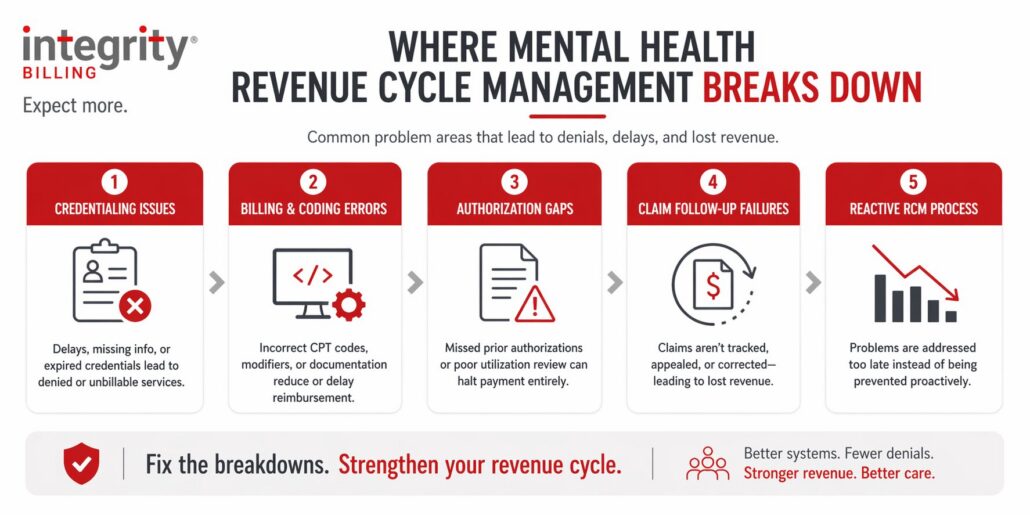
Horizontal infographic showing where mental health revenue cycle management breaks down, including credentialing issues, billing and coding errors, authorization gaps, claim follow-up failures, and reactive processes that lead to lost revenue.
Claim Follow-Up and Denial Management
Submitting a claim may feel like one of the last items on your to-do list, but in many ways, it’s only the beginning. Mental health practices often lose revenue after the claim is submitted, whether during follow-up, tracking, denial analysis, or the appeals process. When denied claims are not appealed within the payer’s deadline, they’re often written off with little understanding of what went wrong or how to prevent the same issue in the future.
Effective RCM includes a structured denial management process that involves categorizing denials by reason, identifying patterns, correcting root causes, and submitting timely appeals with the proper supporting documentation. Without these steps, the same errors are likely to continue, leading to repeated denials and ongoing revenue loss.
Discover the Real Problems Beneath the Surface
Whether your practice is experiencing breakdowns in billing and coding, credentialing, utilization review, or denial management, the underlying issue is usually the same: the revenue cycle isn’t being managed proactively—it’s being reacted to. Practices end up moving from one problem to the next without the data, processes, or expertise to get ahead of the cycle.
When you partner with a billing company that specializes in mental health, you can fix these breakdowns. But first, you need to know where the gaps are. Integrity Billing can help your practice discover where it’s losing revenue through a free forensic assessment. There’s no obligation to continue, but with this information, you can get an honest look at where your revenue cycle stands and what it could look like with the right support. Reach out to us today to learn more at 888-368-7461.