

Growth is often a good thing, but it can also create stress, especially for a behavioral health facility that’s scaling. From the outside, growth looks like success. Census is up, programs are expanding, and new staff members are being added. But cash flow is inconsistent, denials are increasing, and the billing department that once kept pace is now falling behind.
Scaling a behavioral health facility is extremely rewarding, but it’s also operationally complex. The good news is that the right support can help make that growth more sustainable. Let’s take a closer look at how your behavioral health RCM needs evolve as your facility scales and what it takes to keep moving toward your goals.
When Simple Systems Stop Being Enough
In the early days of a behavioral health facility, the revenue cycle is relatively manageable. A small billing team, limited payer mix, and modest census can typically be handled in-house. Usually one or two people manage these tasks and learn as they go. Even if the system is imperfect, it still works enough to keep the lights on.
But growth exposes every crack. As census increases and program offerings expand, the volume and complexity of claims increases exponentially. Suddenly, behavioral health facilities find themselves dealing with constantly changing payer rules, multiplying authorization requirements, and greater demands on billing, coding, and follow-up. What worked at 25 clients a month simply can’t be replicated at 100 with the current infrastructure.
The Hidden Cost of Scaling Without the Right Support
The most concerning phase of growth for behavioral health revenue cycle management is the middle stage. This is the phase where a facility is large enough for billing errors to be expensive, but not yet large enough to have invested in the systems and expertise needed to prevent them.
At this stage, billing and coding errors become systemic rather than isolated. A missed modifier, an incorrect service code, or a failure to follow payer-specific documentation requirements can trigger denials across entire claim batches. And because growing facilities are often stretched thin, those denials often sit in a queue rather than being appealed promptly.
Utilization review is another area where scaling facilities frequently fall behind. Managing authorizations proactively across a growing census and an expanding payer mix is a full-time job. When utilization review becomes reactive, the revenue impact is immediate and often unrecoverable. For facilities running multiple programs simultaneously, the compounding effect of poor utilization review management can quietly drain hundreds of thousands of dollars annually.
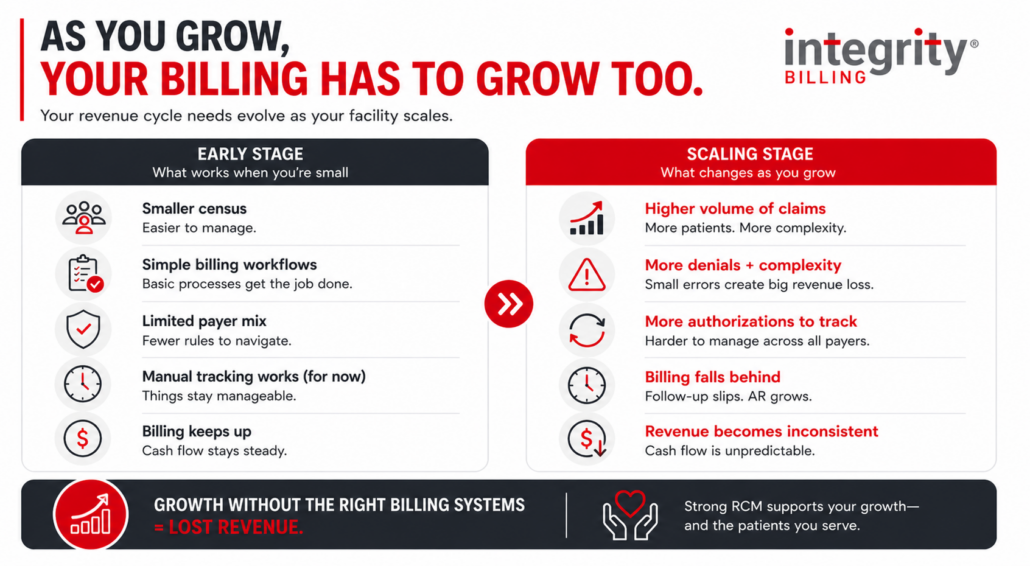
Horizontal infographic comparing early-stage and scaling behavioral health facilities, showing how simple billing systems that work for smaller census levels become overwhelmed as claim volume, denials, and authorization demands in
What a Scalable Revenue Cycle Looks Like
Facilities that scale successfully share a few common characteristics in how they manage their revenue cycle. First, they have real-time visibility into key performance metrics: denial rates, days in accounts receivable, collection rates by payer, and authorization approval rates. Second, they have consistent billing and coding processes that don’t depend on institutional knowledge held by one or two individuals. Third, they have a proactive utilization review function that stays ahead of authorization requirements.
Building this infrastructure internally is possible, but it’s expensive, time-consuming, and vulnerable to the turnover challenges in behavioral health billing departments. Experienced billers who understand the nuances of behavioral health billing are in high demand, and when they leave, the knowledge they take with them can take months to rebuild.
Outsourcing to a specialized behavioral health revenue cycle management company solves this problem at every stage of growth. The expertise, the processes, the utilization review support, and the billing and coding infrastructure are already in place and scale with your organization. You no longer have to worry about the hiring, training, and retention burden that comes with building an internal team.
Growth Should Build Revenue, Not Erode It
The facilities that grow most sustainably are the ones that treat their revenue cycle as a strategic priority. Every new program, payer contract, and level of care represents both an opportunity and a billing complexity that must be managed correctly from day one.
If your facility is in a growth phase, a free forensic billing assessment is the fastest way to understand where your revenue cycle stands today and what needs to be in place to support where you’re going. Because the cost of getting it wrong doesn’t just affect your bottom line— it affects your ability to serve the patients who need you most.