

Most behavioral health practice owners have a solid understanding of the big-picture revenue cycle: claims go out, payments come in, and denials get worked. But somewhere between the clinical side and the billing side is a process that can lead to significant revenue loss when it doesn’t get the attention it deserves: authorization tracking.
So what is authorization tracking, exactly, and why is it so important to stay on top of it? This administrative task involves monitoring, managing, and documenting approved services to ensure they match the care actually provided. When done well, authorization tracking helps prevent claim denials, payment delays, and avoidable revenue loss. But if your practice is managing this process with sticky notes, spreadsheets, and institutional memory, it’s probably not serving you well.
Let’s take a closer look at authorization tracking, why it can become one of the weakest links in behavioral health RCM, and how to keep it from falling through the cracks.
What Causes Authorizations to Break Down?
Behavioral health billing is different from medical billing in the sense that care is ongoing. A patient with depression, substance use disorder, or a history of trauma isn’t going to heal after one appointment. Instead, they’re going to come in for treatment regularly—sometimes weekly—over the course of several months or years. This means that authorizations are not a one-time task. They’re a continuous, rolling process that has to keep pace with active caseloads, changing payer requirements, and evolving treatment plans.
Most payers require prior authorization for behavioral health services and will only approve a set number of sessions at a time, often eight to twelve, before requiring a renewal. If this doesn’t happen and the practice continues to see the client, the denials can quietly pile up in the background. By the time someone catches it, you could be looking at weeks of unbillable sessions.
What Poor Authorization Tracking Can Cost You
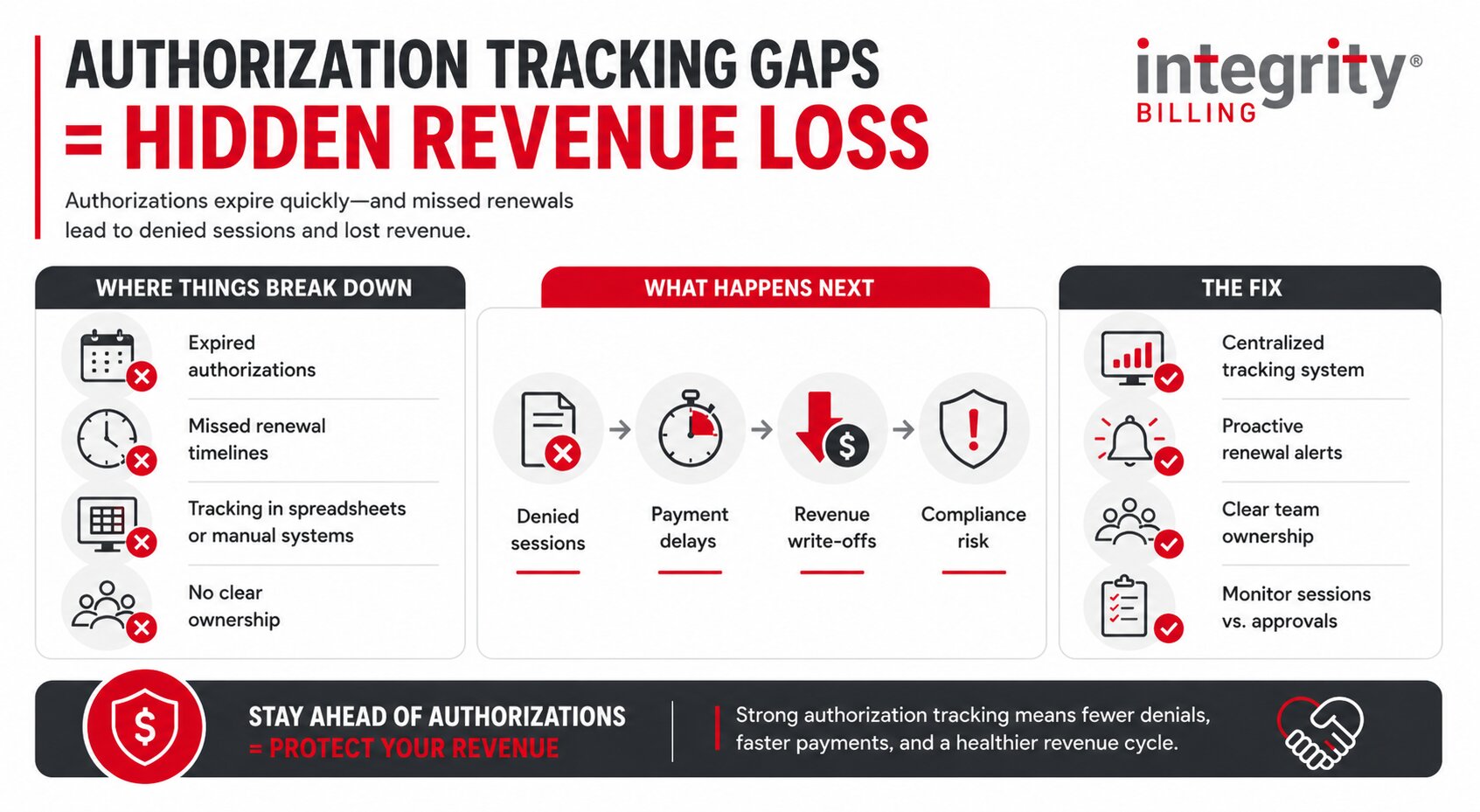
The financial impact of authorization gaps usually doesn’t show up as one large denial. More often, it appears as a pattern of smaller denials that get treated as individual claim issues rather than signs of a larger tracking problem.
What does this look like in practice? Let’s say a therapist sees a client for six sessions under an authorization that covers eight. The authorization expires, and no one catches it. In the meantime, the therapist provides two more sessions, but both claims are denied. The biller works the denials, identifies the authorization gap, and submits a retro authorization request, which the payer may or may not approve. Best case, the practice gets paid late after a significant amount of administrative effort. Worst case, those sessions are written off entirely.
When you consider how many clients a typical practice serves, and how often this type of scenario can happen, it becomes clear how quickly revenue can slip away. Beyond the direct write-offs, staff spend time working avoidable denials, cash flow slows down, and patient relationships can be strained when surprise bills arrive weeks after treatment has already been delivered.
Tracking Problems Can Also Be Compliance Problems
Authorization failures not only hurt your bottom line but also create compliance concerns. Billing for services provided without a valid authorization can trigger payer audits, recoupment demands, and in more serious cases, fraud and abuse scrutiny.
Behavioral health practices are already under heightened payer attention given the growth in utilization, the expansion of mental health parity enforcement, and increased scrutiny through utilization review process. An authorization tracking gap that looks like a billing oversight from within the practice can look very different under an audit.
This is one of the many reasons why a reactive approach won’t cut it in behavioral health billing. Catching authorization issues after a claim has been denied means your practice is forced to fight for payment on services that should have been covered from the start. Effective authorization management needs to happen before the appointment, not after the denial.
What a Strong Authorization Process Looks Like
Practices that manage authorizations well have a few things in common. First, they track authorizations in a centralized system rather than a spreadsheet. This provides visibility into session counts, expiration dates, and renewal timelines. Second, they build in proactive alerts so that renewal requests go out well before the current authorization is exhausted, not after. Third, they have clear ownership structure so that authorization management doesn’t fall through the cracks between clinical scheduling and billing teams.
For many independent and group practices, this level of infrastructure isn’t realistic to build and maintain in-house, especially if the team is small. This is where a specialized behavioral health billing partner makes all the difference. When authorization tracking is coordinated alongside billing and coding instead of treated as a side task, your practice is far less likely to lose revenue from missed approvals, expired authorizations, or preventable denials.
Let Integrity Billing Manage the Authorization Process So You Don’t Have To
At Integrity Billing, authorization tracking is a central part of how we manage billing, coding, and the broader revenue cycle for behavioral health practices. We monitor active authorizations across your caseload, initiate renewals before sessions run out, and flag issues before they become denials. This way, your clinicians can focus on care and your cash flow stays predictable.
If authorization gaps are costing your practice revenue you can’t afford to lose, it may be time to take a closer look at your process. Contact Integrity Billing today for a free forensic assessment and get a clearer picture of where revenue is being delayed, denied, or lost. From there, we can help you build a more reliable revenue cycle that supports the care your practice provides.