
Here’s a scenario that probably sounds familiar: A patient shows up ready for treatment. Your team is ready. The bed is ready. And somewhere in the middle of all that momentum, someone asks the question that can derail everything: “Did we verify their insurance?”
Insurance verification might not be the most glamorous part of running a behavioral health facility, but it might be the most important step in your entire admissions process. Get it right, and your revenue cycle starts on solid ground. Get it wrong, and you could be chasing denials for months on services you’ve already delivered.
Let’s talk about why verification matters so much in this space and what happens when it breaks down.
It’s More Than Just “Do They Have Insurance?”
A lot of facilities make the mistake of treating insurance verification as a simple yes or no question. The patient has coverage, so you’re good to go, right?
Not quite.
This is also where it helps to understand the difference between insurance verification and verification of benefits (VOB). Insurance verification confirms that a policy is active and gives you a basic snapshot of coverage. Verification of benefits goes much deeper. It looks at the actual details that affect reimbursement and patient responsibility, including:
- Deductibles
- Out-of-pocket costs
- Prior authorization requirements
- Network status
- Exclusions
- Covered levels of care
In behavioral health billing, these distinctions matter. A patient may technically have active insurance, but that does not automatically mean residential treatment, PHP, IOP, or other services will be covered the way the facility expects. That is why VOB is such an important part of the admissions process. It helps your team understand not just whether coverage exists, but how that coverage actually works in practice.
Credentialing and Verification Are Connected
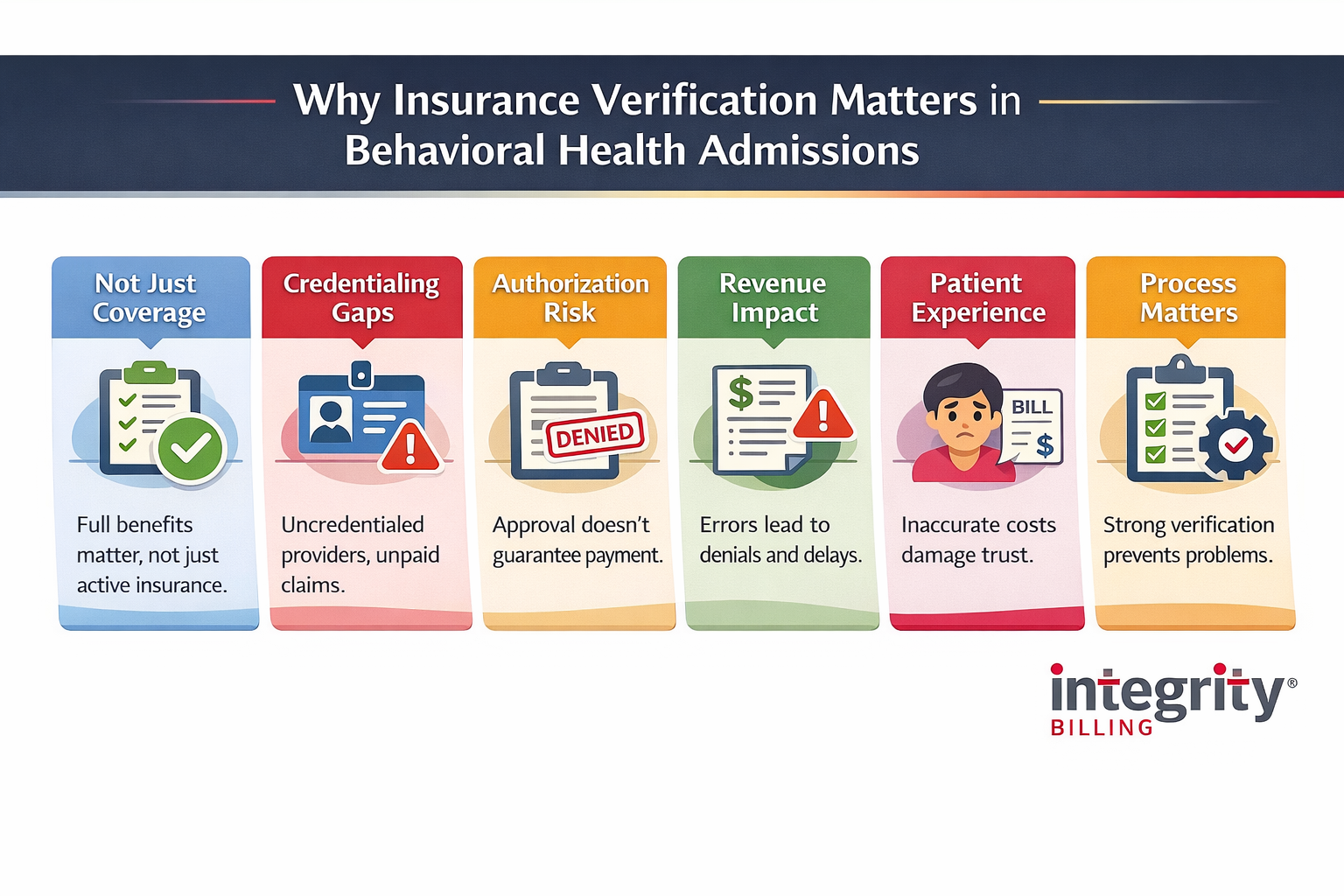
This is a piece that often gets overlooked in the admissions rush. Your facility’s credentialing status with a payer directly impacts what gets reimbursed and at what rate. If a provider on your team isn’t yet credentialed with a specific insurance plan, services they render may not be covered. This is the case even if your facility is contracted with that payer.
Credentialing gaps are one of the quieter revenue leaks in behavioral health. They don’t always show up as an obvious denial. Sometimes they show up as a reduced reimbursement, a delayed payment, or a retroactive takebacks months down the line. Verification at admissions is the moment to catch these issues.
Prior Authorization Is Not a Guarantee
Let’s clear up a common misconception: getting a prior authorization approved does not mean a claim will be paid. It means the payer has agreed that the service may be medically necessary based on the information provided at that moment.
What happens next is the utilization review process. Unfortunately, this is where facilities often run into trouble. Payers will conduct ongoing reviews throughout a patient’s stay to determine whether continued treatment at that level of care is still justified. If your clinical documentation doesn’t consistently support medical necessity, authorization can be pulled mid-stay, leaving you holding the bill for services already rendered.
Understanding this from the moment of admission changes how your team approaches documentation, communication with payers, and length-of-stay planning. Verification isn’t a one-time task but rather the beginning of an ongoing conversation with the insurance company.
When Verification Breaks Down, Everyone Pays
Poor verification practices don’t just create billing headaches. They create patient experience problems too. When a family isn’t given accurate information about their out-of-pocket costs upfront, the financial surprise at the end of treatment can damage trust and create stressful collection issues.
On the facility side, the cost of skipping or rushing verification shows up in claim denials, delayed reimbursements, and write-offs that quietly chip away at your bottom line. Strong behavioral health billing and coding practices start at the front door, and verification is the first test of whether your revenue cycle is built on a solid foundation.
What Good Verification Looks Like
Effective insurance verification in behavioral health isn’t a five-minute phone call. It’s a structured process that includes confirming benefits in writing when possible, documenting every conversation with the payer, flagging any limitations or exclusions, and looping in your billing team before admission is finalized. Taking these steps ensures that no surprises happen on the back end.
Strong verification practices also mean training your admissions staff to know what questions to ask and what answers to push back on when something doesn’t add up.
Don’t Let Admissions Be Your Weakest Link
Insurance verification is where your revenue cycle either gets set up for success or starts falling apart. In behavioral health admissions, the stakes are too high and the payer rules too complex to treat it as an afterthought. Fortunately, the right processes and the right billing partner can help turn verification into a strength rather than a vulnerability.
At Integrity Billing, we offer a free forensic billing assessment to help behavioral health facilities identify where revenue is slipping through the cracks. Whether it’s verification gaps, credentialing issues, or claims that should have been paid but weren’t, we’ll show you exactly what’s happening and what it’s costing you.
Claim your free forensic assessment today and get a comprehensive review of your entire billing system.