

Claim denials are one of the most frustrating parts of running a behavioral health practice. You’ve done everything right—delivered the care, documented the session, and submitted the claim. But then it comes back denied, with a cryptic reason code that doesn’t make it immediately obvious what went wrong or how to fix it.
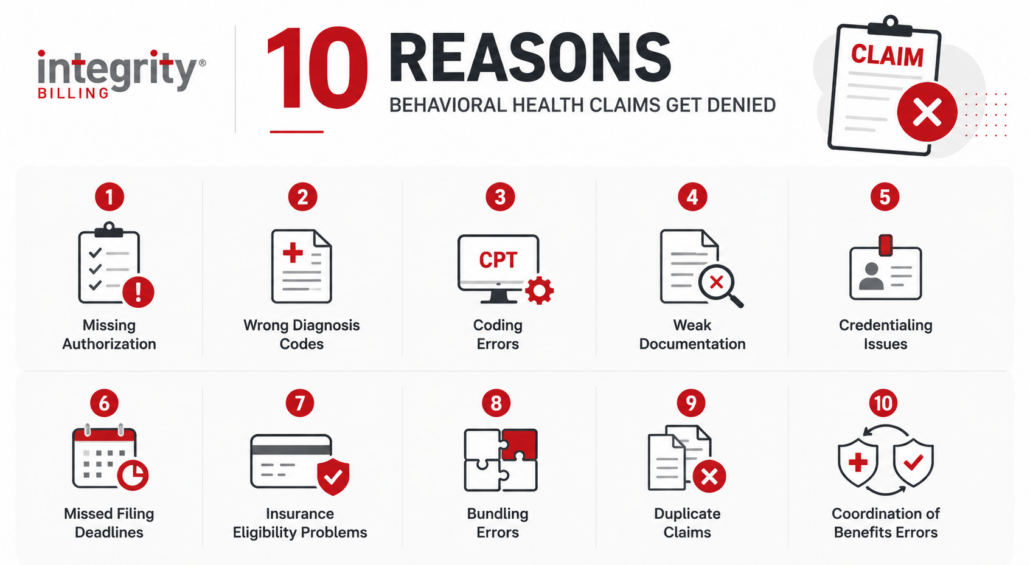
One fact you’ll find reassuring is that most behavioral health claim denials are not random. They follow recognizable patterns, and understanding these patterns is the first step in preventing them from happening over and over again. Below are the ten most common reasons behavioral health claims get denied and what each one means for your billing process.
1. Authorization Was Not Obtained or Has Expired
Prior authorization is one of the most common denial triggers in behavioral health billing. Many payers require authorization before services are rendered, and if that authorization wasn’t obtained, wasn’t obtained correctly, or has lapsed by the time the claim is submitted, the claim will be denied.
Authorization management is particularly complex in behavioral health because different levels of care—residential, PHP, IOP, outpatient—have different authorization requirements, and those requirements vary by payer. A robust utilization review process that stays ahead of authorization deadlines is essential for preventing this category of denial.
2. Incorrect or Mismatched Diagnosis Codes
The diagnosis codes on a claim have to align with the level of care and the services being billed. A diagnosis that doesn’t support the medical necessity of the treatment will result in a denial. This is especially common when codes are carried forward from an older record without being updated to reflect the client’s current clinical presentation.
3. Billing and Coding Errors
Incorrect procedure codes, wrong modifiers, invalid place of service codes, and simple data entry errors are among the most preventable causes of claim denials. At the same time, they also happen to be the most common. Behavioral health billing and coding has its own set of payer-specific rules that change regularly, and a billing team that isn’t keeping pace with those changes is going to generate denials that have nothing to do with the quality of care delivered.
4. Lack of Medical Necessity Documentation
Payers want to know more than just what services were provided. They also want evidence that those services were medically necessary. When clinical documentation doesn’t clearly support the level of care being billed, the claim is at risk. This is particularly true for higher levels of care like residential and PHP, where payers scrutinize medical necessity more closely. Strong, specific documentation that ties the client’s clinical presentation to the level of care is essential.
5. Credentialing Issues
If the provider rendering the service isn’t properly credentialed with the payer, the claim will be denied. Oftentimes, the reason code isn’t immediately obvious either. Credentialing delays, expired credentials, and services billed under the wrong provider NPI are all common credentialing-related denial triggers. A healthy revenue cycle depends on keeping credentialing current and accurate across all payers.
6. Timely Filing Deadlines Were Missed
Every payer has a timely filing window, or a period within which claims must be submitted after the date of service. Miss that window, and the claim is denied with very little recourse. Timely filing denials are particularly frustrating because the service was delivered correctly, the documentation may be perfect, and the only issue is a process failure. A claims submission process with consistent timelines and exception tracking prevents this entirely avoidable denial category.
7. Eligibility and Coverage Issues
Billing a claim for a client whose insurance has lapsed, whose benefits don’t cover behavioral health services, or whose deductible hasn’t been verified accurately is a setup for denial. Eligibility verification should happen at every single visit (not just at intake) because coverage can change without notice. A client who was eligible last month may not be eligible this month.
8. Bundling and Unbundling Errors
Some behavioral health services are bundled by payers, meaning they’re expected to be billed together under a single code rather than separately. Billing them as separate line items is called unbundling and results in denial. Conversely, incorrectly bundling services that should be billed separately also creates problems. Understanding payer-specific bundling rules is an area where specialized behavioral health billing expertise pays off directly.
9. Duplicate Claim Submissions
A claim that’s submitted more than once will be denied as a duplicate. This can happen because the denial wasn’t noticed, the resubmission wasn’t tracked, or a billing system error occurred. Duplicate denials are easy to generate and take time to resolve. The good news is that a billing system with clear claims tracking and a defined resubmission workflow prevents most duplicate claim situations.
10. Coordination of Benefits Issues
When a client has more than one insurance plan, coordination of benefits (determining which plan is primary and which is secondary) needs to be handled correctly for both claims. If the primary payer information is wrong, or if the secondary claim is submitted without the primary’s explanation of benefits, the claim will be denied. For behavioral health clients who may have both commercial insurance and Medicaid or Medicare, coordination of benefits errors are a recurring source of revenue loss.
Fewer Denials Start With the Right Billing Partner
Looking at this list, a pattern emerges. Most behavioral health claim denials aren’t the result of bad care or bad intentions. Instead, they’re the result of process gaps, outdated information, and the complexity of navigating payer-specific rules across multiple programs and levels of care. The practices that minimize denials are the ones with consistent processes, current billing and coding knowledge, proactive utilization review, and a systematic approach to working denials when they do occur.
That’s exactly what a specialized behavioral health billing partner provides. At Integrity Billing, we work with behavioral health practices to reduce denial rates, recover revenue from existing denials, and build the billing infrastructure that prevents these issues from occurring in the first place. If your denial rate is higher than it should be, a free forensic billing assessment is the fastest way to find out where the gaps are. Request yours today.