

One of the most challenging experiences in behavioral health billing is receiving a claim denial on a service that was fully authorized. You dotted your i’s and crossed your t’s by calling the insurance company, obtaining the approval, and documenting the authorization number. However, the claim still came back denied. How does this happen?
The answer is that authorization approval and claims payment are two separate processes, governed by two separate sets of rules. A prior authorization confirms that a payer has reviewed the clinical justification for a service and agrees that it’s medically necessary. But it does not guarantee that you’ll receive payment.
Things can—and do—go wrong between the authorization and paid claim. Understanding where those gaps occur is important for any behavioral health practice that wants to protect its revenue.
The Authorization Confirmed the Service—But Not Every Detail
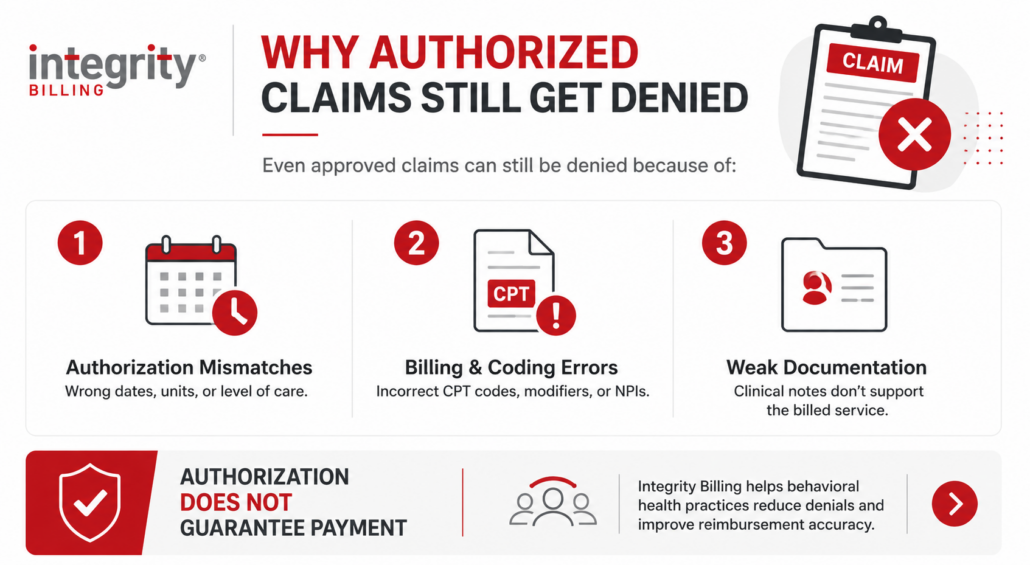
Authorizations are specific, and claims have to match the approval details. They cover a defined service, a defined level of care, a defined number of units or days, a defined date range, and sometimes a specific provider or location. When the actual claim deviates from any of those specifics, the payer has grounds to deny it.
Common mismatches that trigger denials on authorized services include:
- Wrong Date of Service. If the authorization covers a specific date range and the service was rendered outside that window, the claim can be denied.
- Exceeding Authorized Units. Billing beyond the authorized units results in a denial, even when clinically justified.
- Wrong Place of Service Code. If the claim is submitted with a place of service code that doesn’t match what was authorized—outpatient versus telehealth, for example—the payer may deny it.
- Provider Mismatch. If the service is delivered by one clinician but the claim is submitted under an NPI that does not match the authorization, the payer may deny the claim.
- Level of Care Discrepancy. A claim billed at a different level of care than what was authorized will often be denied.
Billing and Coding Has to Be Right
Authorization approval doesn’t grant immunity from billing and coding errors. A claim can be perfectly authorized and still denied because of a mismatched diagnosis code, an incorrect modifier, an invalid procedure code for the payer in question, or a bundling error. The authorization confirms medical necessity but it doesn’t validate the technical accuracy of the claim submission.
This is a particularly common source of confusion for practices that assume an authorization effectively pre-approves the claim. It doesn’t. Every element of the claim still needs to be accurate and consistent with the payer’s billing requirements.
Documentation Has to Support the Service
Many payers conduct post-service audits or apply medical necessity review even to authorized claims, particularly for higher levels of care like residential treatment and PHP. If the clinical documentation in the medical record doesn’t adequately support the services billed, the payer can deny or recoup payment after the fact, regardless of whether authorization was granted upfront.
Authorization is granted based on what the payer was told at the time of the request. If the clinical record tells a different story, the claim is vulnerable. Strong, specific documentation that clearly ties the client’s presentation to the level of care being billed is the protection against this category of denial.
Coordination of Benefits Can Still Create Problems
When a client has multiple insurance plans, authorization from the primary payer doesn’t automatically resolve coordination of benefits issues on the claim. If the secondary payer information is handled incorrectly, or if the claim is submitted to the wrong payer as primary, denials can result even when the service was properly authorized by the correct plan.
Effective denial management in these cases often comes down to sequencing and verification. The billing team needs to confirm which payer is primary, whether the secondary payer requires separate authorization, and how each plan expects the claim to be submitted. Without that extra layer of review, a claim can get delayed, denied, or bounced between payers even though the clinical service itself was approved.
What to Do When an Authorized Claim Is Denied
First, don’t assume the denial is correct. Authorized claims can still be denied because of technical errors, such as an incorrect modifier, mismatched date of service, or provider NPI issue. In many cases, these denials are correctable and worth appealing quickly. Start by pulling the authorization record and comparing it against the denied claim line by line. The goal is to identify exactly where the payer’s system, the claim, or the documentation does not align.
For denials that require more substantive appeals, the response needs to be built around the clinical record, the authorization documentation, and a clear explanation of why the denial is inconsistent with the approved authorization. This may apply to medical necessity challenges, documentation disputes, level-of-care disagreements, or situations where the payer approved care but later denied reimbursement.
Timelines matter. Most payers have strict appeal filing deadlines, and missing them can mean losing the right to appeal altogether. Denied authorized claims should be flagged, prioritized, and worked immediately rather than left sitting in a general denial queue. The faster the issue is reviewed, the better the chance of recovering revenue that should not have been lost.
Authorization Is the Beginning, Not the End
The lesson for behavioral health practices is this: getting the authorization is an important first step, but it’s not the finish line. The claim still has to be submitted accurately, the documentation still has to support the service, and the details of the authorization still have to be honored in the billing. Treating authorization as a guarantee of payment is one of the most common and costly misunderstandings in behavioral health revenue cycle management.
At Integrity Billing, we work with behavioral health practices to manage the full claims lifecycle, from authorization tracking and utilization review through accurate claim submission, denial management, and appeals. If authorized claims are being denied in your practice and you’re not sure why, a free forensic billing assessment will tell you exactly where the breakdown is happening. Schedule yours today by calling us at 888-368-7461 or filling out our contact form.