
Running a behavioral health facility means balancing two missions: helping clients heal and keeping your bottom line healthy. While client care is always the priority, efficient billing is what keeps that care sustainable. Unfortunately, inefficient billing systems can drain your time, resources, and revenue—and it often happens quietly in the background without you realizing the full impact.
If you’ve ever felt frustrated by delayed payments, confusing denials, or inconsistent claim results, you’re not the only one. To some degree, this comes with the territory. But just because many treatment centers face these same challenges doesn’t mean they have to be the norm. There are ways to successfully navigate the complex world of behavioral health billing and substance use billing—and we’re here to show you how.
Let’s break down the real cost of inefficiency and how partnering with a specialized substance use billing company like Integrity Billing can help you turn things around.
The Hidden Cost of Billing Inefficiency
When billing isn’t streamlined, the consequences reach far beyond your back office. Common issues like missed deadlines, incorrect coding, and inconsistent documentation can quickly snowball into serious financial losses.
Here’s what that can look like:
- Denied or delayed claims. Small coding errors or outdated terminology, like using “substance abuse” instead of “substance use disorder”, can lead to avoidable rejections.
- Lost revenue. Every unbilled session, incomplete record, or missed follow-up represents potential income that never makes it into your account.
- Staff burnout. Administrative teams spend hours trying to fix errors, resubmit claims, and track down reimbursements instead of focusing on client care.
- Compliance risks. Inconsistent billing practices increase the risk of audits and noncompliance with payer and federal regulations.
Why Behavioral Health Billing Is So Complex
Unlike other areas of healthcare, behavioral health billing involves unique challenges. Each client’s treatment plan is individualized, services often span multiple levels of care, and documentation requirements vary widely from payer to payer.
For example, behavioral health facilities must navigate frequent authorization requirements, detailed progress notes and treatment justifications, and complex coding for dual diagnoses. And, they must do this while also keeping up to date on ongoing changes to insurance policies and terminology.
Even a simple shift in language, such as the growing move from substance abuse to substance use terminology, has real implications for coding accuracy and compliance. Understanding the difference between substance use billing vs. substance abuse billing isn’t just about semantics but also aligning with DSM-5 and ICD-10 standards.
With so much at stake, partnering with a dedicated behavioral health billing company can make all the difference.
The Financial Impact: By the Numbers
The numbers tell the story. Industry research shows that behavioral health facilities lose 5–10% of total revenue each year due to inefficient billing practices. That might not sound like much, but for a midsize treatment center, that can add up to hundreds of thousands of dollars annually.
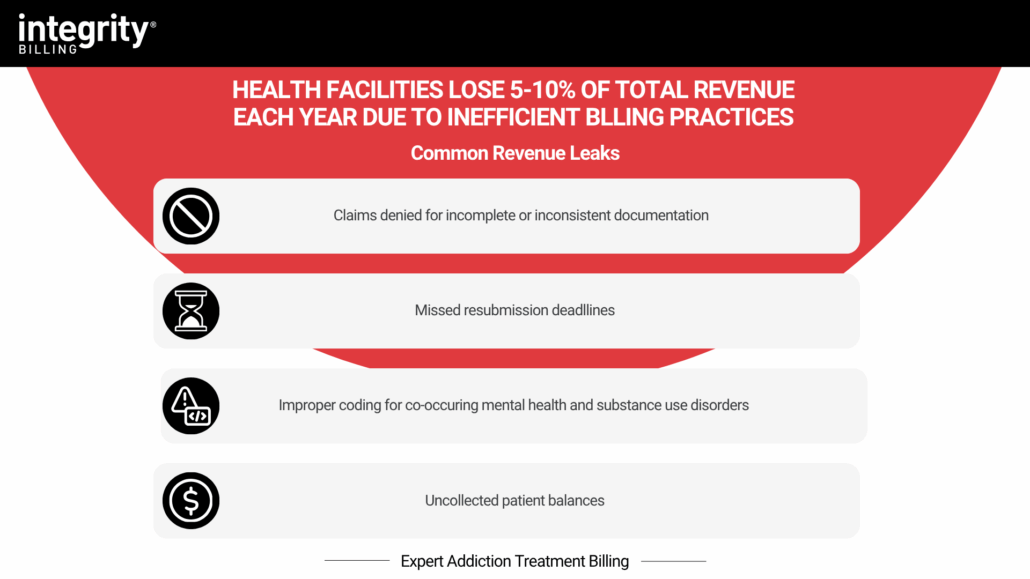
When facilities rely on outdated systems or untrained billing staff, these inefficiencies multiply. Over time, they can limit growth, affect cash flow, and even put high-quality programs at risk.
How to Fix It: Streamline, Standardize, Simplify
The good news? Billing inefficiencies are completely fixable. It starts with having the right systems, the right training, and—most importantly—the right partner.
Here’s how to start improving your billing process today:
Modernize Your Documentation and Coding
Ensure that all documentation uses up-to-date DSM-5 and ICD-10 terminology. For example, “substance use disorder” should always replace the outdated term “substance abuse.” It’s a small change that helps reduce denials and aligns your claims with payer expectations.
Audit Your Current Billing Workflow
Identify where errors or delays most often occur, such as missing clinical notes, coding inconsistencies, or gaps in communication between billing and clinical teams.
Train Your Staff Regularly
Insurance rules and payer requirements change constantly. Continuous education helps your team stay ahead of evolving policies and compliance standards.
Partner with a Specialized Billing Company Today
Inefficient billing can be a drain on your revenue, and it might also be limiting your impact. By addressing workflow gaps, updating your coding language, and partnering with experts who understand substance use billing vs. substance abuse billing, you can strengthen both your financial foundation and your quality of care.
When your billing process runs smoothly, your entire organization does too. Partner with Integrity Billing, a trusted substance use billing company, and take the next step toward efficiency and compliance. Contact us today at 800-683-5640 or fill out our online contact form to get started.